


If you believe a traditional bank loan is the safest path to scale in 2026, you’re likely leaving your most valuable equity on the table. While the WSJ Prime Rate sits at 6.75%, the real cost of capital isn’t just the interest rate; it’s the missed opportunities caused by slow approval cycles and rigid collateral demands. You’ve likely felt the sting of a capital gap during a period of rapid growth, realizing that conventional lenders often lack the personalized consulting your complex operations require. Finding agile commercial financing solutions shouldn’t feel like a constant battle against bureaucracy.
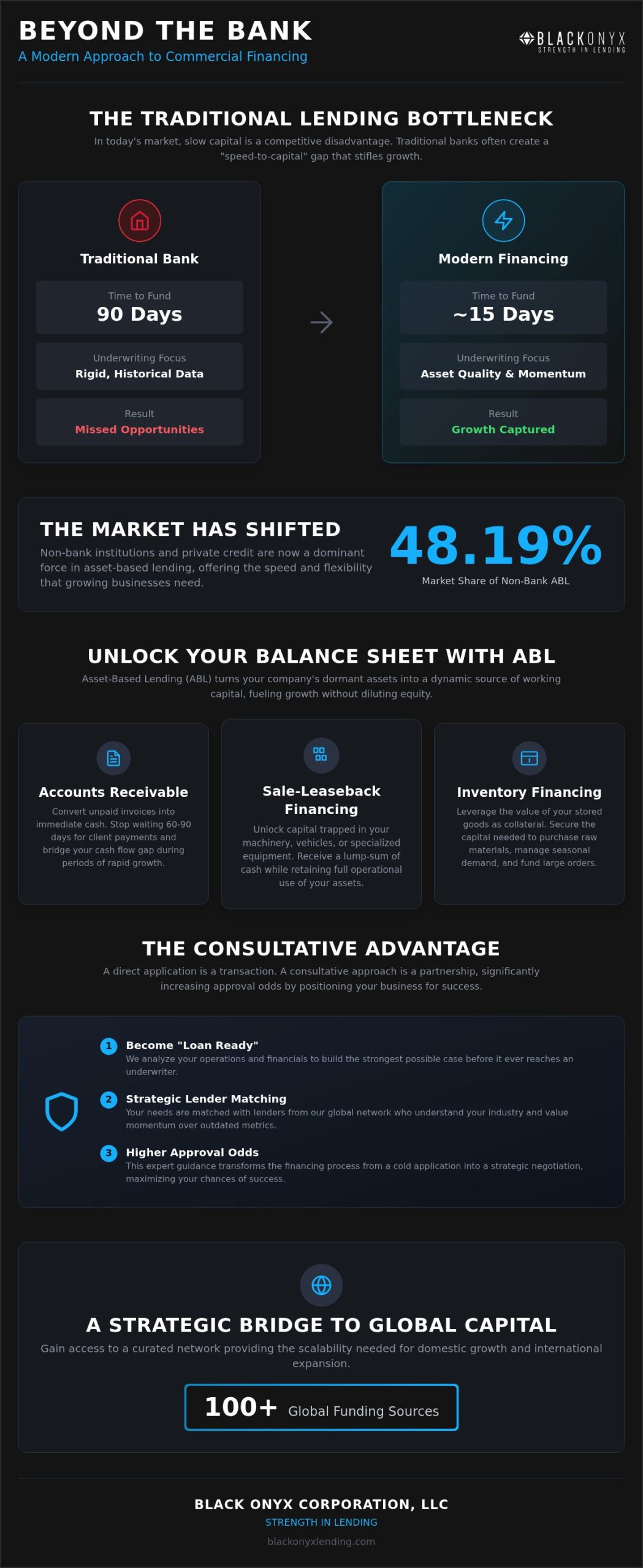
This guide will show you how to move from a state of limitation to one of significant opportunity by identifying specific structures that unlock liquidity. You’ll learn how to leverage your existing assets to fuel expansion while preserving your equity. We will examine how modern leaders use non-bank institutions, which now account for 48.19% of the asset-based lending market, to secure rapid access to capital. If you apply these strategic frameworks, you can bridge the gap between your current capacity and your long-term competitive edge. By the end of this guide, you’ll have a clear roadmap to navigate the capital landscape with precision.
Key Takeaways
- Learn why moving beyond a “bank-first” mentality to a diversified funding approach is essential for maintaining liquidity in 2026.
- Discover how to transform your balance sheet into a growth engine by leveraging asset-based lending structures like accounts receivable and equipment.
- Evaluate the top 5 commercial financing solutions based on time-to-fund and cost of capital to find the perfect fit for your industry.
- Understand why a consultative underwriting model significantly increases your approval odds compared to direct applications.
- Explore how a strategic bridge to over 100 global funding sources provides the scalability needed for international expansion.
The Evolution of Commercial Financing Solutions in 2026
The traditional perception of debt as a burden is an outdated relic of the 20th century. In the current market, sophisticated leaders view commercial financing solutions as a strategic engine for liquidity rather than a simple liability. If you operate with a “bank-first” mentality, you’re likely limiting your growth to the speed of a bureaucrat’s pen. A modern, diversified funding approach treats capital as a tool to be optimized, ensuring that your expansion isn’t throttled by the limitations of a single institution’s balance sheet.
Traditional banking often fails the very companies that drive the most innovation. Fast-growing firms or asset-heavy operations frequently find themselves in a “capital gap.” They have the contracts, the equipment, and the inventory, yet they lack the cash flow to bridge the next leap. This is where the role of a financing broker evolves into that of a strategic consultant. They act as a high-level bridge, connecting your specific operational needs with a global network of resources that understand your industry’s unique dynamics.
Why Traditional Banks are Stalling Growth
Institutional banking is built on risk aversion and rigid underwriting protocols. For mid-market companies, this often leads to a “speed-to-capital” gap that can be fatal during periods of rapid expansion. If a bank’s approval cycle takes 90 days but your market opportunity requires action in 15, the bank isn’t a partner; it’s an obstacle. Utilizing expert business financial consulting allows you to bypass these systemic hurdles. It transforms the financing process from a cold application into a strategic negotiation where your business’s true value is properly articulated to lenders who value momentum over paperwork.
The Rise of Private Credit and Asset-Based Structures
The 2026 market landscape favors lenders who prioritize collateral quality over historical credit scores. This shift toward private credit has opened doors for businesses that were previously sidelined by traditional lenders. If your company holds significant value in its balance sheet, asset based financing serves as a primary liquidity driver. These structures are designed to be flexible, scaling upward as your accounts receivable and inventory grow. This results-oriented approach ensures you have the capital to fund payroll, purchase raw materials, or acquire new equipment without the need for equity-diluting venture capital. Selecting the right commercial financing solutions is about precision and speed, removing the bureaucratic friction that slows down your competitive edge.
Asset-Based Lending: Maximizing Your Balance Sheet
Many legacy institutions treat asset-based lending (ABL) as a sign of financial distress. This is a strategic error. For high-growth firms, ABL is a powerful growth catalyst that turns dormant balance sheet items into immediate working capital. Unlike traditional cash-flow loans that rely on historical EBITDA, ABL focuses on the current value of your accounts receivable, inventory, and equipment. This creates a “borrowing base,” which is a revolving credit limit that fluctuates in real-time based on your asset levels. If your sales double, your capital access doubles too. Understanding the specific asset based line of credit requirements is essential to structuring a borrowing base that scales with your operations. This flexibility provides fewer restrictive covenants than conventional commercial financing solutions, allowing you to focus on execution rather than bank compliance.
Unlocking Liquidity with Sale-Leaseback Financing
If you’ve already invested heavily in machinery, fleet vehicles, or specialized medical equipment, that capital is currently trapped in your hardware. A sale-leaseback allows you to sell those assets to a lender for an immediate cash infusion while retaining full operational use through a lease agreement. It’s a surgical strike for your balance sheet. You convert illiquid assets into cash without disrupting your production cycle. This structure often carries significant tax advantages and improves your debt-to-equity ratio by moving heavy liabilities off the books. While some businesses prioritize SBA funding programs for long-term stability, a sale-leaseback offers a faster, non-dilutive alternative for immediate scaling needs.
Accounts Receivable and Purchase Order Funding
Rapid growth often creates a “growth trap” where your success outpaces your cash reserves. If you’re waiting 60 or 90 days for client payments, you’re essentially acting as an interest-free bank for your customers. Implementing accounts receivable financing breaks this cycle by providing an advance on your outstanding invoices. It’s important to distinguish this from factoring; you maintain control over your customer relationships while securing a line of credit backed by your receivables. For manufacturers and distributors, purchase order (PO) financing goes even further by funding the cost of raw materials before you even bill the client. This ensures you never have to turn down a massive contract due to a lack of inventory capital. If you’re ready to see how these structures can scale your operations, reviewing your asset-based options is the first step toward unlocking hidden liquidity.
Roundup: Choosing the Right Financing Solution for Your Industry
Selecting the ideal commercial financing solutions requires more than just comparing interest rates; it’s about matching the structure of the capital to the rhythm of your operations. If you prioritize “Time to Fund,” asset-based structures or AR financing often outperform traditional term loans. Conversely, if “Cost of Capital” is your primary constraint, government-backed programs might be the better fit. When evaluating different types of business loans, you must consider the opportunity cost of waiting for a bank’s approval. A slightly higher rate is negligible if it allows you to capture a high-margin contract that would otherwise vanish.
The most common objection we hear is that non-bank capital is too expensive. This is a narrow view that ignores the return on investment. If a capital infusion of $500,000 allows you to secure a $2 million contract with a 25% margin, the cost of the money is a minor line item compared to the profit unlocked. This is particularly true in specialized sectors like healthcare. Our medical finance programs are designed to handle the unique cash flow delays inherent in insurance reimbursements, ensuring that practices can upgrade technology without draining their reserves. For a deeper look at how alternative lenders have captured 41% of market share and what this means for your liquidity strategy, the 2026 strategic trend analysis on business cash flow solutions provides essential context for making informed capital decisions.
Equipment Leasing vs. Purchasing
In 2026, technology cycles are moving faster than ever. If you purchase high-tech machinery outright, you risk “economic obsolescence” where the asset loses value before it’s paid off. Utilizing commercial equipment leasing protects your liquidity while allowing for regular upgrades. Under current 2026 tax guidelines, Section 179 and bonus depreciation continue to provide significant incentives for businesses to lease rather than buy. Before committing, use this checklist:
- Is the equipment’s useful life less than five years?
- Does your industry require frequent tech refreshes to stay competitive?
- Would a lease payment improve your debt-to-income ratio for future borrowing?
If you answer yes to any of these, leasing is the superior strategic choice for preserving your capital.
The Role of 2026 SBA Loans in Expansion
Government-backed funding remains a cornerstone of mid-market growth. The SBA 7(a) and 504 programs offer some of the most competitive long-term rates available, though the application process remains notoriously complex. Because 2026 market dynamics have tightened credit requirements, working with an SBA loan consultant is no longer optional; it’s a necessity for timely approval. Industries like manufacturing, professional services, and specialized retail are currently seeing high favorability under SBA guidelines. If your project involves owner-occupied real estate or long-term working capital, the SBA route provides the stability needed for decade-long expansion plans.
The Underwriting Advantage: Getting Your Business “Loan Ready”
Applying for a commercial loan is often treated like a black box where algorithms make binary decisions. If you want to secure high-level commercial financing solutions, you must treat underwriting as a strategic presentation rather than an administrative chore. In 2026, lenders have tightened their focus on Debt-Service Coverage Ratios (DSCR), frequently requiring a 1.25x or higher margin to offset market volatility. Professional business planning and financial modeling are no longer optional; they are the tools you use to prove that your company is a safe bet for significant capital deployment. A consultant-led model ensures your story is told with the precision that institutional lenders demand.
Professional Underwriting and Negotiation
Direct bank applications are prone to automatic denials due to rigid, outdated criteria. If you have a unique business model or have experienced a recent pivot, a standard bank algorithm may flag you as high-risk. A strategist “packages” your deal by contextualizing your financial data and highlighting your operational strengths. This process involves presenting your business to multiple funding sources simultaneously to create a competitive environment. Common pitfalls that lead to bank denials include:
- Inconsistent financial reporting across different fiscal years.
- High credit utilization on short-term debt instruments.
- Lack of a clear, data-backed plan for capital deployment.
Having an expert negotiate your terms allows you to avoid restrictive covenants that could hamper future borrowing capacity. This bridge between your business and the lender ensures you aren’t just getting an approval, but a structure that supports your long-term vision.
Short-Term Capital and Payroll Financing
Rapid growth often leads to temporary liquidity gaps, particularly during aggressive hiring phases or seasonal peaks. If you encounter a capital gap during a growth spurt, it can lead to operational stalls that jeopardize your reputation. Payroll financing provides a targeted solution to ensure your team is paid on time while you wait for receivables to clear. These specialized commercial financing solutions prevent the “growth trap” where your success outpaces your cash on hand. While bridge loans offer a quick fix for one-time expenditures, a strategic line of credit provides a scalable resource for managing ongoing cash flow volatility. If you’re ready to move from a state of limitation to one of significant opportunity, you can access our global network of funding sources to secure the capital you need today.
Scaling Globally: The Black Onyx Strategic Bridge
Growth shouldn’t stop at the border. While many firms feel tethered to local credit markets, Black Onyx Corporation, LLC acts as a strategic bridge to over 100 global funding sources. Based in Troy, Michigan, we provide a rare combination of Midwestern reliability and international reach. If you’ve been frustrated by the rigid, automated algorithms of major banks, our commitment to individualized attention offers a decisive alternative. We don’t just process applications; we architect commercial financing solutions that align with your long-term competitive edge.
Our role as a high-level consultant is to remove the bureaucratic obstacles that foster a sense of stagnation. We position ourselves as a powerful ally, ensuring you move from a state of limitation to one of significant opportunity. By leveraging our vast network, you gain access to capital that is results-oriented and tailored to your specific operational needs. We understand that in a fast-moving market, precision and speed are your most valuable assets.
Financing Solutions Beyond US Borders
Expanding into Canada, Australia, or the UK requires a lender network that understands the nuances of international market dynamics. If your business holds assets across multiple jurisdictions, we can leverage that global balance sheet to unlock liquidity that local banks simply cannot see. This cross-border capability ensures that your expansion isn’t stalled by fragmented financial systems. By utilizing our global network, you gain access to capital structures that respect the regulatory environments of each territory while maintaining a unified growth strategy. This global perspective is essential for mid-market firms looking to scale without the constraints of geographic boundaries.
Next Steps: Securing Your Strategic Funding
The path to transformation begins with a high-level consultation. We start by analyzing your current capital structure and identifying the specific gaps that are hindering your momentum. Unlike the “black box” of institutional banking, our process is transparent and methodical. From the initial contact to the successful closing, our team manages the complexities of underwriting and negotiation on your behalf. If you’re ready to secure scalable funding that preserves your equity, the timeline to execution is designed to respect your sense of urgency.
The current market rewards the bold and the prepared. By choosing more agile commercial financing solutions, you position your firm to capture market share while others are still waiting for a bank’s callback. Your expansion deserves a partner that acts as a decisive innovator in your long-term success. Contact Black Onyx today to explore your financing options.
Architecting Your Capital Strategy for 2026
The landscape of 2026 demands more than passive borrowing; it requires a proactive mastery of your balance sheet. You’ve seen how shifting from a bank-only mentality to a diversified funding model transforms debt into a strategic asset. By leveraging your accounts receivable and equipment, you unlock the liquidity needed to capture market share without diluting your ownership. If you align your financing structure with your operational rhythm, you remove the bureaucratic friction that stalls expansion.
Navigating this terrain alone is a risk you don’t need to take. Black Onyx acts as your strategic bridge, providing access to over 100 funding sources and a global reach spanning the US, UK, Canada, and Australia. Our expert underwriting and consulting services ensure your business is presented with the precision required for rapid approval. It’s time to move from a state of limitation to one of significant opportunity. Partner with Black Onyx for specialized commercial financing solutions and secure the capital that fuels your long-term success. Your next phase of growth is within reach.
Frequently Asked Questions
What is the difference between commercial financing and a traditional business loan?
Commercial financing solutions encompass a vast range of capital structures, whereas traditional business loans are typically limited to term loans or lines of credit from a single bank. Financing includes specialized options like equipment leasing and accounts receivable factoring. This diversity allows you to select a structure that matches your specific asset base. If you rely solely on banks, you’re limited by their narrow risk appetite rather than your business’s true potential.
How does a sale-leaseback agreement improve my company’s cash flow?
A sale-leaseback agreement improves your cash flow by unlocking the equity trapped in your existing machinery or fleet. You sell the equipment to a lender for an immediate cash infusion and then lease it back to maintain full operational use. This process converts illiquid assets into working capital without disrupting your production schedule. It’s a strategic tool for companies needing rapid liquidity to fund expansion or manage short-term operational gaps.
Can I qualify for commercial financing if I have been rejected by a bank?
You can certainly qualify for financing even after a bank rejection because non-bank lenders prioritize different metrics. While banks focus heavily on historical credit scores and rigid debt-to-income ratios, strategic lenders often look at the value of your collateral or the strength of your contracts. If your business has strong accounts receivable or valuable equipment, we can often structure a deal that bypasses the bureaucratic hurdles that caused the initial bank denial.
What are the current Section 179 deduction limits for equipment in 2026?
For the 2026 tax year, Section 179 deduction limits are subject to annual inflation adjustments by the IRS. This provision allows businesses to deduct the full purchase price of qualifying equipment and software in the year it’s placed in service rather than depreciating it over several years. Because these limits change, you should consult with a tax professional to determine the exact deduction available for your specific equipment leasing or purchasing strategy.
How long does the commercial loan approval process typically take with a broker?
The approval process through a strategic consultant is significantly faster than traditional institutional cycles; it often closes in a matter of days or weeks. Because we manage the packaging and negotiation with multiple funding sources simultaneously, we eliminate the back-and-forth delays common in bank underwriting. If you have your financial documentation ready, the timeline from initial consultation to successful funding is designed to respect the urgency of your growth opportunities.
Is asset-based lending only for businesses in financial trouble?
Asset-based lending is a sophisticated growth catalyst used by healthy, high-performing companies, not just those in financial distress. Rapidly scaling firms often use their inventory and receivables as collateral to fund massive orders that would otherwise exceed their cash reserves. This structure provides a flexible borrowing base that grows alongside your sales. It’s a strategic engine for liquidity that allows you to expand without diluting your equity through venture capital.
What industries can benefit from specialized medical or payroll financing?
Specialized medical finance benefits healthcare providers, dental practices, and diagnostic centers by bridging the gap between service delivery and insurance reimbursements. Payroll financing is essential for staffing agencies, manufacturers, and seasonal businesses that experience rapid hiring phases. These targeted commercial financing solutions ensure that your most critical operational expenses are covered, preventing stalls during periods of peak demand. Any industry with long payment cycles or high labor costs can benefit.
How does Black Onyx access over 100 different funding sources?
Black Onyx acts as a strategic bridge by maintaining a global network of over 100 diverse funding sources across the US, Canada, Australia, and the UK. We don’t act as a simple broker; we function as a high-level consultant that matches your specific business profile with the lender most likely to approve your deal. This extensive reach allows us to find competitive terms and specialized structures that are often unavailable through local or regional banks.