


Your most competitive advantage isn’t found in your product lineup or your sales deck; it’s found in the velocity of your capital. If your cash is locked in a 90-day waiting room of unpaid invoices, you aren’t just stalling; you’re actively losing ground to more liquid competitors. Most high-growth executives agree that waiting for large client payments creates a dangerous friction that can stall payroll or kill new opportunities. Strategic accounts receivable financing transforms these paper assets into immediate, actionable fuel for your next move.
It’s time to stop viewing invoice delays as an inevitable cost of doing business. This article demonstrates how high-growth businesses leverage strategic funding to bridge the 90-day payment gap and fuel immediate expansion. You’ll learn how a scalable model grows in lockstep with your sales while providing the immediate liquidity your operations demand. We’ll examine a real-world case study where professional underwriting provided the momentum needed to move from limitation to significant opportunity. If you’re ready to bypass the restrictive covenants of traditional banks, then understanding this strategic bridge to capital is your next logical step.
Key Takeaways
- Identify the “Success Trap” where rapid growth drains your liquidity, and learn how to maintain momentum during high-demand cycles.
- Distinguish the strategic benefits of accounts receivable financing over traditional factoring to ensure your brand reputation remains intact.
- See how a $10M manufacturer utilized revolving asset-based facilities to scale operations without the burden of restrictive bank covenants.
- Prepare for funding by cleaning your AR aging reports and focusing on the financial health of your largest debtors for optimal terms.
- Leverage a global network of 100+ funding sources to access personalized underwriting that understands your specific industry dynamics.
The Liquidity Gap: Why Profitable B2B Companies Struggle with Cash Flow
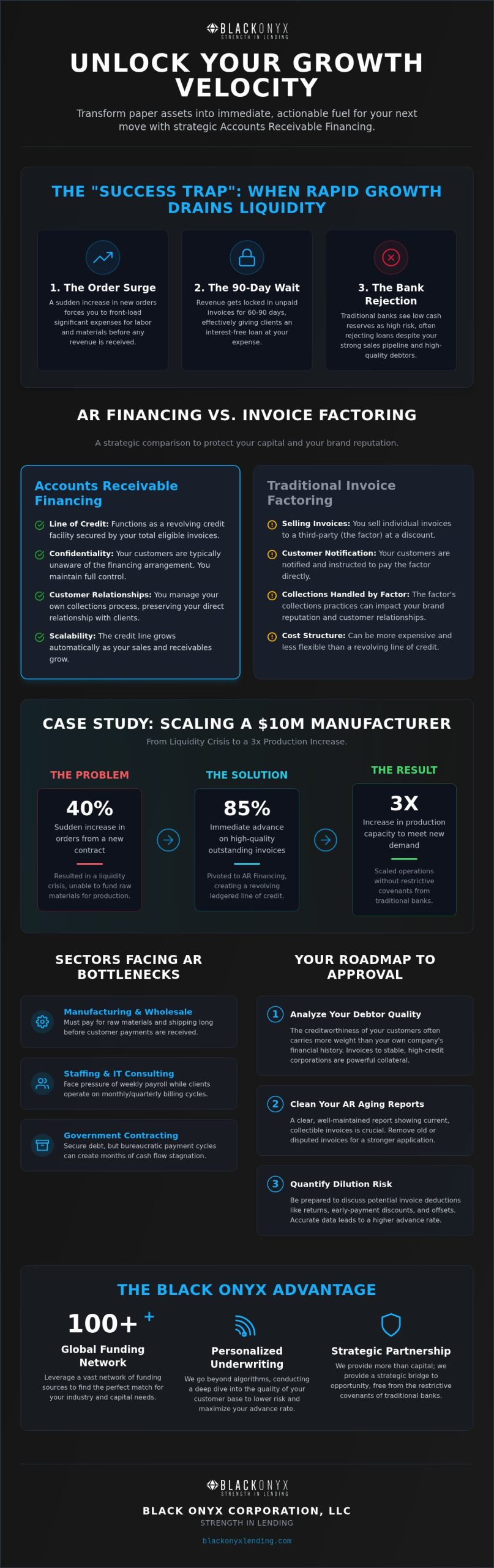
Profitability doesn’t always equal liquidity. Many B2B firms fall into the Success Trap, a scenario where a surge in new orders forces you to front-load expenses for labor and materials while your revenue stays locked in unpaid invoices for 60 or 90 days. If your business is growing at 30% year-over-year, your cash reserves can vanish even as your balance sheet looks stronger than ever. Traditional banks often struggle to support this momentum. Their rigid underwriting models focus on historical cash balances rather than the strength of your current sales pipeline. When a bank sees high AR and low liquid reserves, their automated systems often trigger a rejection. They view the lack of cash as a risk, failing to recognize that the AR represents high-quality debt from reputable debtors.
Unlike a standard term loan, accounts receivable financing functions as a revolving asset-based facility. It provides a strategic bridge that turns your outstanding invoices into immediate working capital. This isn’t traditional debt; it’s the acceleration of funds you’ve already earned. Waiting 90 days for a payment effectively gives your clients an interest-free loan at your expense. This delay costs you more than just time. It costs you the ability to bid on new contracts, negotiate early-payment discounts with your own suppliers, or scale your workforce to meet demand. Quantifying the gap is simple: every day a dollar sits in AR is a day it isn’t earning a return in your operations.
The Anatomy of an AR Asset
In a modern financial strategy, invoices are viewed as near-cash assets. On your balance sheet, these represent guaranteed future income that just hasn’t reached your bank account yet. When securing funding through accounts receivable financing, the creditworthiness of your customer often carries more weight than your own company’s financial history. If you’re billing a stable, high-credit corporation, that invoice becomes a powerful collateral tool. The advance rate is the specific percentage of the total invoice value that a funding source provides to your business upfront.
Common Industries Facing AR Bottlenecks
- Manufacturing and Wholesale: These firms must often pay for raw materials and shipping long before the customer settles the final bill, creating a massive cash drain during production.
- Staffing and IT Consulting: Service firms face the pressure of meeting weekly or bi-weekly payroll while clients operate on monthly or quarterly billing cycles.
- Government Contracting: While the debt is secure, the bureaucratic approval cycles of state and federal agencies can create months of stagnation for the contractor.
By utilizing strategic funding, businesses in these sectors can eliminate the friction of long payment terms and maintain the steady forward movement required for true expansion.
This principle of speed and direct connection is a common thread in many high-stakes industries. For instance, real estate investors often rely on Lead Exchange to find homeowners ready to sell quickly, allowing them to secure off-market deals before they hit the general market—much like how AR financing allows you to access capital before an invoice is officially paid.
Case Study Analysis: Scaling a $10M Manufacturer via AR Financing
A Michigan-based automotive supplier recently encountered a classic “Success Trap.” After securing a prestigious contract that promised a sudden 40% increase in orders, the company found itself in a liquidity crisis. They had the talent and the equipment to fulfill the work, but they lacked the immediate working capital to purchase the massive influx of raw materials required for the production run. Traditional bank lending proved too slow and restrictive, as the bank’s rigid debt-to-equity requirements failed to account for the company’s rapid trajectory. By pivoting to accounts receivable financing, the supplier converted their high-quality Tier-1 invoices into a revolving ledgered line of credit. This strategic move unlocked an immediate 85% advance on outstanding invoices, providing the fuel needed for a 3x increase in production capacity.
Phase 1: Diagnostic and Underwriting
Strategic funding begins with a deep dive into the quality of your customer base. During the diagnostic phase, professional underwriting identified that the supplier’s primary debtors were high-credit Tier-1 automotive manufacturers, which significantly lowered the risk profile of the deal. The process involved evaluating “dilution” risk, which includes potential returns, early-payment discounts, and offsets that could impact the final collection amount. By accurately quantifying these variables, the underwriters were able to secure a higher advance rate than a standard bank would offer. Detailed business planning played a vital role here. It allowed the supplier to demonstrate exactly how the accelerated cash would be deployed to meet the new contract’s rigorous demands.
Phase 2: Facility Integration and Growth
The implementation moved the business away from a restrictive “invoice-by-invoice” model toward a systematic ledgered line approach. This integration allowed the supplier to act with the speed of a much larger corporation. With the newfound liquidity, they negotiated early-payment discounts with their own raw material vendors, effectively lowering their cost of goods sold. If you can pay a vendor in 10 days instead of 45, the resulting discounts often offset the cost of the financing facility itself. This facility scaled automatically as sales grew, providing more capital in real-time without the administrative burden of re-applying for a loan. For businesses that also need to fund supplier costs before production even begins, purchase order financing can work alongside AR facilities to cover the full cash conversion cycle. If your current credit limit is holding back your production schedule, our consultants can help you structure a facility designed for high-velocity growth.
AR Financing vs. Invoice Factoring: A Strategic Comparison
Choosing between these two structures depends entirely on your company’s maturity and operational capacity. While they both unlock cash from unpaid work, their execution differs fundamentally. Invoice factoring involves the actual sale of your invoices to a third party at a discount. The factor takes ownership of the asset and typically manages the collections process. In contrast, accounts receivable financing functions as a revolving credit facility where you retain ownership of the invoices while using them as collateral. This distinction is critical for your balance sheet and your daily operations.
If you prioritize brand perception, the notification process is a major factor. Factoring often requires a “Notice of Assignment,” informing your customers that they must pay the factor directly. For many mid-market firms, this is a hurdle they prefer to avoid. Accounts receivable financing often allows for non-notification facilities, meaning your customers never know a third party is involved. You continue to collect payments in your own name, maintaining a seamless front for your brand. This allows you to keep the customer relationship strictly between you and your client.
Cost drivers also shift significantly between the two. Factoring fees are typically calculated as a discount rate on the total invoice value. AR financing usually operates on an interest rate applied to the funds you actually draw, similar to a traditional bank line but with far more flexibility. If you only need a portion of your AR value, the interest-based model is often more efficient. It ensures you aren’t paying for capital that is sitting idle in your account.
When to Choose Invoice Factoring
This path is often best for startups or businesses with limited credit history. If you don’t have a dedicated accounting team to chase payments, outsourcing collections to a factor can save significant administrative time. It’s a way to leverage your customers’ credit strength when your own history is still developing. Many firms pair this with commercial equipment leasing to build a comprehensive asset-based strategy that covers both their machinery and their working capital needs.
When to Graduate to Accounts Receivable Financing
Established firms with robust internal accounting often find that they’ve outgrown the factoring model. If your company has consistent sales and a proven track record of collections, you’ve earned the right to more sophisticated structures. Non-notification facilities are the “gold standard” here, offering a lower overall cost of capital because the lender isn’t charging for collection services. By keeping these processes in-house, you maintain total control over the customer experience while enjoying the liquidity of an asset-backed line. As your strategic bridge to capital, we help you identify the precise moment to make this transition, ensuring your financing structure always matches your growth stage.
The Roadmap to Approval: Qualifying for Optimal Terms
Securing the best terms for accounts receivable financing isn’t just about showing your sales numbers; it’s about demonstrating the quality of your operations. Lenders don’t just look at what you’re owed. They look at who owes you and how reliably those funds move. If you want to move from a basic approval to a high-advance, low-cost facility, you must follow a methodical preparation path. This starts with a rigorous audit of your AR aging report. You should identify and remove uncollectible or severely aged invoices, typically those past the 90-day mark. A clean report shows a lender that your internal collections process is disciplined and that the collateral is “fresh.”
Once your ledger is clean, focus on your customer credit assessment. Since your debtors are the ones who ultimately pay the lender, their financial health is more important than yours. If your largest clients are blue-chip corporations or government entities, your leverage for better terms increases significantly. Professional underwriting then steps in to build the “story” behind your data. If you can explain why a cash gap exists, perhaps due to a massive new contract or seasonal surge, lenders view the request as a strategic growth move rather than a sign of distress. Finally, facility matching ensures you aren’t trying to fit a manufacturing deal into a lender that specializes in healthcare. Selecting a partner with niche expertise in your industry streamlines the approval and results in a more flexible structure. Working with a dedicated business financial consulting team can help you navigate these complex underwriting requirements and present your capital request in the most compelling way possible.
Critical Eligibility Criteria
Candidate invoices must generally be for completed work or delivered goods within B2B or B2G (Government) sectors. Consumer-facing receivables aren’t eligible for this specific asset-based tool. One common hurdle is “Progress Billing,” where an invoice is issued for work that is only partially complete. If your contracts rely on progress payments, you may need to restructure your billing milestones to ensure each invoice represents a fully earned, undisputed debt. Businesses that need capital before an invoice even exists may benefit from exploring purchase order financing solutions to fund supplier costs at the front end of the order cycle. Volume requirements vary significantly across the 100+ sources in the Black Onyx network, allowing us to find a fit for both emerging firms and established middle-market players.
Avoiding Common Application Pitfalls
Existing UCC filings or tax liens can immediately block your path to funding. If another lender already has a first-position lien on your receivables, we must negotiate a subordination or pay off the existing debt to clear the title. You should also avoid the trap of “Double Factoring,” which involves trying to finance the same invoice with two different lenders. This is a major red flag that destroys trust and can lead to immediate termination of a facility. Instead, prepare a clear “Use of Funds” statement that outlines exactly how the liquidity will fuel expansion. If you’re ready to see how your ledger stacks up, you can start your professional underwriting assessment today to identify the most competitive facilities available for your industry.
The Black Onyx Advantage: Navigating a Global Funding Network
Working with a single bank often feels like trying to fit a square peg into a round hole. If your business doesn’t meet their exact, rigid criteria, the answer is a simple “no.” Black Onyx Corporation, LLC challenges this conventional wisdom by acting as a strategic bridge to a global network of over 100 funding sources. We don’t just offer a product; we provide a marketplace. This reach allows us to find the specific accounts receivable financing facility that aligns with your operational reality rather than forcing you to conform to a bank’s limitations. Our personalized underwriting looks past automated rejections to find the “yes” in complex deals, ensuring your business maintains its competitive edge.
Based in Troy, Michigan, our consulting services extend far beyond local borders. We support high-growth firms across the US, Canada, UK, and Australia, bringing a sophisticated understanding of global market dynamics to every deal. Whether you’re a domestic manufacturer or an international consultant, we provide the individualized attention required to navigate systemic hurdles and secure immediate liquidity. We position ourselves as a powerful ally rather than a mere service provider, focusing intensely on your long-term success.
Matching Industry to Lender
A transportation lender evaluates risk differently than a healthcare lender. If you’re in a specialized sector like medical finance or government contracting, using a generalist lender often results in higher rates and lower advance percentages. Our network includes niche specialists who understand the nuances of your industry’s billing cycles and debtor behaviors. For those in the mortgage sector, companies like Orchestrate provide the specialized settlement and support services that ensure these complex transactions remain liquid and predictable. By matching your specific industry to the right lender, we ensure you receive the most aggressive terms possible. Our Troy-based team acts with the speed and precision that busy professionals respect, moving your application through the global network quickly to respect your time.
True financial transformation requires more than a single loan; it requires a comprehensive capital structure. You can maximize your liquidity by combining accounts receivable financing with strategic tools like commercial equipment leasing and inventory financing for small business to unlock the dormant capital sitting on your warehouse shelves. This multi-layered approach ensures that both your unpaid invoices and your hard assets are working to fuel expansion. We view our role as a long-term ally, helping you build the credit strength necessary to eventually transition into SBA loans or traditional lines of credit. If you’re ready to move from limitation to opportunity, Secure Your Strategic Capital with Black Onyx Corporation, LLC Today and experience the advantage of a truly global funding network.
Unlocking Your Next Phase of Expansion
Capital velocity determines how fast your business can scale. If you’re currently sidelined by a 90-day payment gap, you’re missing opportunities that your more liquid competitors are seizing. By treating your unpaid invoices as strategic assets rather than static debt, you can maintain the momentum required for true market leadership. Accounts receivable financing provides the immediate liquidity needed to bridge these gaps, allowing you to fund payroll, purchase raw materials, and bid on larger contracts without the weight of restrictive bank covenants.
Black Onyx Corporation, LLC acts as your strategic bridge, offering access to over 100 global funding sources across the US, Canada, the UK, and Australia. We specialize in non-bank commercial financing and provide personalized underwriting to solve complex business needs that traditional institutions often ignore. If you’re ready to transform your ledger into a growth engine, it’s time to act. Scale Your Business with Expert AR Financing Solutions and secure the capital you need to win. Your expansion shouldn’t have to wait for a client’s check to clear.
Frequently Asked Questions
What is the difference between accounts receivable financing and a traditional bank loan?
Traditional bank loans focus heavily on your historical balance sheet and personal credit score. In contrast, accounts receivable financing prioritizes the creditworthiness of your customers and the quality of your invoices. While a bank loan provides a fixed amount with rigid repayment schedules, an AR facility is a revolving asset-based tool that scales automatically as your sales volume increases. This allows for greater flexibility without the restrictive covenants typically found in bank debt.
How quickly can I access funds once my accounts receivable facility is set up?
The initial underwriting and setup process generally takes between seven and 14 days to complete. Once your facility is active, you can typically access funds within 24 hours of submitting new invoices for verification. This speed provides an immediate solution to the 90-day payment gap, ensuring you have the liquidity to meet payroll or purchase materials without the delays associated with traditional commercial lending cycles.
Will my customers know that I am financing their invoices?
Not necessarily. While some factoring arrangements require a notice of assignment to your debtors, many high-level accounts receivable financing structures are non-notification facilities. This means you continue to manage your own collections and maintain the direct relationship with your clients. Your customers send payments to a dedicated lockbox in your name, which allows you to protect your brand reputation while accessing the working capital you need.
What happens if one of my customers fails to pay an invoice I have financed?
The outcome depends on whether your agreement is structured with recourse or non-recourse terms. In a recourse facility, your business is responsible for replacing the invoice or repaying the advance if the customer fails to settle the debt. In a non-recourse facility, the lender assumes the credit risk if the debtor becomes insolvent. We help you evaluate these options during the underwriting phase to ensure your risk exposure matches your comfort level.
Can I choose which specific invoices I want to finance, or do I have to finance the whole ledger?
Flexibility varies by lender, but many facilities allow you to select specific high-value invoices or certain customer accounts to finance. This is often referred to as selective or spot financing. However, some institutional sources prefer a whole-ledger approach to balance risk across your entire customer base. We leverage our network of 100+ sources to match you with a provider that supports the specific level of selectivity your business requires.
Does my business need to be located in Michigan to work with Black Onyx?
No, your physical location is not a barrier to our services. While our headquarters is in Troy, Michigan, we act as a strategic bridge for businesses operating throughout the United States, Canada, the UK, and Australia. Our global network of funding sources allows us to provide localized expertise and specialized underwriting regardless of where your company is registered. We coordinate all documentation and funding remotely to respect your time and operational needs.
What are the typical advance rates for AR financing in 2026?
Advance rates generally range from 70% to 90% of the total invoice value. The specific percentage you receive is determined by several factors, including your industry niche, the credit strength of your debtors, and the historical dilution rate of your receivables. If you work with high-credit Tier-1 corporations or government agencies, you are more likely to secure an advance at the higher end of that spectrum, providing maximum immediate liquidity.
Can I use AR financing if I already have an existing SBA loan?
Yes, it is possible to utilize both tools simultaneously. Since an SBA loan often involves a blanket lien on all business assets, the AR lender will typically require a subordination agreement or an inter-creditor agreement. This document allows the AR lender to take the first-priority position specifically on your receivables while the SBA lender maintains their position on other assets. We specialize in navigating these complex legal structures to ensure your total capital stack remains functional.