

Most entrepreneurs view an sba loan as a last resort for struggling companies, but in 2026, the most aggressive market leaders treat this capital as high-octane fuel for scaling. You likely understand the frustration of staring at a mountain of paperwork or waiting months for a bank to decide your company’s future. It’s exhausting to feel like your growth is held hostage by a slow-moving bureaucracy that doesn’t understand your vision or your timeline.
If you can navigate the updated eligibility requirements and the new 10 million dollar combined loan limits, then you can unlock the resources needed to dominate your sector. This guide will help you master the complexities of SBA financing and show you how to leverage these government-backed tools to scale your business with expert precision. We’ll break down the 2026 shifts in 7(a) and 504 structures, provide a clear roadmap for the underwriting process, and help you move from a state of limitation to one of significant opportunity. By the end of this article, you’ll have the confidence to secure the funding your business deserves.
Key Takeaways
- Understand the 2026 regulatory shifts, including the increased $10 million combined loan limit, to maximize your total available capital.
- Compare the strategic benefits of 7(a) versatility against the fixed-rate stability of 504 financing for real estate and equipment.
- Learn to identify when an sba loan provides superior leverage compared to asset-based financing or commercial equipment leasing.
- Demystify the underwriting process by learning how to present a professional debt schedule and personal financial statement that lenders can’t ignore.
- Discover the advantage of using a strategic bridge to access a network of 100+ funding sources and bypass common bureaucratic obstacles.
Understanding the SBA Loan Landscape in 2026
An sba loan is a strategic asset for companies that need to scale without depleting their cash reserves. In the current 2026 fiscal environment, where the prime rate sits at 6.75%, these programs provide a necessary buffer against volatile market shifts. Unlike traditional bank products that often carry restrictive covenants, government-backed financing offers a path to liquidity that prioritizes the borrower’s long-term stability. If your firm is ready to transition from survival to significant expansion, then understanding these structural advantages is the first step toward a successful capital raise.
The Small Business Administration (SBA) does not issue checks directly to business owners. It functions as a guarantor. This distinction is vital because it means you’re still working with private banks or credit unions, but those lenders have a safety net. If a borrower defaults, the government covers a significant portion of the loss. This backing allows lenders to offer terms that are simply unavailable through conventional channels, effectively bridging the gap between a bank’s risk tolerance and your company’s growth needs.
Strategic benefits of this structure include:
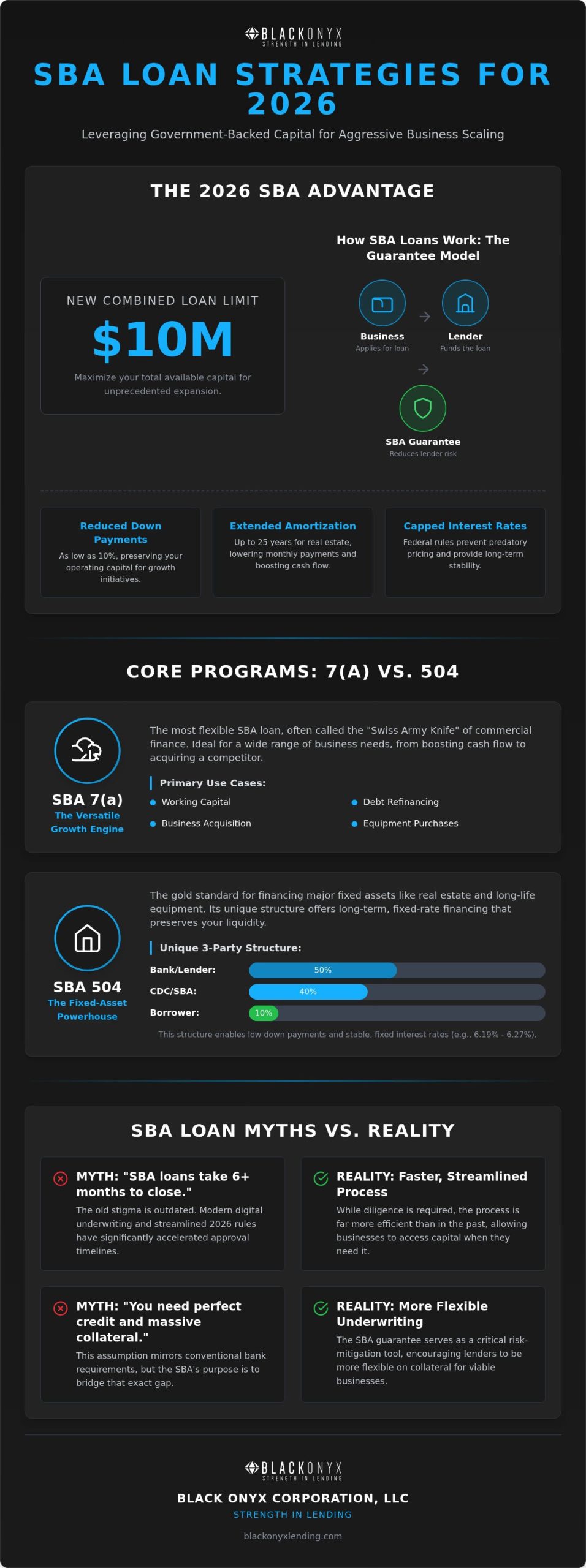
- Reduced Down Payments: Many programs require as little as 10%, keeping more capital in your operating account for payroll or inventory.
- Extended Amortization: Repayment windows can reach 10 years for working capital and 25 years for commercial real estate.
- Capped Interest Rates: Federal rules limit how much a bank can charge over the prime rate, preventing the predatory pricing often found in the subprime market.
Why Businesses Choose SBA Over Conventional Lending
Traditional lenders often demand high collateral and short repayment windows that can choke a growing firm’s cash flow. If your company is expanding rapidly but lacks the massive balance sheet of a legacy corporation, an sba loan provides the necessary leverage. The ‘credit elsewhere’ requirement ensures that these tools are reserved for firms that have viable business models but can’t find similar terms in the private market. Long-term amortization schedules are the primary draw. They lower your monthly debt service, which directly increases your monthly cash flow for research, development, or aggressive marketing campaigns.
SBA Loan Myths vs. Reality
The old stigma that these loans take six months to close is no longer accurate. Modern digital underwriting and streamlined 2026 procedural rules allow for much faster approval timelines than in previous decades. While banks still want to see assets, the SBA is often more flexible regarding collateral than a standard commercial lender. The SBA guarantee serves as a critical risk-mitigation tool that encourages lenders to approve profiles they might otherwise decline.
Comparing the Core SBA Programs: 7(a), 504, and Microloans
Selecting the right financing vehicle is a high-stakes decision that dictates your company’s capital structure for years. If you choose a 7(a) for a 25-year real estate project, you might miss the fixed-rate stability of a 504. Conversely, using a 504 for working capital is impossible. Applying for an sba loan in 2026 requires a precise understanding of these distinctions to ensure your debt remains an asset rather than a burden. The SBA’s official loan programs are designed to match specific capital needs with appropriate repayment structures. In 2026, the combined loan limit for businesses accessing both programs was increased to $10 million, providing unprecedented room for aggressive expansion.
Strategic Use Cases for the 7(a) Program
The 7(a) is the most versatile sba loan available. It’s the ideal choice for funding seasonal working capital gaps or acquiring a competitor to consolidate market share. If your balance sheet is weighed down by high-interest debt, then a 7(a) refinance can immediately improve your debt-service coverage ratio. It’s built for flexibility, allowing you to bundle equipment purchases with operating capital in a single closing. This versatility makes it the “Swiss Army Knife” of commercial finance, capable of addressing almost any operational hurdle. Working with an experienced SBA 7a loan broker ensures your application is structured to take full advantage of this flexibility while meeting the updated 2026 underwriting standards.
Leveraging the 504 Loan for Commercial Real Estate
For major fixed assets, the 504 program is the gold standard. It utilizes a three-party structure involving a private lender, a Certified Development Company (CDC), and the business owner. This setup preserves your liquidity by requiring only a 10% down payment. In September 2026, effective interest rates for the CDC portion are holding between 6.19% and 6.27%, fixed for the life of the loan. This stability is essential for long-term forecasting. These loans also support community development, often requiring job creation or retention to qualify for the most favorable terms. Working with a qualified SBA 504 loan consultant ensures your application correctly navigates the complex 50/40/10 structure and positions your business as a low-risk opportunity for both the CDC and the primary lender.
While Microloans provide up to $50,000 for startups and smaller operational needs, larger growth-oriented firms should focus on the 7(a) and 504 paths. Proactive growth loans offer a strategic advantage over reactive disaster loans, which are strictly for recovery. If you’re unsure which vehicle aligns with your five-year plan, consulting with a strategic finance partner can clarify your roadmap and prevent costly application errors.
SBA Loans vs. Alternative Financing: A Strategic Analysis
Choosing between an sba loan and alternative financing isn’t just about the interest rate; it’s about the long-term impact on your balance sheet. If you prioritize monthly cash flow, then the extended terms of the SBA loan programs are unmatched. However, if your growth requires immediate capital to fulfill a massive purchase order, alternative tools might be more effective. Evaluating the “Total Cost of Capital” involves looking at origination fees, closing costs, and the opportunity cost of tied-up collateral. A strategic borrower looks beyond the monthly payment to see how a debt structure affects their future borrowing capacity and equity retention.
When acquiring machinery or technology, you must decide between ownership and flexibility. Comparing SBA terms to commercial equipment leasing reveals a clear trade-off. An SBA loan builds equity over time, whereas leasing allows for faster upgrades and often provides tax benefits through off-balance-sheet treatment. If your equipment has a long useful life, the SBA route is typically superior. If the technology becomes obsolete within a few years, leasing is the smarter strategic move to avoid being stuck with depreciating assets.
SBA vs. Asset-Based Lending
Asset-based options excel in speed. While an sba loan might take 45 to 60 days to fund, asset-based financing can often be secured in two weeks or less. This speed is essential for urgent scenarios like a sudden expansion opportunity or a supply chain disruption. Beyond speed, SBA loans generally offer more operational freedom by avoiding the restrictive financial covenants common in private lending. Many sophisticated firms use accounts receivable financing alongside an SBA line of credit to ensure they have both long-term stability and immediate liquidity for payroll or inventory spikes.
SBA vs. Conventional Bank Loans
The most glaring difference lies in the down payment. Conventional loans often demand 20% to 30% equity, while an SBA loan typically requires only 10%. This allows you to keep hundreds of thousands of dollars in your business rather than locking it in a building. You also avoid the “cliff” of balloon payments. Conventional commercial mortgages often require a full payoff after five or seven years. In 2026, SBA loans provide fully amortized terms that offer significantly more security than conventional credit products that force frequent refinancing in a volatile interest rate environment. This structure ensures your monthly obligations remain predictable as you scale. Businesses seeking broader commercial financing solutions beyond SBA programs can leverage non-bank institutions and alternative capital structures to further accelerate growth while preserving equity.
The Audit-Proof Application: Navigating the Underwriting Process
Securing an sba loan in 2026 requires more than just a decent credit score. It demands a surgical approach to your financial presentation. If your application lacks a cohesive narrative, then even the strongest balance sheet can face rejection. You must organize your financial story around the “Five Cs of Credit”: Character, Capacity, Capital, Collateral, and Conditions. This framework allows underwriters to assess risk with precision, moving your file from the “maybe” pile to a formal approval. With national sba loan approval rates typically ranging between 50% and 65%, your presentation must be flawless to succeed.
Precision in documentation is non-negotiable. You’ll need a comprehensive Debt Schedule and a Personal Financial Statement (PFS) that accounts for every asset and liability with absolute transparency. While the numbers provide the foundation, your business plan provides the soul of the deal. In 2026, lenders are looking for management depth and a clear explanation of how the capital will generate a return on investment. You must identify and mitigate potential red flags, such as past tax liens or inconsistent cash flow, before the bank’s software flags them. Engaging strategic business financial consulting ensures your file is pre-screened and your financial narrative is structured to meet the specific appetite of the target lender before a single document is officially submitted.
Common Pitfalls That Lead to SBA Rejection
Inadequate Debt Service Coverage Ratio (DSCR) is the primary reason for denial. If your net operating income doesn’t comfortably cover your debt obligations, the lender sees an unacceptable risk. Incomplete tax transcripts or inconsistent financial reporting between your internal books and your tax filings will also stall your progress. Furthermore, failing to demonstrate management experience in your specific industry is a common deal-breaker. You must prove you’ve successfully managed similar operations to gain the underwriter’s trust and secure the funding.
The Role of Professional Consulting in Approval
Navigating the Preferred Lender Program (PLP) network is a strategic shortcut for busy entrepreneurs. These lenders have the authority to make final decisions on behalf of the SBA, which dramatically accelerates your funding timeline. A consultant acts as your advocate, negotiating terms and removing the bureaucratic friction that stalls most applications. If you’re ready to bypass the cold, automated bank portals and secure personalized attention, then partnering with a professional underwriting consultant is the most decisive move you can make for your company’s future.
Maximizing Your Approval Odds with Black Onyx Corporation, LLC
Applying for an sba loan through a single local bank is a high-risk strategy that often leads to unnecessary rejection. If that specific lender’s internal appetite for your industry shifts or their capital reserves tighten, your expansion plans could be derailed in an instant. Black Onyx Corporation, LLC eliminates this vulnerability by acting as a strategic bridge between your business and a network of over 100 funding sources. This vast range of options ensures that your loan package lands on the desk of an underwriter who is actively looking for your specific profile.
Black Onyx Corporation, LLC provides personalized underwriting and consulting services to ensure your file is “bank-ready” before it ever reaches a lender. Our team identifies potential friction points early. By cleaning up financial narratives and addressing credit nuances proactively, we transform your application from a stack of forms into a compelling investment opportunity. This shift from education to execution is where many business owners finally find the momentum they’ve been seeking.
Our Strategic Bridge Approach
Black Onyx Corporation, LLC acts as your dedicated advocate during the complex lender negotiation process. While our network is global, we maintain a localized commitment to excellence from our Troy, Michigan headquarters. This allows us to provide highly individualized attention while leveraging massive institutional resources. Our expertise doesn’t end at the closing table. We provide ongoing business financial consulting and planning to help you manage your capital with precision, ensuring your new liquidity translates into a long-term competitive edge.
Get Started with Your SBA Strategy
To move from a state of limitation to one of significant opportunity, you must take decisive action. If you’re ready to scale, follow these steps to prepare for your underwriting assessment with Black Onyx Corporation, LLC:
- Identify your primary growth objective: Clearly define whether you’re seeking capital for aggressive expansion, a business acquisition, or improved liquidity.
- Gather your financial foundation: Compile your last three years of federal tax returns and your current year-to-date financials.
- Contact our consultants: Reach out to Black Onyx Corporation, LLC for a professional underwriting assessment to determine which sba loan program best fits your 2026 roadmap.
Your business deserves more than a cold, automated portal. It deserves an ally that understands market dynamics and is intensely focused on your success. Black Onyx Corporation, LLC handles the red tape so you can focus on leading your company into its next phase of growth.
Securing Your Competitive Edge in 2026
The 2026 financial landscape offers a unique window for businesses to secure transformative capital. By mastering the distinction between 7(a) versatility and 504 stability, you can align your debt structure with your long-term vision. Remember that your application is more than just a set of forms; it’s a narrative of your company’s future success. If you approach the underwriting process with precision and professional backing, then you can bypass the bureaucratic hurdles that stop most entrepreneurs. Your firm’s growth shouldn’t be limited by a bank’s internal policy shifts or slow approval timelines.
Securing an sba loan doesn’t have to be a journey defined by uncertainty. Black Onyx Corporation, LLC provides the strategic bridge you need, offering access to 100+ commercial funding sources and specialized underwriting to streamline your approval. Our results-oriented advisory is designed to handle complex financing so you can focus on leading your market with confidence. You have the vision, and we have the resources to fund it.
Consult with our SBA experts to secure your growth capital today. Your next phase of expansion is within reach, and with the right ally, the path to funding is clear and decisive.
Frequently Asked Questions
What is the maximum amount I can borrow with an SBA 7(a) loan in 2026?
The maximum amount for a single sba loan under the 7(a) program remains $5 million in 2026. However, if you’re leveraging both the 7(a) and 504 programs, the combined limit increased to $10 million on July 4, 2026. This expansion allows larger firms to fund aggressive growth strategies while maintaining the government-backed security that keeps interest rates competitive compared to conventional commercial products that often lack these robust federal guarantees.
How long does the SBA loan approval process typically take?
Approval timelines generally range from 45 to 90 days depending on the complexity of your file and the lender’s efficiency. Using a Preferred Lender Program (PLP) bank can significantly accelerate this process because they have the authority to make final credit decisions in-house. If you ensure your financial package is “bank-ready” before submission, you can avoid the common back-and-forth delays that stall most applications in the system.
Can I get an SBA loan with a credit score below 680?
You can still secure funding with a score below 680, though it requires a more holistic underwriting approach. Since the SBA sunsetted the mandatory FICO SBSS score for loans under $350,000 in early 2026, lenders now focus more on your business cash flow and industry experience. If your company demonstrates strong debt-service coverage, then a lower personal credit score is often a surmountable hurdle during the professional underwriting process.
Do SBA loans require a personal guarantee from all owners?
The SBA requires a full unconditional personal guarantee from anyone owning 20% or more of the business. This requirement ensures that the primary stakeholders are personally committed to the success of the venture. In some cases, lenders may also require guarantees from owners with smaller stakes if their management role is critical to operations. It’s a standard risk-mitigation tool used across all government-backed commercial financing to ensure borrower accountability.
What is the difference between an SBA 7(a) and an SBA 504 loan?
The 7(a) is a versatile tool used for working capital, inventory, and debt refinancing. In contrast, the 504 program is specifically designed for fixed assets like commercial real estate or heavy machinery. While the 7(a) usually features variable rates, the CDC portion of a 504 loan offers long-term fixed rates, which were holding between 6.19% and 6.27% in September 2026. Choosing between them depends entirely on your asset’s useful life.
Can I use an SBA loan to buy an existing business or franchise?
You can absolutely use an sba loan for business acquisitions or franchise startups. The 7(a) program is the primary vehicle for these transactions, providing the necessary capital for goodwill, equipment, and initial operating expenses. Lenders will closely examine the historical cash flow of the target business and your management experience to ensure the transition is viable. It’s an excellent way to scale through acquisition without depleting your personal liquidity.
Are SBA loan interest rates fixed or variable?
Most 7(a) loans feature variable interest rates based on the prime rate plus a negotiated spread. As of September 2026, these rates typically range from 9.75% to 13.25% APR depending on the loan size. If you prefer the stability of a fixed rate, the 504 program provides a fixed-rate structure for the government-backed portion of the debt. This distinction is vital for long-term forecasting when managing large-scale real estate or equipment investments.
What happens if I cannot provide 100% collateral for the loan?
Lenders cannot decline your request solely because of a lack of collateral if your business demonstrates strong cash flow and character. However, the SBA requires lenders to lien all available business assets and may require a lien on personal real estate if the loan isn’t fully secured by business collateral. If your debt-service coverage is robust, then a collateral shortfall is rarely a deal-breaker, though it may influence the final terms offered by the bank.