

Why are eight out of ten American businesses choosing to lease their infrastructure rather than own it outright? In a market defined by rapid technological shifts and tightening bank criteria, the traditional buy and hold model for commercial equipment leasing is quickly becoming a strategic liability. You likely feel the pressure of rigid lending requirements and the constant fear that your hardware will be obsolete before the final payment is made. It’s frustrating to watch your capital get tied up in depreciating assets while hidden fees and complex underwriting processes stall your momentum.
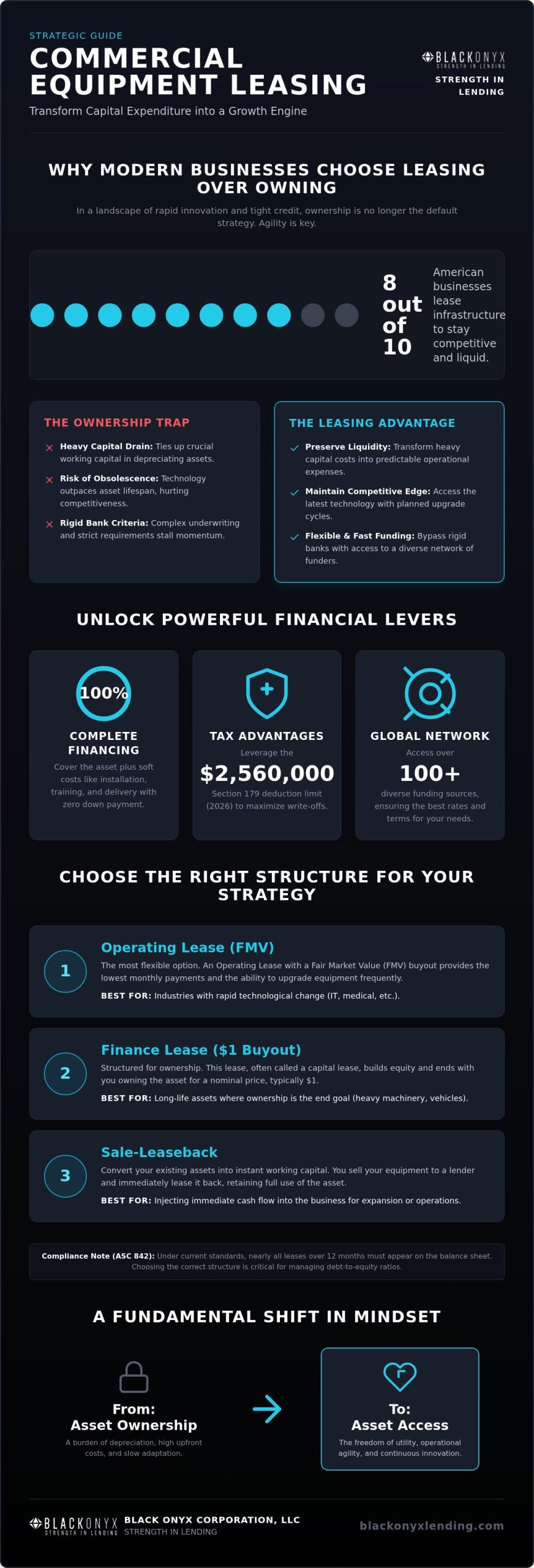
This guide will help you master the complexities of equipment leasing to preserve liquidity, leverage significant tax advantages like the $2,560,000 Section 179 deduction, and maintain a competitive edge. If you want to unlock 100% financing that includes soft costs and rapid access to capital, you need a modern approach. We will explore the transition from capital to finance leases under ASC 842, the strategic power of sale-leasebacks, and how to utilize a global network of over 100 funding sources to secure the most efficient structure for your business growth.
Key Takeaways
- Transform equipment acquisition from a cash drain into a strategic liquidity engine. Learn why modern firms are abandoning ownership to keep capital available for high-growth opportunities.
- Navigate the critical technical differences between operating and finance leases under current ASC 842 standards. Choosing the right commercial equipment leasing structure is essential for maintaining a healthy, compliant balance sheet.
- Capture significant tax advantages by leveraging the $2,560,000 Section 179 deduction limit for 2026. We explain how to structure your lease to maximize immediate write-offs and lower the total cost of equipment.
- Bypass rigid bank lending criteria by accessing a global network of over 100 diverse funding sources. Discover how professional underwriting can secure 100% financing, including soft costs like installation and training.
- Utilize sale-leaseback structures to convert existing assets into immediate working capital. This strategy allows you to inject cash into your business without sacrificing the tools you need to operate.
Beyond Ownership: Why Commercial Equipment Leasing is a Strategic Liquidity Play
Ownership is no longer the hallmark of a successful enterprise. In fact, for many high-growth firms, it’s a strategic anchor that drags down the balance sheet. Choosing commercial equipment leasing transforms a heavy capital expenditure into a streamlined operational expense. This shift allows you to focus on the utility of the asset rather than the burden of its depreciation. If you tie up millions in machinery, you lose the ability to pivot when market opportunities arise. This is the “opportunity cost” that often separates market leaders from those struggling to keep pace.
The economic climate of 2026 demands a more agile approach. With interest rates fluctuating and inflation impacting purchasing power, leasing acts as a vital hedge. You lock in today’s equipment costs and pay them back with tomorrow’s inflated dollars. This preserves your purchasing power and provides a level of predictability that traditional bank lending rarely offers. Modern operations are moving away from the “Asset Ownership” mindset in favor of “Asset Access,” prioritizing the use of the latest tools over the title of the equipment.
Defending Against Economic and Technological Obsolescence
Technology moves faster than depreciation schedules. If your industry relies on precision electronics or medical hardware, owning the asset is a gamble against time. You don’t want to be stuck with a five-year-old machine when your competitor just upgraded to a more efficient model. Leasing equipment to avoid obsolescence allows for mid-term upgrades, ensuring your operations remain at the cutting edge without requiring a massive cash infusion every few years. Economic obsolescence in the context of industrial machinery refers to the loss of an asset’s value caused by external factors, such as new environmental regulations or shifts in market demand, rather than physical deterioration.
Preserving Working Capital for Growth Initiatives
Cash is the oxygen of your business. Redirecting funds from “hard assets” to “revenue-generating activities” like marketing, R&D, or talent acquisition creates immediate momentum. By utilizing 100% financing, you protect your operational cash flow from the shock of large down payments. This approach also strengthens your financial profile; understanding finance leases is essential here, as these structures can help you manage debt-to-equity ratios more effectively than traditional loans. When you choose commercial equipment leasing, you aren’t just getting a machine; you’re securing the liquidity needed to fund your next major expansion. For businesses that also struggle with cash locked in unpaid invoices, strategic accounts receivable financing offers a complementary solution to keep capital moving at the velocity your growth demands.
Decoding Lease Structures: Operating, Capital, and Sale-Leaseback Options
Choosing the right commercial equipment leasing structure is a matter of precise financial engineering. If your priority is keeping monthly payments to a minimum while maintaining the flexibility to upgrade, a Fair Market Value (FMV) lease is the logical choice. Conversely, a $1 Buyout lease, commonly classified as a finance lease, is better suited for businesses that intend to own the asset at the end of the term. Using leasing as a strategic financial tool requires aligning these structures with your specific cash flow needs and long-term tax objectives.
Accounting standards have evolved significantly. Under the ASC 842 standard, nearly all leases longer than 12 months must now appear on the balance sheet. This change makes the distinction between finance and operating leases more critical than ever for your debt-to-equity ratios. If you’re managing a fleet, a Terminal Rental Adjustment Clause (TRAC) lease offers a unique hybrid. It combines the benefits of a lease with a final adjustment based on the vehicle’s actual residual value at the end of the term.
Modern financing goes beyond the sticker price of the hardware. Most strategic structures now allow for the inclusion of “soft costs.” This means you can wrap delivery, installation, and personnel training into the lease, achieving true 100% financing. If you’re unsure which path fits your current expansion plans, you can consult with a strategic financing partner to model the long-term impact of each option.
The Sale-Leaseback: Unlocking Capital from Existing Assets
A sale-leaseback is one of the most effective liquidity tools in commercial finance. In this scenario, you sell your currently owned equipment to a lender and immediately lease it back. This provides an instant cash infusion without disrupting your daily operations. While traditional commercial equipment leasing typically focuses on new acquisitions, the sale-leaseback looks backward to unlock equity from the assets already sitting on your warehouse floor. It’s an ideal strategy for firms undergoing rapid restructuring or those needing to fund an unexpected growth opportunity.
FMV vs. $1 Buyout: Tax and Ownership Implications
The decision between FMV and a $1 Buyout often hinges on the asset’s useful life. If you’re acquiring technology that will be obsolete in three years, the FMV structure allows you to walk away or upgrade without the burden of ownership. This is a core reason why many businesses are now strategically leasing equipment to avoid obsolescence rather than committing to long-term ownership. If the equipment is a “workhorse” asset with a ten-year lifespan, the $1 Buyout ensures you own the asset once the financing is complete. Determining which structure aligns with the asset’s useful life ensures you aren’t paying for tools that no longer provide a competitive advantage.
The ROI of Leasing: Navigating Section 179 and Tax Benefits
Measuring the return on investment for a new asset often overlooks the “tax delta” between leasing and buying. When you choose commercial equipment leasing, you aren’t just paying for a machine; you’re executing a sophisticated tax strategy. While outright ownership requires you to depreciate an asset over several years, specific lease structures allow for a massive front-end deduction. According to the Equipment Leasing and Finance Association (ELFA), eight out of ten businesses use some form of financing to acquire equipment, largely because of these immediate fiscal efficiencies. This approach turns a necessary expense into a powerful tool for reducing your overall tax liability.
Maximizing the Section 179 Deduction in 2026
For the 2026 tax year, the Section 179 deduction limit has reached $2,560,000. This allows you to write off the full purchase price of qualifying equipment in the very year you put it into service. If your total equipment acquisitions exceed the $4,090,000 phase-out threshold, the deduction begins to reduce dollar-for-dollar. To capture this benefit through a lease, the agreement must be structured as a finance lease, such as a $1 buyout option. Timing is everything here. If you don’t have the equipment “put into service” by the final day of your fiscal year, you lose the deduction for that period. This makes Q4 a critical window for strategic asset identification.
Bonus depreciation also remains a factor in 2026, though its primary value lies in assets that exceed the Section 179 caps. By combining these tax tools, you can often lower the “True Cost” of your acquisition to a fraction of its sticker price. It’s vital to consult with your tax professional early in the year. They can help you align your lease timing with specific fiscal goals to ensure you don’t leave capital on the table. If you wait until December to plan, you may find that delivery delays prevent you from meeting the “put into service” requirement. Businesses seeking to pair equipment financing with longer-term growth capital should also explore how an SBA loan can serve as a complementary funding vehicle for major expansion initiatives in 2026.
Impact on Financial Statements and Credit Capacity
Beyond tax savings, commercial equipment leasing protects your long-term borrowing power. Traditional bank loans often come with restrictive covenants that can limit your future operational freedom. Leasing preserves your existing bank lines of credit for true emergencies or short-term working capital needs. It also improves your current ratio by preventing a massive drain on your cash reserves. You gain the psychological benefit of a predictable, fixed-rate payment that won’t fluctuate with market volatility. This stability allows you to forecast growth with a level of precision that variable-rate debt simply cannot provide.
The Path to Approval: Underwriting and Funding Logistics
Securing approval for commercial equipment leasing requires more than a clean balance sheet. It demands a structured approach that presents your business as a low-risk, high-reward opportunity for capital providers. If you treat the application as a mere formality, you risk rejection or suboptimal terms. The process begins with strategic asset identification and quote solicitation. You need precise figures from your equipment vendors before you approach the capital markets to ensure your funding request is accurate and professionally presented.
Professional underwriting preparation follows this initial phase. This involves assembling your financials, personal credit history, and a concise business plan that explains how the new asset will drive revenue. Once your package is ready, you move into the multi-lender marketplace. This is where a strategic bridge to over 100 funding sources becomes invaluable. Instead of waiting on a single bank’s decision, you force multiple sources to compete for your business. After selecting a structure, you move to final documentation and electronic closing, followed by rapid funding and asset acquisition. Understanding how to finance business equipment through a structured, multi-lender approach is what separates firms that scale efficiently from those that stall at the application stage.
What Modern Commercial Lenders Look for in 2026
Lenders have shifted their focus significantly this year. While cash flow remains important, 2026 has seen a move toward asset-based credit decisions. If the equipment has a strong resale value, lenders are often more flexible with credit requirements. Common benchmarks for approval currently include a FICO score of 600 or higher and at least $15,000 in monthly revenue. Lenders also prioritize “time in business” over “projected revenue,” as established operations present a more predictable risk profile. Professional underwriting consulting can bridge the gap between your current financials and a lender’s specific criteria, especially with the full implementation of CFPB Section 1071 data collection rules. For businesses that require larger capital structures beyond equipment alone, understanding the updated eligibility requirements for an SBA loan in 2026 can open additional pathways to government-backed funding at competitive rates.
Overcoming Common Obstacles in the Approval Process
Bureaucratic hurdles can stall even the most promising deals. One common issue is “score fatigue,” where multiple credit inquiries from different banks lower your FICO score. A strategic partner manages these inquiries to protect your credit profile throughout the process. Additionally, traditional banks often shy away from specialized or unconventional equipment types. Non-bank sources are typically more comfortable with these assets and don’t require the restrictive blanket liens that traditional institutions demand. This keeps your other business assets unencumbered. If you’re ready to accelerate your growth, you can start your professional underwriting process here to ensure a seamless path to funding.
Precision Financing: The Black Onyx Consultative Advantage
Single-source lenders are often the biggest bottleneck in a company’s expansion plans. If an internal credit committee at a traditional bank decides your industry is too risky, your project stalls immediately. This is where the Black Onyx Corporation, LLC advantage becomes clear. We act as a strategic bridge to a global network of over 100 funding sources, ensuring your commercial equipment leasing request isn’t just processed; it’s strategically placed. We match your specific financial profile with the capital source most likely to offer competitive terms, bypassing the rigid constraints of local institutions.
Our expertise spans across the US, UK, Canada, and Australia. This global reach combined with local market knowledge allows us to navigate complex cross-border transactions that automated portals simply can’t handle. While “one-size-fits-all” fintech platforms prioritize speed over strategy, our consultative approach focuses on your long-term business planning. We bridge the gap between asset-based lending and your broader growth objectives, ensuring that every lease structure supports your debt-to-equity goals and liquidity needs.
Tailoring Solutions for Specialized Industries
Different sectors require different financial blueprints. In the medical and healthcare space, we focus on structures that account for rapid technological shifts, allowing for easy upgrades to diagnostic imaging or surgical hardware. For industrial and manufacturing firms, we often utilize TRAC leases or specialized fleet structures to manage heavy vehicles and long-life assets efficiently. Even in the specialty beverage industry, companies like Blackhand Coffee Co can use these financing models to acquire the high-end equipment necessary to maintain their craft standards. Rapid-growth technology firms also benefit from our ability to finance “soft costs” like software implementation and personnel training, which traditional lenders frequently exclude from their commercial equipment leasing packages.
For entrepreneurs who value the craftsmanship that defines the specialty beverage industry, you can explore Italian Roast from Bambi Nonno Coffee to see the results of combining traditional techniques with the right professional tools.
Engaging with a specialist should be a catalyst for progress, not a source of bureaucratic friction. Your journey begins with a preliminary review where a Black Onyx Corporation, LLC consultant analyzes your current asset needs and financial standing. We provide a no-obligation underwriting assessment that gives you a clear view of your funding potential before you commit to a specific path. This transparency allows you to make informed decisions without the pressure of a hard sales pitch. If you’re ready to move from a state of limitation to one of significant opportunity, you can schedule a consultation with Black Onyx Corporation, LLC to unlock your equipment financing potential.
Executing Your Strategic Capital Transition
The transition from a state of limitation to one of significant opportunity requires more than just new machinery; it demands a sophisticated approach to commercial equipment leasing. By prioritizing liquidity and leveraging the $2,560,000 Section 179 deduction, you move your business from a defensive posture to a proactive growth phase. If you’ve been constrained by rigid bank lending or the fear of technological obsolescence, the right lease structure acts as a powerful catalyst for your next expansion.
Success in 2026 depends on speed and precision. Black Onyx provides a strategic bridge to over 100 funding sources, offering global reach across the US, UK, Canada, and Australia. Our expert underwriting and personalized consulting ensure you aren’t just another number in an automated portal. We remove the bureaucratic obstacles that stall progress, allowing you to focus on scaling your operations with confidence. It’s time to stop letting capital constraints dictate your competitive edge.
Ready to transform your balance sheet? Secure Your Commercial Equipment Financing Strategy with Black Onyx today and unlock the resources your business deserves.
Frequently Asked Questions
What is the difference between an equipment loan and a commercial lease?
An equipment loan is a debt instrument where you borrow funds to own the asset immediately, typically requiring a down payment of 10% to 20%. In contrast, commercial equipment leasing focuses on the utility of the asset. Leases often provide 100% financing and more flexible end-of-term options. While both now appear on the balance sheet under ASC 842 standards, leasing preserves more of your upfront working capital for other growth initiatives.
Can I lease used commercial equipment or only new assets?
You can absolutely lease used equipment. Lenders evaluate the asset’s remaining useful life and resale value rather than just its age. This is a strategic move for businesses looking to acquire high-quality, specialized machinery at a lower entry point. If the equipment is in good working condition and has a verifiable market value, non-bank funding sources are often willing to structure a lease that matches its expected operational lifespan.
How does Section 179 work with equipment leasing in 2026?
In 2026, the Section 179 deduction limit is $2,560,000 with a phase-out threshold of $4,090,000. To qualify through a lease, you must use a finance lease structure, such as a $1 buyout. This allows you to deduct the full purchase price of the equipment in the year it’s put into service. It’s a powerful way to reduce the “true cost” of your acquisition while maintaining a predictable monthly payment schedule.
What are “soft costs” in equipment financing and are they covered?
Soft costs include non-tangible expenses such as freight, installation, and personnel training. While traditional bank loans often exclude these, modern commercial equipment leasing structures allow you to wrap these costs into the total financed amount. This creates a true 100% financing solution. Including these costs prevents you from having to pay thousands of dollars out-of-pocket before the equipment even begins generating revenue for your business.
Can I lease equipment if my business has a less-than-perfect credit score?
Yes, leasing is often more accessible than traditional bank lending for those with varied credit profiles. Non-bank lenders prioritize the value of the equipment and your consistent business revenue over a single credit score. If your business generates at least $15,000 in monthly revenue and you have a FICO score of 600 or higher, you can often secure competitive terms. Professional underwriting helps frame your financial story to highlight your operational strength.
What happens at the end of a commercial equipment lease term?
Your options depend on the initial lease structure. If you chose a Fair Market Value lease, you can return the equipment, renew the lease, or purchase the asset at its current market price. If you utilized a $1 buyout structure, you simply take full ownership of the asset for one dollar. These options allow you to decide whether to keep the equipment or upgrade to newer technology to maintain your competitive edge.
How long does the approval process take for a commercial lease?
The approval process is significantly faster than traditional commercial lending. While a bank might take weeks to review a file, strategic non-bank sources can often provide an approval within 24 to 48 hours. Once you’ve submitted your financials and equipment quotes, the entire process from application to funding typically takes between three and seven business days. This speed allows you to respond quickly to new market opportunities or urgent equipment needs.
Is a sale-leaseback a good way to raise working capital?
A sale-leaseback is one of the most efficient ways to inject liquidity into your business. You sell your existing, owned equipment to a financing partner for an immediate cash infusion and then lease it back to maintain uninterrupted use. This strategy converts the equity tied up in your machinery into liquid capital. It’s an ideal solution for firms that need to fund a major expansion or restructure debt without taking on traditional high-interest loans. Businesses that also carry significant outstanding invoices may find that combining this approach with accounts receivable financing creates a comprehensive liquidity strategy that addresses multiple cash flow constraints simultaneously.