


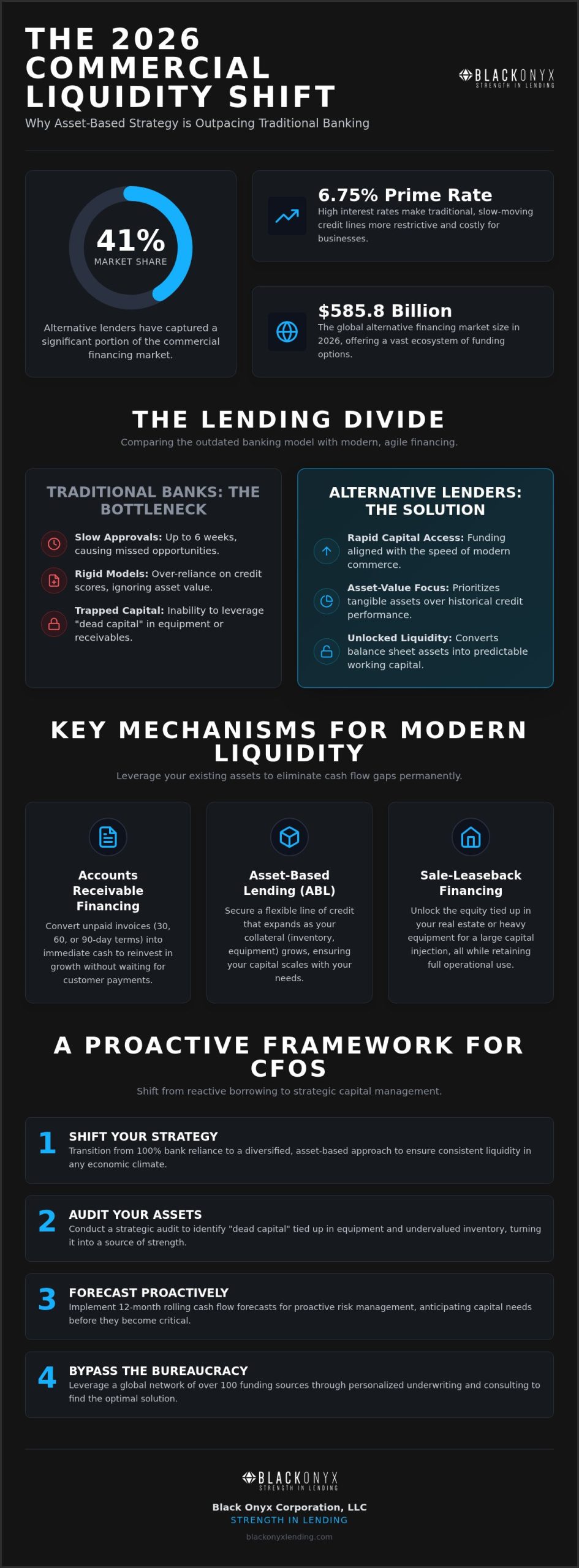
Alternative lenders have captured 41% of the market share in 2026, marking a definitive end to the era of bank-first dominance. If you’ve felt the frustration of bureaucratic delays or watched opportunities vanish while waiting for a loan committee, you know that traditional banking often fails to keep pace with modern commerce. Relying on inconsistent revenue cycles is no longer a viable strategy when the prime rate sits at 6.75% and traditional credit requirements remain stifling. You need business cash flow solutions that recognize the value of your existing assets rather than just your credit score.
This guide reveals the 2026 shifts in commercial liquidity and demonstrates how to leverage non-bank financing to eliminate cash flow gaps permanently. If you transition from static balance sheet management to a dynamic asset-based approach, then you can secure predictable working capital without sacrificing equity. We’ll provide a strategic framework to help you choose between sale-leaseback financing, accounts receivable funding, and specialized SBA consulting. You’ll gain the clarity needed to bypass systemic hurdles and maintain a competitive edge in a high-interest environment.
Key Takeaways
- Transition from traditional bank reliance to a diversified, asset-based strategy to ensure consistent liquidity in a high-interest environment.
- Utilize modern business cash flow solutions like accounts receivable financing to convert unpaid invoices into immediate, predictable working capital.
- Conduct a strategic audit to identify “dead capital” tied up in equipment and implement 12-month rolling forecasts for proactive risk management.
- Recognize that while digital automation improves operational efficiency, it cannot replace the strategic capital injections required to solve fundamental cash deficits.
- Bypass traditional bank bureaucracy by leveraging a global network of over 100 funding sources through personalized underwriting and consulting.
The Evolution of Business Cash Flow Solutions in 2026
Modern business cash flow solutions are no longer just about tracking receipts. They represent the synthesis of operational precision and rapid capital access. A fundamental understanding cash flow reveals that liquidity is the lifeblood of growth, yet many firms treat it as a static metric. In 2026, the high-velocity market demands a shift from “Emergency Borrowing” to “Strategic Liquidity.” The “wait-and-see” management style fails because it ignores the reality of a 6.75% prime rate and persistent inflation. If you treat capital as a tool to be deployed proactively, then you can secure a competitive advantage that reactive competitors simply cannot match.
Why Traditional Bank Lines are Stagnating
Local banks have tightened their grip significantly. Stricter 2026 commercial underwriting standards mean that even profitable firms face rejection due to rigid, credit-score-based models. These legacy systems often ignore the tangible value of your equipment or accounts receivable. Traditional institutions are also slow to adapt to 2026 tax incentives like updated Section 179 limits or bonus depreciation schedules, leaving capital trapped where it should be working. This “bureaucracy gap” creates a lethal delay for mid-market companies needing to scale. When a bank takes six weeks to approve a line of credit, the opportunity you intended to fund has likely already passed. Asset-based metrics are replacing credit scores as the primary indicator of reliability, allowing for more flexible, logic-driven lending decisions.
The Rise of the Non-Bank Financial Ecosystem
Alternative lenders now hold 41% of the market share, marking a definitive shift in how businesses fuel their growth. Private credit and specialized brokers have effectively decentralized commercial finance, offering a vast range of options that traditional institutions cannot replicate. This ecosystem provides commercial financing solutions that prioritize asset value over historical credit performance. Modern business cash flow solutions function as a multi-channel strategy that integrates financial technology with direct capital injections to ensure your operations never outpace your liquidity. With the global alternative financing market reaching $585.8 billion in 2026, the “strategic bridge” to non-bank resources is now the primary path for global business expansion.
Modern Mechanisms: Beyond Traditional Commercial Loans
Digital dashboards provide excellent visibility, but they cannot manufacture liquidity. Many industry guides focus heavily on software for monitoring, but true business cash flow solutions require actual capital injections. In the 2026 market, Asset-Based Lending (ABL) has become the cornerstone of liquidity for mid-market firms. Unlike traditional loans that fixate on historical cash flow, ABL unlocks the value trapped in your balance sheet. This approach is particularly effective for businesses with significant inventory or equipment that traditional banks often undervalue.
Asset-Based Financing vs. Unsecured Lines
Unsecured lines of credit are often capped by rigid debt-to-income ratios. If your business experiences a sudden surge in demand, these static limits can actually stifle your growth. In contrast, asset-based financing offers a “flexing” limit that expands as your collateral grows. You should review the asset based line of credit requirements to see how your inventory and equipment can serve as the foundation for a larger, more responsive capital pool. This mechanism ensures your borrowing power scales in lockstep with your operational needs rather than being held back by a credit score. For businesses ready to convert stagnant balance sheet assets into high-limit liquidity, a secured business line of credit provides the strategic leverage needed to close cash flow gaps during rapid growth phases.
The Strategic Use of Accounts Receivable Financing
Managing the gap between fulfilling an order and receiving payment is a perennial challenge. If you are waiting on 30, 60, or 90-day terms, your capital is effectively held hostage by your customers’ accounting departments. You can utilize accounts receivable financing to convert those outstanding invoices into immediate cash. This isn’t just about survival; it’s a strategic move to reinvest in new contracts without waiting for checks to clear. This cash flow management guide highlights how monitoring these gaps is vital, but AR financing is the tool that actually closes them. For many, confidential factoring is the preferred route because it allows you to maintain direct relationships with your clients while accessing the capital you’ve already earned.
For manufacturers and distributors, Purchase Order (PO) financing provides the leverage needed to handle supply chain spikes. If a record-breaking order arrives, PO financing covers the cost of goods so you don’t have to turn away business. Similarly, sale-leaseback strategies allow you to sell existing equipment to a lender and lease it back immediately. This move injects a lump sum of cash into your business while you retain full use of the machinery. If you want to explore how these specialized business cash flow solutions can transform your balance sheet, consulting with a strategic lender can provide the necessary bridge to these global resources.
Comparing Digital Automation vs. Strategic Capital Injection
Software provides the visibility you need to identify a problem, but it lacks the power to solve a fundamental capital deficit. While SaaS platforms dominate the market with promises of AI-driven efficiency, they’re merely the management layer of a robust strategy. Effective business cash flow solutions require a synergy between these efficiency tools and actual liquidity tools. If you only invest in tracking, you’re essentially watching a fuel gauge hit empty without having a way to refill the tank.
Software: The Management Layer
Digital tools excel at predicting seasonal troughs and identifying bottlenecks in your revenue cycle. AI-driven platforms can now forecast gaps with significantly more accuracy than manual spreadsheets. Automated reminders can also improve your Days Sales Outstanding (DSO) by ensuring invoices don’t sit stagnant. However, software is strictly defensive. It can’t fund a sudden inventory expansion or bridge the gap created by a record-breaking purchase order. It tracks the movement of money; it doesn’t generate it.
Financing: The Execution Layer
Strategic capital injection is the execution layer required for offensive business moves. If you want to capitalize on a competitor’s exit or secure a bulk-buy discount from a supplier, you need immediate access to cash. This is where commercial equipment leasing becomes vital, as it allows you to preserve your existing cash for daily operations while acquiring the machinery needed to scale. If software is the dashboard that shows your speed and direction, then financing is the high-octane fuel that powers the engine toward your destination.
Choosing between a tech upgrade and a new line of credit requires a nuanced approach. Technology is appropriate when your processes are slow; financing is mandatory when your opportunities are larger than your balance sheet. Engaging in business financial consulting helps you navigate this decision by providing a high-level view of your market dynamics. A consultant acts as a bridge, ensuring you don’t over-invest in management tools while leaving your execution layer underfunded. Balancing these two elements is the only way to maintain a true competitive edge and secure comprehensive business cash flow solutions in 2026.
Modernizing Your Cash Flow: A Strategic Audit for CFOs
CFOs often view audits as a mechanism for compliance, but a strategic audit serves as a proactive tool for capital discovery. To implement resilient business cash flow solutions, you must move beyond historical reporting. If you treat your balance sheet as a dynamic resource rather than a static record, you can uncover significant liquidity that remains hidden from traditional banks. This modernization process requires a methodical approach to identifying and redeploying capital where it generates the highest return.
- Step 1: Conduct a 12-month rolling cash flow forecast to pinpoint seasonal troughs and anticipate capital needs before they become urgent.
- Step 2: Evaluate “Dead Capital” currently tied up in aged equipment or unpaid invoices that could be better utilized elsewhere.
- Step 3: Assess your current debt service coverage ratios against 2026 market benchmarks to ensure your cost of capital remains competitive.
- Step 4: Diversify your funding sources to eliminate “single-bank risk” and ensure access to liquidity even if one lender’s appetite shifts.
- Step 5: Partner with a specialized consultant to navigate the complex SBA loan landscape and secure government-backed growth capital.
Identifying Hidden Liquidity on the Balance Sheet
Underutilized assets represent one of the most overlooked business cash flow solutions in a high-velocity market. If you hold fully-owned machinery while maintaining high-interest short-term debt, a sale-leaseback can instantly rebalance your position. This maneuver converts static equity into a lump sum of working capital while you retain full operational use of the assets. You must also analyze the “Cost of Waiting” against the “Cost of Capital.” Delaying a purchase often costs more in lost productivity and inflation than the interest on an asset-based line. To improve your underwriting profile, ensure your financial statements are transparent and reflect the true value of your collateral rather than just your credit score.
Mitigating Global Cash Flow Risks
Operating in a global economy introduces variables that can erode margins overnight. If you manage international partners, utilizing payroll financing ensures you maintain top-tier talent even during currency fluctuations or growth spurts. This specialized financing allows you to meet your most critical obligations without dipping into your primary operational reserves. A robust strategy also includes maintaining a “standby” credit facility. Having this liquidity on deck provides a buffer against market volatility and allows you to move decisively when competitors are forced to retreat. If you are ready to move from limitation to opportunity, modernizing your financing strategy is the first step toward long-term stability.
Securing Multi-Source Funding with Black Onyx Corporation
Traditional banking institutions often operate with a narrow view of risk that doesn’t account for the complexities of high-growth commercial operations. If you’ve encountered rigid lending criteria, then you understand the need for a more versatile partner. Black Onyx Corporation acts as a strategic bridge, connecting your firm to a global network of over 100 funding sources. This multi-source approach ensures you aren’t dependent on a single lender’s shifting appetite. With a footprint that spans the US, Canada, Australia, and the UK, we provide the localized expertise and global reach required to implement comprehensive business cash flow solutions across borders.
We don’t view financing as a one-off transaction. Instead, we position ourselves as a long-term ally focused on your competitive edge. While software providers often push self-service platforms, we recognize that complex commercial deals require human expertise and custom underwriting. If your business model is nuanced or rapidly evolving, an algorithm likely won’t capture your true potential. We bypass the automated “No” by presenting your case to lenders who value your assets and future revenue cycles over a simple credit score.
The Black Onyx Advantage: Personalized Underwriting
A boutique approach is essential for businesses that don’t fit into the standard boxes of local credit committees. We negotiate directly with multiple lenders to find the optimal debt structure for your specific needs, whether that involves sale-leaseback arrangements or purchase order financing. Having a single point of contact for diverse products like SBA loans, asset-based lending, and equipment leasing simplifies your capital stack significantly. This streamlined communication removes the bureaucratic friction that usually stalls growth, allowing you to focus on execution rather than paperwork. If your goal is to move from a state of limitation to one of significant opportunity, our personalized underwriting provides the momentum you need.
Next Steps: From Limitation to Opportunity
Modernizing your capital access begins with a high-level consultation to map out your 12-month liquidity needs. We analyze your current balance sheet to identify “dead capital” and suggest the most efficient business cash flow solutions for your industry. Once we begin our partnership, you can expect a decisive response within the first 48 hours as our team starts the underwriting process. We act quickly because we respect the time of busy professionals and understand that market opportunities don’t wait for bank committees. If you’re ready to secure the capital required for your next offensive move, contact Black Onyx today to unlock your business liquidity.
Securing Your Competitive Edge in 2026
Navigating the 2026 financial landscape requires a transition from passive cash management to a proactive capital strategy. You’ve seen how relying on traditional bank bureaucracy can stifle growth, while asset-based models and accounts receivable financing unlock immediate liquidity. If you combine digital forecasting with strategic capital injections, then you can eliminate cash flow gaps and maintain a decisive market position. Sustainable success in this high-velocity environment depends on treating your balance sheet as a dynamic resource rather than a static record.
Black Onyx Corporation serves as your strategic bridge to global capital. We offer access to over 100 global funding sources and provide specialized commercial underwriting expertise that bypasses automated rejections. Whether you operate in the US, Canada, Australia, or the UK, we’re committed to your long-term success. It’s time to move from a state of limitation to one of significant opportunity by implementing modern business cash flow solutions tailored to your unique operational needs. You don’t have to face systemic hurdles alone. Our team is ready to help you navigate the complexities of commercial finance with precision and speed. We’re here to ensure your business remains agile and well-funded.
Request a Strategic Cash Flow Consultation
Frequently Asked Questions
What are the most effective business cash flow solutions in 2026?
The most effective business cash flow solutions in 2026 integrate asset-based financing with accounts receivable funding to ensure liquidity. If you rely solely on traditional bank lines, then you’re vulnerable to rigid underwriting. Diversifying your capital sources allows you to leverage inventory and equipment value. This strategy moves your firm from a state of limitation to one of opportunity. It ensures you have the capital required for offensive market moves rather than just survival.
How does asset-based lending differ from a traditional bank loan?
Traditional bank loans prioritize credit scores and historical revenue, which often limits high-growth companies. Asset-based lending differs by focusing on the tangible value of your collateral, such as inventory or machinery. If your assets are strong, then your borrowing capacity can exceed what a standard term loan allows. This approach provides a “flexing” limit that grows as your business expands. It’s a more responsive mechanism for firms with substantial balance sheet assets but inconsistent cash flow.
Can accounts receivable financing help if my customers pay slowly?
Accounts receivable financing is specifically designed to bridge the gap when customers pay on 30, 60, or 90-day terms. It allows you to convert outstanding invoices into immediate working capital without waiting for checks to clear. This isn’t a loan; it’s an advance on capital you’ve already earned. If you use this tool, then you can reinvest in new projects or payroll immediately. It’s a vital component of modern business cash flow solutions for distributors and service providers.
What is the benefit of using a commercial finance broker over a direct bank?
A commercial finance broker like Black Onyx Corporation provides a strategic bridge to over 100 funding sources. Direct banks are restricted by their own internal risk appetites and rigid committees. If one bank says no, then a business financing broker can pivot to dozens of alternative lenders with different criteria. You benefit from specialized underwriting and a single point of contact for multiple products. This boutique approach ensures your complex or high-growth business model receives the individualized attention it deserves.
How does equipment leasing improve my monthly cash flow?
Equipment leasing preserves your cash by replacing a large upfront capital expenditure with predictable monthly payments. If you lease your machinery, then you retain your liquid reserves for daily operations and emergency needs. This strategy also simplifies your technology cycles, as you can upgrade equipment more easily without the burden of ownership. Many firms use leasing to take advantage of 2026 tax incentives like Section 179. It’s a low-friction way to maintain modern operations while protecting your liquidity.
Is purchase order financing available for international trade?
Purchase order financing is a robust tool for international trade, especially for manufacturers and distributors. Black Onyx facilitates these deals across the US, Canada, Australia, and the UK. If you receive a large international order that exceeds your current production capacity, then PO financing covers the cost of goods from your suppliers. This allows you to fulfill record-breaking contracts without depleting your working capital. It’s an essential resource for companies looking to expand their global footprint in 2026.
What documents are required for a strategic cash flow audit?
A strategic cash flow audit requires a 12-month rolling forecast and an accounts receivable aging report. You should also provide a comprehensive list of equipment for potential sale-leaseback evaluation and current debt service schedules. If you have these documents ready, then a consultant can quickly identify “dead capital” trapped on your balance sheet. This data allows for a precise analysis of your liquidity gaps. It’s the first step toward building a more resilient and diversified funding strategy for your firm.
How quickly can a business secure a new line of credit through Black Onyx?
You can expect an initial response and a preliminary review of your file within the first 48 hours of working with our team. While traditional banks often take weeks to move through committees, our specialized underwriting process is designed for speed and precision. If your documentation is complete, then the path to securing a secured business line of credit is significantly shorter. We respect the time of busy professionals and understand that market opportunities require decisive, rapid capital injections to be successful.