


In 2026, your balance sheet’s strength is no longer measured by total assets alone, but by the “liquidity velocity” of your collateral. Understanding the specific asset based line of credit requirements is the difference between stagnant growth and a business that scales with precision. You’ve likely felt the sting of a traditional bank’s slow underwriting or a rejection based on a credit score that doesn’t reflect your actual sales volume. It’s frustrating to watch opportunities pass by while your capital remains locked in inventory or unpaid invoices. If you can demonstrate the quality of your underlying assets, then you can bypass the bureaucratic hurdles that typically hinder traditional financing.
This strategic guide provides a roadmap to master the specific eligibility criteria needed to unlock immediate liquidity from your balance sheet. With the global asset-based lending market now surpassing $1 trillion, the opportunity for rapid access to revolving credit has never been greater. We’ll examine how to leverage your receivables and equipment to secure higher borrowing limits than unsecured loans. By the end of this article, you’ll have a clear path to transform your current assets into a powerful engine for growth and long-term SBA financing.
Key Takeaways
- Discover why modern lenders prioritize “asset-first” underwriting over traditional credit scores to accelerate your funding timeline.
- Gain a clear understanding of the specific asset based line of credit requirements regarding revenue thresholds and debt service coverage ratios.
- Learn how to calculate your borrowing base by applying strategic advance rates to accounts receivable and inventory.
- Follow a step-by-step preparation guide to audit your internal assets and optimize your accounts receivable aging report for maximum approval odds.
- Explore how to use an asset-based line of credit as a tactical bridge to secure long-term SBA financing through a global network of over 100 funding sources.
Understanding Asset Based Line of Credit Requirements in 2026
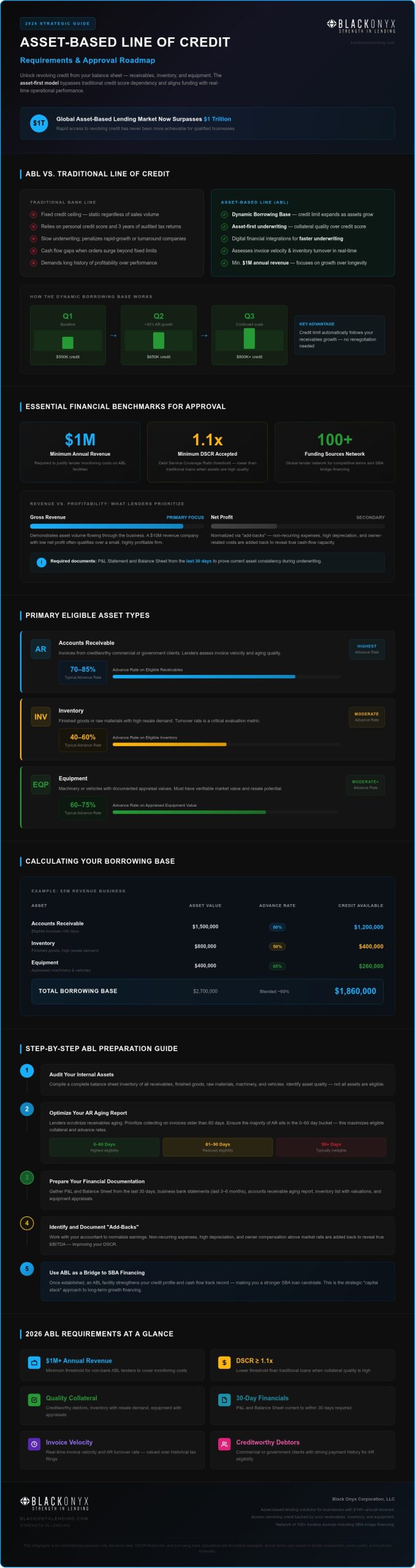
An asset-based line of credit (ABL) functions as a revolving credit facility where your loan limit is directly tied to the liquid value of your balance sheet. Unlike traditional loans that rely heavily on your personal credit score or three years of audited tax returns, modern asset based line of credit requirements in 2026 prioritize an “asset-first” model. This shift allows businesses with at least $1 million in annual revenue to bypass the rigid constraints of traditional banking. If you have significant accounts receivable or inventory, your business possesses untapped leverage that can be converted into immediate working capital.
The Core Difference Between ABL and Traditional Lines
Traditional bank lines often come with a fixed ceiling that remains static regardless of your sales volume. This “set it and forget it” approach frequently leads to cash flow gaps when a business experiences a sudden surge in orders. In contrast, an ABL utilizes a dynamic “Borrowing Base” model. This structure ensures your credit limit expands automatically as your sales and assets increase. If your receivables grow by 30% in a single quarter, your available credit follows suit. It’s the ultimate tool for short term business capital management because it aligns your funding with your operational reality rather than an arbitrary bank limit.
Why 2026 Requirements Favor Growth Over Longevity
In the current market, lenders value real-time performance data over historical records. Traditional institutions often demand a long history of profitability, which can stifle rapid-growth companies or those navigating a turnaround phase. Non-bank lenders in our network utilize digital financial integrations to assess asset quality instantly. This approach looks at the velocity of your invoices and the turnover rate of your inventory rather than just your tax filings from years prior. It allows for faster underwriting and provides a strategic advantage for firms that need to move quickly. For a deeper look at how this fits into your broader financial strategy, see our Strategic Commercial Financing: 2026 Growth Guide.
Primary assets that satisfy these requirements include:
- Accounts Receivable: Invoices from creditworthy commercial or government clients.
- Inventory: Finished goods or raw materials with high resale demand.
- Equipment: Machinery or vehicles with documented appraisal values.
Meeting the asset based line of credit requirements in 2026 is less about your past and more about the current velocity of your operations. By focusing on these tangible values, lenders can offer higher limits and more flexible terms than unsecured options ever could.
The Essential Financial Benchmarks for ABL Approval
Securing approval for an asset-based facility requires a precise understanding of how lenders view your financial metrics. While traditional banks often obsess over your debt-to-equity ratio, asset-based lenders focus on the “exit strategy” provided by your collateral. Most non-bank lenders in our network look for a minimum of $1 million in annual revenue to justify the monitoring costs associated with these lines. The Debt Service Coverage Ratio (DSCR) is still monitored, but the threshold is often lower than traditional products. If your assets are liquid and high-quality, a DSCR as low as 1.1x can be sufficient for approval because the asset based line of credit requirements prioritize the value of the assets over the historical cash flow of the company.
Revenue and Profitability: What Is the Minimum?
Lenders often prioritize gross revenue over net profit because it demonstrates the sheer volume of assets flowing through your business. A company with $10 million in revenue but low net profit due to strategic reinvestment is often a better candidate than a small, highly profitable firm with no scale. During underwriting, we look for “add-backs” to normalize your earnings. These are non-recurring expenses, high depreciation, or owner-related costs that, when added back to your net income, reveal the true cash-flow capacity of your operation. To prove this consistency, you’ll need to provide accurate, up-to-date financial statements, including a P&L and Balance Sheet from the last 30 days. If you’re ready to see how your current assets stack up, connect with our advisory team for a preliminary assessment.
The Role of Personal and Business Credit Scores
Your credit score is a secondary factor in the approval process, serving as a measure of character rather than capacity. Lenders want to see that you manage obligations responsibly, even if you’ve faced past capital constraints. Don’t let a sub-700 credit score deter your application. If your assets are strong, a 600 FICO score is often acceptable because the loan is secured by the liquidation value of the collateral, not just your personal guarantee. If your credit history contains blemishes, it’s essential to provide a narrative that explains the “why” behind the numbers. Professional business financial consulting can help you package these credit issues effectively. We ensure lenders see the strength of your balance sheet first, moving you from a state of limitation to one of significant opportunity through our global network of over 100 funding sources.
Evaluating the Borrowing Base: Asset Quality Requirements
The “Borrowing Base” is the engine that drives your daily liquidity. It’s a dynamic formula that calculates your available credit by applying specific advance rates to your eligible collateral. Unlike traditional loans with fixed limits, meeting asset based line of credit requirements involves a continuous evaluation of your balance sheet’s health. If your sales volume increases, your borrowing base expands, providing an immediate influx of capital to support that growth. Lenders typically apply an 85% advance rate to eligible investment-grade accounts receivable and 50% to eligible inventory. These rates ensure the lender maintains a safety margin while providing you with significantly more capital than an unsecured facility could offer.
Accounts Receivable: The Gold Standard of Collateral
Invoices are the most liquid asset on your balance sheet, making them the primary focus for ABL lenders. To be considered “eligible,” receivables must generally be less than 90 days old. Once an invoice crosses that 90-day threshold, it’s typically excluded from the borrowing base. Lenders also evaluate “concentration limits,” which prevent your credit line from being overly dependent on a single customer. If one client represents more than 20% of your total receivables, the excess may be deemed ineligible. This focus on customer creditworthiness is why B2B sales are preferred over B2C. For companies with high-quality debtors, accounts receivable financing techniques provide the fastest path to unlocking trapped cash flow.
Inventory and Equipment: Unlocking Secondary Liquidity
While receivables are the gold standard, inventory and equipment provide essential secondary support. Lenders determine the value of these assets using the Net Orderly Liquidation Value (NOLV), which is the estimated amount an asset would fetch in a quick but managed sale. Not all inventory is treated equally. Finished goods carry the highest advance rates, often around 50%, while raw materials may receive less. Work-in-progress (WIP) is the most difficult to finance, typically seeing advance rates of 40% or lower due to the cost of completion. If your business relies heavily on specialized machinery, commercial equipment leasing might be a more efficient alternative for those specific fixed assets. By diversifying the collateral types within your borrowing base, you ensure that every dollar on your balance sheet is working toward your competitive edge.
Asset quality is the ultimate arbiter of your borrowing capacity. If you maintain clean, aging-protected records and a diversified customer base, you’ll find that asset based line of credit requirements become a strategic tool rather than a hurdle. This asset-first approach allows us to bypass the bureaucratic obstacles that typically slow down bank underwriting, moving your business from a state of limitation to one of significant opportunity.
How to Meet ABL Requirements: A Step-by-Step Preparation Guide
Meeting asset based line of credit requirements isn’t a matter of luck; it’s a matter of meticulous preparation. If you want to bypass the 30 to 60 day delays typical of traditional branch managers, then you must treat your application like a strategic presentation. Precision matters. If your records are disorganized, your advance rates will suffer. We recommend a proactive approach that positions your business as a low-risk, high-velocity operation ready for immediate capital injection. Understanding the latest business cash flow solutions and how non-bank lenders are reshaping the market in 2026 can give you a critical edge when structuring your application.
Follow these five steps to ensure your business is loan-ready:
- Step 1: Conduct an internal asset audit to identify the true value of your borrowing base.
- Step 2: Clean up your Accounts Receivable aging report by resolving disputes and removing uncollectible accounts.
- Step 3: Prepare a “Use of Funds” statement to demonstrate how this liquidity will drive strategic growth.
- Step 4: Engage commercial underwriting consulting to package your deal according to non-bank standards.
- Step 5: Compare offers from multiple global sources through a business financing broker to ensure you secure the most competitive spread and advance rates.
The Audit Trail: Organizing Your Documentation Vault
Speed is a competitive advantage. In 2026, digital transparency speeds up the approval process by allowing lenders to verify asset quality in real-time through cloud-based integrations. You’ll need five core documents to begin: your AR Aging, AP Aging, a detailed Inventory List, the last two years of Tax Returns, and current Financial Statements. It’s vital to remove any “bad debt” from your aging report before you apply. If a lender sees a high volume of invoices past 90 days, they’ll discount your entire borrowing base. High-quality documentation proves you have the professional discipline to manage a revolving facility.
Overcoming Common Roadblocks in the Underwriting Process
Systemic hurdles like existing UCC filings or tax liens don’t have to be deal-breakers. If a previous lender has a blanket lien on your assets, we negotiate an Intercreditor Agreement to carve out the specific collateral for your new line. This level of negotiation is where many independent applications fail. Black Onyx acts as your strategic bridge, navigating these complex legal structures to ensure your assets remain accessible. We focus on removing bureaucratic obstacles so you can maintain your momentum. Ready to see which of our 100+ funding partners is the right fit? Contact Black Onyx today to begin your preliminary asset audit.
Strategizing Your Capital Stack with Black Onyx
A revolving facility is rarely the final destination for a growing enterprise; instead, it’s a high-performance engine designed to propel you toward more permanent financing solutions. Navigating the asset based line of credit requirements effectively allows you to capture immediate market opportunities that traditional bank underwriting would miss. By partnering with Black Onyx Corporation, LLC, you gain access to a global network of over 100 funding sources, ensuring your capital stack is optimized for both current speed and future stability. We prioritize the removal of bureaucratic obstacles to foster a sense of momentum for your business.
From Short-Term Liquidity to Permanent Growth
If you use an ABL to bridge cash flow gaps and fulfill larger contracts, then you’re actively building the financial history needed for lower-cost, bank-grade debt. Many of our clients utilize asset-based financing as a tactical bridge toward long-term SBA loans. This progression allows you to stabilize your operations and improve your debt-to-equity ratios under more flexible non-bank terms. Once your business demonstrates consistent profitability and a fortified balance sheet, we help you execute an exit strategy into permanent growth capital. Our role as a seasoned consultant is to act as that strategic bridge, ensuring you don’t just secure a loan, but a path to a long-term competitive edge.
Why a Troy, Michigan Broker Provides a Global Advantage
Operating out of Troy, Michigan, provides us with a unique vantage point that combines midwestern reliability with a global reach into Canada, the UK, and Australia. This localized underwriting expertise translates to higher approval rates because we understand the specific operational hurdles businesses face in diverse markets. We don’t just submit applications; we provide ongoing advisory to help you maintain your borrowing base and navigate complex intercreditor dynamics. If you’re ready to move from a state of limitation to one of significant opportunity, then a personalized assessment is your first step. Secure Your Strategic Capital Assessment with Black Onyx Corporation, LLC to unlock the full liquidity potential of your balance sheet today.
The speed of non-bank financing is essential for capturing market share before your competitors can react. By aligning your assets with our global network, you ensure that capital is never the bottleneck for your vision. We remain intensely focused on your long-term success, providing the expert advice and practical resources needed to thrive in the 2026 commercial landscape.
Unlocking Your Balance Sheet’s Full Potential
Your business is no longer defined by the limitations of traditional bank underwriting or a static credit score. By prioritizing the quality of your receivables and inventory, you can leverage a dynamic borrowing base that scales alongside your sales volume. Mastering the asset based line of credit requirements in 2026 is about more than just securing a loan; it’s about building a tactical bridge toward long-term stability and permanent growth. If you’re ready to bypass bureaucratic hurdles and access immediate liquidity, then professional guidance is your most valuable asset.
We provide the specialized underwriting expertise needed to navigate complex collateral valuations and intercreditor agreements. With access to over 100 funding sources and deep roots in both Michigan and global commercial markets, we ensure your deal is packaged for maximum approval rates. Don’t let cash flow gaps dictate your competitive edge. Partner with Black Onyx for a Strategic Capital Assessment and move from a state of limitation to one of significant opportunity. Your balance sheet holds the key to your next phase of growth, and we’re here to help you unlock it.
Frequently Asked Questions
What is the minimum credit score for an asset-based line of credit?
You don’t need a perfect credit score to qualify because the facility is secured by your balance sheet. While traditional banks demand 700+, many non-bank lenders accept scores as low as 600 if your collateral is high-quality. The primary focus remains on the liquidity of your receivables and inventory. We use your credit history to assess management character rather than just borrowing capacity, allowing for more flexible underwriting.
How long does it take to get approved for an ABL in 2026?
Approval timelines for an asset-based line of credit typically range from two to four weeks. This is significantly faster than traditional bank underwriting, which often drags on for 60 days or more. If your digital financial integrations are ready, initial term sheets can arrive in as little as 48 hours. The speed depends on how quickly you provide an accurate accounts receivable aging report and inventory valuations.
Can I use inventory as the primary collateral for a line of credit?
Yes, you can use inventory as a primary collateral source, though it’s most common to pair it with accounts receivable. Lenders typically apply a 50% advance rate to finished goods. Raw materials or work-in-progress items may receive lower rates due to their lower liquidation value. If your business holds significant stock, we match you with specialized lenders who prioritize inventory velocity over traditional cash flow metrics.
What are the typical advance rates for accounts receivable?
Typical advance rates for eligible accounts receivable range from 80% to 85%. This rate applies to invoices from creditworthy customers that are less than 90 days old. If your customers have high credit ratings, you’ll likely secure the upper end of that range. This immediate influx of capital allows you to bridge cash flow gaps without waiting for 30 or 60-day payment cycles, providing a superior alternative to unsecured debt.
Do ABL lenders require a personal guarantee?
Most ABL lenders require a personal guarantee, especially for mid-market businesses. However, the nature of the guarantee is often more limited than with an unsecured loan. Lenders primarily want to ensure that the collateral reported in your borrowing base is accurate and free of fraud. If your business has a strong historical performance and high asset quality, we can often negotiate more favorable guarantee terms through our network of funding partners.
How does an asset-based line of credit differ from factoring?
An asset-based line of credit is a revolving facility that stays on your balance sheet, whereas factoring is the outright sale of your invoices. ABL typically offers lower overall costs and allows you to maintain control over your customer relationships. Factoring is often better for startups with no credit history, but an ABL is the preferred strategic tool for established firms with at least $1 million in annual revenue.
What reporting requirements should I expect after approval?
After approval, you should expect to provide regular borrowing base certificates, often on a weekly or monthly basis. These reports update the lender on your current levels of eligible receivables and inventory. You’ll also need to submit monthly financial statements and an updated accounts receivable aging report. While this requires more administrative discipline than a standard loan, it ensures your credit limit grows automatically as your sales volume increases.
Can I qualify for an ABL if my business is currently losing money?
You can qualify for an asset-based line of credit even if your business is currently losing money or in a turnaround phase. Because asset based line of credit requirements focus on the liquidation value of your collateral, your historical profitability is a secondary concern. If you have high-quality invoices or valuable equipment, lenders look at the strength of those assets to secure the facility. This makes ABL an ideal bridge toward long-term stabilization.