


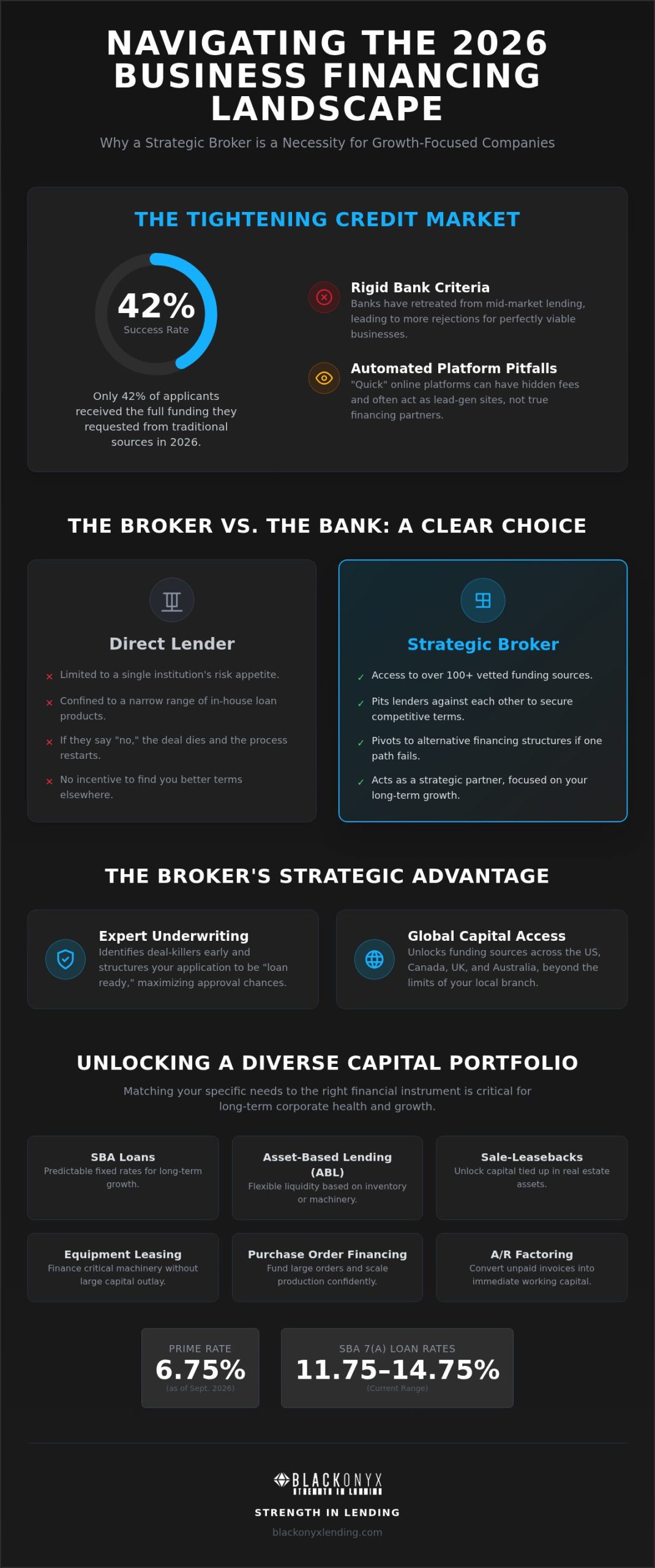
Only 42% of small business financing applicants received the full amount they requested in 2026. If you’ve faced rejection from traditional banks due to rigid criteria or discovered hidden fees in “quick” online platforms, you’re experiencing the systemic friction of a tightening credit market. Finding a competent business financing broker is no longer about just getting a referral. It’s about securing a partner who provides strategic underwriting and global capital access beyond the limitations of your local branch.
You deserve a financing strategy that matches the complexity of your asset-based deals. This guide will teach you how to evaluate a broker’s network and their ability to make your business “loan ready” for over 100 vetted funding sources across the US, Canada, UK, and Australia. We’ll also examine how current benchmarks, like the 6.75% prime rate and new SBA stacking provisions, affect your leverage. We’ll provide the roadmap to move from a state of limitation to one of significant opportunity through professional, results-oriented guidance that supports long-term growth rather than just a temporary fix.
Key Takeaways
- Recognize why the contraction of traditional bank lending in 2026 necessitates access to a diverse network of 100+ private and alternative funding sources.
- Understand how a professional business financing broker acts as a strategic bridge by identifying deal-killers early through expert underwriting.
- Evaluate potential partners based on their ability to provide global capital access across key markets, including the US, Canada, UK, and Australia.
- Learn to distinguish between automated lead-gen platforms and consultants who offer specialized structures like sale-leasebacks and asset-based financing.
- Master the “loan ready” approach to ensure your business presents a compelling case to lenders, significantly increasing your chances of full approval.
What is a Business Financing Broker and Why Use One in 2026?
A business financing broker acts as a professional intermediary, bridging the gap between ambitious companies and the specialized capital they require to scale. Unlike retail agents, these consultants operate across a vast spectrum of non-bank lenders, including private credit funds and institutional investors. To understand the foundational mechanics of this role, it helps to look at the broader definition of What is a Broker? in a commercial context. In 2026, this role has evolved from a simple middleman into a strategic necessity. While automated lead-gen sites focus on selling your data to the highest bidder, a professional consultant manages the entire lifecycle of a deal, from initial underwriting to final placement.
Traditional banks have continued their decade-long retreat from small and mid-market lending. With the prime rate holding at 6.75% as of September 2026, banks have tightened their criteria to an extreme degree. This has created a vacuum where only 42% of applicants receive the funding they need from traditional sources. A business financing broker navigates this environment by accessing alternative pools of liquidity that banks simply cannot touch. They save executives hundreds of hours by managing the heavy lifting of lender negotiations, allowing leadership to focus on operations rather than chasing paperwork.
Broker vs. Direct Lender: Understanding the Landscape
If you approach a direct lender, you’re limited to their specific risk appetite and current balance sheet constraints. If they say no, the deal dies. Conversely, a broker provides a portfolio-wide view of the market. They pit multiple funding sources against one another, forcing lenders to compete for your business. This competitive environment often results in better terms for structures like Sale-Leaseback Financing or complex asset-based deals that a single bank might find too risky or unconventional.
The ‘No-Bank’ Reality for Modern Commercial Growth
Mid-market firms are increasingly bypassing local banks because the speed of traditional bureaucracy doesn’t align with modern growth cycles. The role of the broker in 2026 is to decode the alternative finance market, identifying which of the 18,807 loan broker businesses actually possess the deep lender relationships required for high-stakes transactions. A professional broker serves as a strategic bridge to global capital, ensuring that your business is never limited by the conservative policies of a single institution.
Evaluating Broker Networks: Accessing 100+ Funding Sources
The efficacy of a business financing broker is defined by the depth and independence of their relationships. If a firm only maintains five or six lender connections, they aren’t functioning as a true broker; they’re acting as an outsourced sales arm for those specific institutions. A robust network of 100+ funding sources ensures that your application doesn’t enter a “rejection loop.” This frustrating cycle occurs when one bank’s “no” is echoed by every other local branch because they all share similar risk profiles and regulatory constraints. When you research how to choose a business loan broker, your first inquiry should always concern the diversity of their capital pool.
A vast network provides the necessary friction against market volatility. In a year where only 42% of applicants received their full requested funding, having access to non-bank lenders and private credit funds is the only way to ensure deal certainty. This scale allows a broker to pivot quickly. If a traditional term loan isn’t viable, they can immediately transition to specialized structures like purchase order financing or accounts receivable factoring without restarting the entire discovery process. This breadth of options is what transforms a standard loan search into a strategic capital acquisition plan.
Diversified Capital: SBA, ABL, and Equipment Leasing
Matching your specific operational needs to the right financial instrument is critical for long-term corporate health. For instance, many firms prioritize 2026 SBA Loans: A Strategic Guide for Business Growth for their predictable fixed rates, which currently range between 11.75% and 14.75% for 7(a) loans. However, if your business requires immediate liquidity based on inventory or heavy machinery, Asset-Based Lending (ABL) offers a more flexible path than a traditional bank term loan. Specialized equipment leasing also plays a vital role in preserving corporate cash flow. It allows you to acquire essential technology or medical hardware without a massive upfront capital expenditure, keeping your balance sheet lean and responsive. For businesses that have hit the ceiling on unsecured financing, a secured business line of credit can convert stagnant balance sheet assets into high-limit liquidity at more competitive rates.
Cross-Border Financing Capabilities
Modern business doesn’t stop at the border, and your financing shouldn’t either. Firms with international operations in Canada, the UK, or Australia require a business financing broker who understands the regulatory nuances and currency considerations of those jurisdictions. While Black Onyx is headquartered in Troy, Michigan, its strategic reach extends globally to provide a hedge against local economic fluctuations. This cross-border capability ensures that if domestic lending markets tighten, you can leverage global partners to maintain momentum. Accessing this level of sophisticated capital requires a partner who acts as a strategic bridge rather than a simple lead-gen site. If you’re ready to explore these options, you can view our full range of strategic funding solutions to see how global access can benefit your specific deal structure.
The Underwriting Advantage: Why ‘Loan Ready’ Matters Most
The rise of AI-driven underwriting in 2026 has made “one-click” applications common for simple lines of credit, but these algorithms frequently fail complex mid-market entities. If your business model involves intricate asset structures or international receivables, an automated system will likely flag your application as high-risk without context. A professional business financing broker provides the human oversight necessary to identify and resolve “deal-killers” before a single lender sees your file. When you’re researching what to look for in a business loan broker, the ability to translate your balance sheet into a narrative of growth is what separates a successful funding round from a flat rejection.
Effective underwriting goes beyond checking credit scores. It involves deep-diving into your cash flow cycles to ensure that the debt structure you’re seeking actually supports your operations. If a broker simply forwards your unvetted documents to dozens of lenders, they’re not helping; they’re damaging your reputation in the capital markets. Strategic positioning ensures that your business is presented in the best possible light, which directly lowers the final cost of credit and improves the likelihood of securing favorable covenants.
Professional Consulting vs. Automated Algorithms
Algorithms can’t negotiate. They don’t understand the strategic value of a sale-leaseback or how purchase order financing can bridge a seasonal gap. This is where Strategic Business Financial Consulting: Navigating Commercial Capital in 2026 becomes indispensable. A human consultant can advocate for your business, explaining historical anomalies and highlighting future revenue projections that an AI would ignore. This level of professional negotiation is essential for securing terms that allow your business to remain agile rather than constrained by rigid bank policies.
Getting Loan Ready: A Checklist for 2026
Being “loan ready” in the current environment requires more than just last year’s tax returns. Lenders now place a higher emphasis on interim business financials, personal financial statements of all owners, and comprehensive debt schedules. A broker assists in restructuring existing high-interest debt to improve your capital efficiency before the application process begins. Professional underwriting reduces the risk of multiple hard credit inquiries by ensuring the package is only presented to lenders whose specific risk appetite matches your profile. By scrubbing the data and verifying every claim, your broker creates a sense of momentum that encourages lenders to move quickly toward a closing.
Selection Criteria: How to Choose Your Financing Partner
Selecting the right business financing broker is a high-stakes decision that dictates your firm’s liquidity for years. It requires moving beyond simple rate comparisons to evaluate the underlying infrastructure of the brokerage. Your first step is to verify the breadth of their lender network. A true consultant should provide access to 100+ diverse funding sources across the US, Canada, UK, and Australia. If they can’t demonstrate global reach or deep relationships with non-bank institutional lenders, your options will be limited to the same rigid criteria you’re trying to avoid.
Transparency in fee structures and commission disclosures is non-negotiable. Professional firms operate with a clear understanding of how they are compensated, ensuring their interests align with your long-term growth. You should also evaluate their history with complex structures like accounts receivable financing. This requires a partner who understands how to leverage your balance sheet to create immediate liquidity without the constraints of a traditional bank loan. Businesses with significant collateral assets may also benefit from exploring a secured business line of credit as a strategic tool for unlocking high-limit capital at superior rates. If you’re ready to partner with a consultant who prioritizes your competitive edge, connect with our strategic underwriting team today to discuss your capital needs.
Industry Specialization: Why It Matters
The requirements for medical equipment financing are fundamentally different from those of high-volume manufacturing payroll funding. Specialized brokers understand industry-specific collateral values and can negotiate advance rates that a generalist might miss. This expertise is vital for maintaining operational momentum during rapid scaling phases. By aligning with a partner who understands your sector’s nuances, you gain access to Business Cash Flow Solutions: 2026 Strategic Trend Analysis that keeps your financing strategy ahead of market shifts.
The Red Flags of Business Brokering
You must avoid “brokers” who demand high upfront fees without performing any legitimate underwriting or consulting. This is often a sign of a lead-generation site rather than a professional firm. Be wary of intermediaries who only maintain two or three funding sources, as they lack the leverage to secure competitive terms. A reputable business financing broker will have a physical headquarters, such as our Troy, Michigan office, and a verifiable track record of managing complex commercial deals. Confirming these credentials ensures you’re building a bridge to capital rather than a dead end.
Black Onyx Lending: Your Strategic Bridge to Commercial Capital
Black Onyx Corporation, LLC isn’t just another business financing broker; it’s a strategic firm designed to remove the bureaucratic friction inherent in traditional banking. By combining personalized underwriting with a network of over 100 third-party funding sources, we ensure your business is matched with capital that aligns with your specific growth trajectory. Our reach extends across the US, Canada, the UK, and Australia, providing a global perspective that single-source lenders can’t match. We focus on results, moving you from a state of capital limitation to one of significant opportunity. Capital is a commodity, but strategic underwriting is the true competitive advantage in 2026.
Our approach is built on precision and speed. We respect the time of busy professionals by getting to the core of your financial needs quickly. Instead of navigating the rigid criteria of a local branch, you gain access to a seasoned, high-level consultant who acts as your advocate. We don’t just find a loan; we build a strategic bridge to the liquidity your business needs to scale effectively.
The Sale-Leaseback and Asset-Based Opportunity
Many firms overlook the hidden liquidity sitting on their own balance sheets. Black Onyx specializes in unlocking this capital through Sale-Leaseback Financing, allowing you to convert existing equipment or real estate into immediate working capital without disrupting operations. If your business carries significant value in machinery or property, this provides a non-dilutive path to liquidity. Understanding the Asset Based Line of Credit Requirements: A Strategic 2026 Guide is the first step toward a more flexible funding structure. We also utilize accounts receivable financing to support rapid growth phases, ensuring your cash flow remains consistent even as your order volume scales. This precision-based approach replaces the “one-size-fits-all” mentality of retail banks with tailored structures that respect your operational complexity.
Partnering for Long-Term Competitive Edge
We view our role as a long-term strategic ally rather than a one-time service provider. Your business’s needs will evolve, and your financing partner should be equipped to navigate those changes alongside you. Initiating a professional underwriting consultation today is the first step toward securing your competitive edge in an increasingly volatile market. If you’re tired of the rejection loop and want a partner who acts as a powerful ally, it’s time to leverage our global network. The transition from capital scarcity to momentum begins with a single, strategic conversation. Our team in Troy, Michigan, is ready to help you move past bureaucratic obstacles and toward a streamlined, successful closing. Don’t let traditional bank limitations dictate your future growth.
Securing Your Competitive Edge in the 2026 Credit Market
The reality of commercial capital has shifted toward specialized, non-bank alternatives. As traditional institutions tighten their lending standards, your success depends on a business financing broker who understands how to navigate global private credit. You’ve seen that access to a network of 100+ funding sources is the only way to avoid the rejection loop common at retail branches. By prioritizing professional underwriting and consulting, you transform your balance sheet into a strategic asset that lenders find irresistible. This shift from simple applications to professional deal structuring is what defines market leaders in the current economy.
Transitioning from capital limitation to market opportunity requires a partner who acts as a bridge, not just a lead-generator. Whether you’re seeking sale-leaseback structures or asset-based lines of credit, Black Onyx provides the global reach across the US, Canada, UK, and Australia needed to scale with precision. It’s time to remove the bureaucratic hurdles that have stalled your progress. Schedule a Strategic Financing Consultation with Black Onyx Today and take the first step toward securing the capital your business deserves. Your next phase of growth is within reach when you have the right advocate in your corner.
Frequently Asked Questions
What does a business financing broker actually do?
A business financing broker acts as a strategic intermediary between your company and a vast network of institutional lenders. They don’t just find loans; they provide professional underwriting and consulting to ensure your business is “loan ready.” By managing the negotiation process and identifying the right capital structure, they remove bureaucratic obstacles. This expertise is vital for complex arrangements like asset-based financing or equipment leasing where algorithms often fail to capture the full picture.
How do business financing brokers get paid?
Revenue typically comes from a combination of loan origination fees and commissions earned upon the successful closing of a deal. Some firms also charge professional consulting fees for specialized services like business planning and deep-dive underwriting. If a firm provides direct financing or sale-leaseback programs, they may also earn interest or lease payments. It’s essential to partner with a broker who maintains transparency regarding their fee structures and commission disclosures from the outset.
Is it better to go to a bank or a financing broker?
While banks offer traditional stability, a business financing broker provides access to a much broader spectrum of capital. Only 42% of small business applicants received their full requested funding in 2026, largely due to rigid bank criteria. Brokers bypass these limitations by connecting you with over 100 third-party funding sources, including private credit and alternative lenders. This approach creates a competitive environment where multiple lenders vie for your deal, often resulting in more flexible covenants.
Can a broker help if I have been rejected by a bank?
Rejection from a traditional bank is often a reflection of their current balance sheet constraints rather than your business’s viability. A broker specializes in navigating these hurdles by utilizing alternative structures such as accounts receivable financing or purchase order funding. They identify “deal-killers” early through professional underwriting and pivot to lenders with higher risk appetites. This strategic bridge allows you to secure capital even when traditional institutions have pulled back their lending activities.
What documents do I need to work with a commercial financing broker?
Preparation is the foundation of a successful funding round. You’ll typically need three years of business tax returns, current year-to-date interim financials, and a detailed aging report for accounts receivable. Lenders in 2026 also place heavy emphasis on personal financial statements for all owners and a comprehensive debt schedule. A professional broker helps you organize these documents into a lender-friendly narrative that highlights your cash flow stability and growth potential.
How long does it take to get funding through a broker?
Funding timelines vary based on the complexity of the deal structure. While AI-driven underwriting has shortened turn times for simple lines of credit to just a few days, more complex asset-based deals or sale-leasebacks may take several weeks. The primary advantage of a broker is the speed of the initial placement. By matching you with the right lender immediately, they avoid the weeks of wasted time spent in a traditional bank’s manual review process.
What industries do business financing brokers typically serve?
Professional brokers serve a wide array of sectors, with specialized focus on industries with significant capital requirements. This includes medical finance for healthcare providers, equipment leasing for manufacturing firms, and payroll financing for high-growth service companies. Because different sectors have unique collateral values, a broker’s expertise in industry-specific underwriting is critical. They understand how to value your specific assets to maximize your borrowing base and ensure long-term operational momentum.
Are there brokers who specialize in SBA loans?
Many brokers specialize in SBA 7(a) and 504 loans, helping businesses navigate complex regulatory changes. As of March 2026, SBA loans are only available to businesses 100% owned by U.S. citizens or nationals. Additionally, new rules from July 2026 allow for loan stacking up to a $10 million cap if the 7(a) loan is taken first. A specialized broker ensures you meet these evolving eligibility requirements while securing competitive fixed or variable rates.