


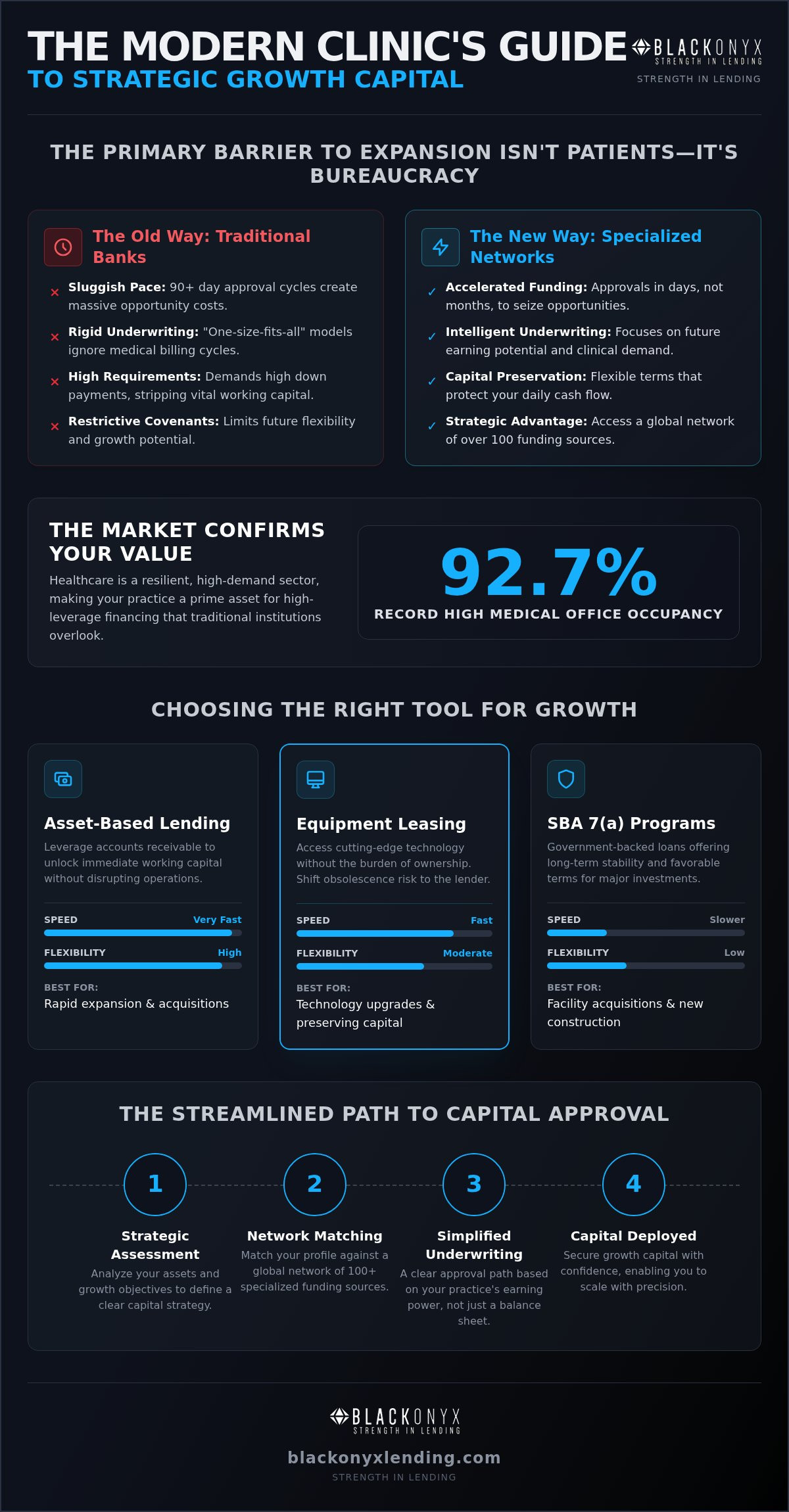
In 2026, the primary barrier to expanding your clinic isn’t a lack of patients; it’s the sluggish pace of traditional bank bureaucracy. With medical office occupancy hitting a record 92.7%, the demand for healthcare services is undeniable, yet many providers remain trapped by outdated medical practice financing options that move too slowly. You’ve likely felt the frustration of restrictive covenants and high down payment requirements that stall your momentum. If you rely solely on big banks, you’re often forced to choose between upgrading your technology and maintaining a healthy cash flow.
We believe your time is better spent on patient outcomes than on chasing loan officers. This guide provides a strategic roadmap to master the complex landscape of healthcare capital using non-bank lending and asset-based strategies. You’ll learn how to secure growth capital without disrupting your daily operations or falling behind the curve of technological obsolescence. From specialized equipment leasing to leveraging your accounts receivable, we provide the clarity you need to scale with precision and confidence. By the end of this guide, you’ll have the expert insights necessary to move from a state of limitation to one of significant opportunity.
Key Takeaways
- Bypass traditional bank bureaucracy by leveraging modern funding networks that prioritize clinical growth over rigid corporate red tape.
- Identify the most effective medical practice financing options to unlock liquidity, including strategic equipment leasing and sale-leaseback arrangements.
- Compare the immediate speed of asset-based lending against the long-term stability of SBA 7(a) programs to determine the best fit for your facility’s expansion.
- Navigate the specialized medical underwriting process with professional insights that simplify complex financial requirements into a clear path toward approval.
- Secure your practice’s competitive edge by accessing a global network of resources designed to minimize technology obsolescence and maintain healthy cash flow.
Defining Medical Practice Financing Options in 2026
Medical practice financing is a highly specialized subset of commercial lending designed to address the unique capital requirements of healthcare enterprises. Unlike generic business loans, these facilities account for the high overhead, complex reimbursement cycles, and specialized equipment costs inherent to modern medicine. Traditional bank-led financing often relies on static historical data, whereas modern alternative funding networks prioritize future earning potential and clinical demand. Medical practice financing serves as a primary catalyst for both clinical excellence and operational scalability in a competitive market.
Practices are uniquely positioned for high-leverage financing because healthcare remains a resilient sector with predictable demand. Record-high medical office occupancy rates, which reached 92.7% in early 2026, demonstrate the underlying strength of the asset class. This stability allows specialized lenders to offer more aggressive terms than what’s typically available to retail or industrial businesses. By viewing your practice as a strategic asset rather than just a balance sheet, specialized funding sources can unlock capital that traditional institutions overlook.
Why Traditional Bank Loans Often Fail Healthcare Providers
Big banks often apply a “one-size-fits-all” underwriting model that ignores the nuances of medical billing. If your practice faces a 60-day delay in insurance reimbursements, a traditional lender might view this as a cash flow red flag rather than a standard industry cycle. Their rigid credit requirements often demand high down payments for new equipment, which can strip a clinic of its vital working capital. This mismatch between bank policy and clinical reality often leads to restrictive covenants that limit your future flexibility.
The most significant hurdle is speed. Waiting 90 days or more for a bank approval creates a massive opportunity cost. While you wait for a loan officer to review your file, your competitors may be acquiring the latest diagnostic technology or expanding into a new territory. This bureaucratic friction often forces doctors to choose between growth and liquidity, a compromise that can hinder long-term success.
The Shift Toward Specialized Medical Finance
Strategic healthcare leaders are moving toward specialized medical finance to bypass these systemic hurdles. These lenders don’t just look at a balance sheet; they evaluate clinical assets and the value of your patient receivables. This specialized underwriting allows for higher capital amounts and more flexible repayment structures that align with your actual revenue patterns. It’s about finding medical practice financing options that respect the professional credentials and earning power of the provider.
Working with a firm that leverages over 100 funding sources provides a distinct competitive edge. It ensures that your practice isn’t beholden to the whims of a single institution’s risk appetite. While programs through the Small Business Administration (SBA) provide excellent long-term stability for facility acquisitions, alternative networks offer the speed and precision required for rapid equipment upgrades or practice acquisitions. This approach turns financing from a bureaucratic obstacle into a strategic advantage.
Equipment Leasing and Sale-Leaseback Strategies for Clinics
In the 2026 healthcare market, owning depreciating assets is often a strategic liability. High-value technology like 3D imaging systems or robotic surgical platforms can become clinically obsolete before the original loan is even half paid. Sophisticated providers prioritize access over ownership by utilizing medical practice financing options that separate the utility of the equipment from the burden of the balance sheet. This approach ensures your working capital remains liquid for operational expenses, recruitment, and patient acquisition rather than being trapped in hardware that loses value every day.
Maintaining a modern facility requires a constant cycle of reinvestment. If you choose to lease, you effectively shift the risk of technological obsolescence to the lender. This allows your clinic to cycle in the latest diagnostic tools every three to five years, ensuring you provide the highest standard of care without the friction of selling used equipment. For a deeper dive into these structures, see the strategic guide to commercial equipment leasing in 2026.
Leasing as a Hedge Against Technological Obsolescence
The pace of medical innovation in 2026 makes traditional ownership risky. If a more efficient diagnostic tool enters the market, owners are stuck with “sunk cost” bias, while lessees can simply upgrade at the end of their term. Most practices choose between two primary structures. A Fair Market Value (FMV) lease offers the lowest monthly payments and the most flexibility to return or upgrade the equipment. Conversely, a $1 Buyout lease functions more like a loan, where you own the asset for a nominal fee at the end of the term.
Tax advantages also play a critical role in this decision. Under current 2026 tax codes, Section 179 and bonus depreciation allow many practices to deduct the full purchase price of qualifying equipment in the year it’s put into service. This provides an immediate cash flow boost that can offset the cost of the lease itself. When you combine these tax benefits with the lower monthly outlay of a lease, the internal rate of return on the investment often far exceeds that of a traditional cash purchase.
Unlocking Capital via Sale-Leaseback Arrangements
If your practice already owns high-value assets like MRI machines or specialized surgical suites, you may be sitting on a significant source of untapped liquidity. A sale-leaseback allows you to sell these assets to a lender for their current appraised value and immediately lease them back for continued use. This process converts “dead equity” into immediate cash that can be used to fund a second practice location or bridge a working capital gap. It’s a brisk, efficient way to recapitalize your business without taking on traditional debt.
Consider a scenario where a growing oncology clinic needs $500,000 for a new satellite office. Instead of applying for traditional SBA loan programs, which may involve lengthy approvals and restrictive covenants, the clinic performs a sale-leaseback on its existing linear accelerator. They receive the cash in a fraction of the time, maintain full use of the machine, and pay for the expansion through the revenue the new location generates. If you’re looking to unlock similar liquidity, consulting on equipment strategies can provide the roadmap you need.
Comparing Asset-Based Lending and SBA 7(a) for Medical Growth
Choosing between government-backed stability and market-driven agility is a pivotal decision for healthcare executives. While many traditional banks push government products as a catch-all solution, different growth stages require distinct medical practice financing options. If you’re looking to anchor your practice with a permanent facility, the SBA 7(a) loan program offers unparalleled long-term security. However, if your goal is rapid expansion or bridging cash flow gaps, asset-based lending (ABL) provides the velocity that bureaucratic programs simply cannot match.
The SBA 7(a) Advantage for Facility Acquisition
The 7(a) program remains a powerful tool for practice acquisitions and real estate purchases due to its favorable repayment structures. In 2026, these loans offer terms up to 25 years for real estate and 10 years for equipment or working capital. This longevity ensures that your monthly debt service remains manageable while you scale. For practitioners, the primary draw is the low down payment requirement, which preserves your liquid cash for clinical operations.
Navigating the application process requires precision. SBA guarantee fees for fiscal year 2026 range from 2% to 3.75% of the guaranteed portion, and the documentation requirements are extensive. Working with a consultant ensures your business plan meets the specific “Five C’s of Credit” that lenders prioritize. If your priority is long-term stability over immediate speed, this program is your strongest tool for facility ownership.
Asset-Based Lending: Speed and Flexibility
Asset-based lending shifts the focus from your historical credit score to the tangible value of your balance sheet. By using your inventory and accounts receivable as primary collateral, you can unlock significant liquidity without the 90-day wait times common in traditional banking. This is particularly effective for practices experiencing high growth but dealing with fluctuating insurance reimbursements. Unlike SBA loans, ABL typically avoids the broad, restrictive liens that can hamper your future borrowing capacity.
ABL is a superior choice when you need to maintain working capital for small business operations while simultaneously funding a new venture. It integrates seamlessly with accounts receivable financing, allowing you to draw against your outstanding invoices. If your practice has a high volume of third-party billings, ABL turns those pending payments into immediate fuel for expansion. This flexibility allows you to bypass the systemic hurdles of traditional lending and maintain a decisive edge in your local market.
The Medical Underwriting Process: Preparing Your Practice for Approval
Underwriting is the bridge between your clinical vision and the capital needed to realize it. In 2026, this isn’t a passive event where you simply hand over tax returns and wait. It’s a strategic presentation of your practice’s health and future earning potential. While big banks often use automated systems that miss the nuances of healthcare revenue, modern medical practice financing options prioritize a comprehensive 5-step approach. This journey moves from initial consultation and document analysis to strategic packaging, lender matching, and final funding. Professional underwriting ensures that your practice’s narrative is framed to attract the most competitive terms available.
Supply chain management also plays a critical role in the approval process. Lenders want to see that you can manage large inventory orders without depleting your liquid reserves. Integrating purchase order financing into your operational strategy demonstrates a sophisticated understanding of cash flow management. It shows that you can scale up for high-volume seasons or new service lines without straining your primary credit facilities.
Phase 1: Financial Documentation and Performance Metrics
Your documentation must tell a story of consistency and clinical demand. Lenders require Profit and Loss (P&L) statements, debt schedules, and detailed Accounts Receivable (AR) aging reports. They specifically look for a Debt Service Coverage Ratio (DSCR) of at least 1.25x. This means your practice’s cash flow must be at least 125% of your total loan payment obligations. If your ratio is lower, professional consultants can help identify “add-backs” to reveal your true profitability.
Add-backs are non-recurring or discretionary expenses that won’t continue after a loan or acquisition. These might include one-time legal fees, excess owner compensation, or personal expenses run through the business. By adding these back to your EBITDA (Earnings Before Interest, Taxes, Depreciation, and Amortization), you present a much stronger financial profile. This adjustment often makes the difference between a standard approval and a high-leverage funding offer.
Phase 2: Strategic Consulting and Lender Matching
The most common mistake providers make is submitting a “cold” application to a single bank. This often results in a rejection that can damage your credit profile. Personalized consulting before submission allows you to address potential red flags and match your needs with the specific risk appetite of over 100 funding sources. Some lenders specialize in imaging centers, while others prefer primary care clinics; knowing which is which saves you weeks of wasted time.
Negotiation is the final hurdle. Your first offer is rarely the best one. A seasoned consultant acts as a strategic bridge, leveraging multiple offers to drive down interest rates and remove restrictive covenants. This proactive approach ensures you aren’t just getting capital, but getting it on terms that foster long-term growth. If you’re ready to move beyond the limitations of traditional banking, speak with a medical finance specialist today to begin your underwriting assessment.
Scaling Your Healthcare Enterprise with Black Onyx
Black Onyx operates as a seasoned, high-level consultant that acts as a strategic bridge between your clinical goals and the global capital markets. Our approach is brisk, direct, and intensely focused on results. We don’t just facilitate loans; we remove the bureaucratic obstacles that stall your momentum. By positioning ourselves as a powerful ally, we help you transition from a state of financial limitation to one of significant opportunity. Our team understands that for a modern provider, speed and precision are just as important as the interest rate.
We specialize in providing a diverse suite of medical practice financing options that go beyond what traditional banks offer. Whether you need sophisticated equipment leasing, asset-based financing, or a strategic sale-leaseback, our role is to streamline the path to capital. We respect your time by getting to the core of your needs quickly and providing actionable advice that supports your long-term competitive edge.
The Power of 100+ Funding Sources
Relying on a single-bank relationship is a strategic risk for any growing healthcare enterprise. If that bank changes its risk appetite or hits its lending limit for the healthcare sector, your expansion plans could grind to a halt. Black Onyx mitigates this risk by leveraging a network of over 100 funding sources. We create a competitive environment where lenders must vie for your business. This competition naturally drives down rates and forces more favorable terms that a single institution wouldn’t offer voluntarily.
This vast network also provides access to specialized medical capital pools that remain invisible to traditional commercial banks. These lenders understand the specific value of healthcare assets and patient receivables, allowing for higher leverage and more flexible structures. We match your practice’s specific needs with the lender most likely to approve your facility, ensuring a higher success rate and faster funding cycles.
Global Reach, Local Expertise
While we are headquartered in Troy, Michigan, our reach is truly global. With a presence in Canada, the UK, and Australia, we bring international financing perspectives to local medical practices. This global footprint allows us to leverage international financing partners for global medical brands or practitioners looking to expand across borders. We combine this high-level reach with the individualized attention of a boutique consultancy.
Your practice deserves a partner that is as ambitious as you are. We don’t settle for the status quo; we challenge conventional wisdom to find the most efficient path to growth. If you’re ready to secure capital without disrupting your daily operations, it’s time for a professional assessment. Contact Black Onyx today for a personalized financial consultation and take the first step toward scaling your enterprise with precision.
Securing Your Competitive Edge in the 2026 Healthcare Market
The transition from a state of limitation to one of significant opportunity depends on how quickly you can deploy capital. By moving beyond the friction of traditional banking, you’ve discovered how strategic equipment leasing and asset-based lending preserve your cash flow during expansion. Mastering the modern landscape of medical practice financing options ensures that your clinic remains a leader in clinical innovation rather than a victim of technological obsolescence. If you’re ready to bypass bureaucratic hurdles, professional underwriting is your most powerful tool for sustainable growth.
Black Onyx serves as a strategic bridge, connecting healthcare providers with a network of over 100 global funding sources. Based in Troy, Michigan, with an established reach across Canada, the UK, and Australia, we provide the individualized attention required for complex financial transformations. Our expert underwriting for healthcare professionals is designed to streamline approvals and maximize your leverage. Accelerate your practice’s growth with a Black Onyx Medical Finance consultation today. Your clinic’s next chapter of expansion is within reach; we’re here to ensure you move forward with absolute precision.
Frequently Asked Questions
What is the fastest way to secure medical practice financing in 2026?
The fastest route involves bypassing traditional bank bureaucracy in favor of alternative funding networks that use specialized underwriting. While big banks may take 90 days for approval, non-bank lenders often provide funding in a fraction of that time by focusing on your earning potential and clinical demand. Leveraging a network of over 100 funding sources allows you to find lenders who prioritize speed and have a higher risk appetite for healthcare growth.
Can I get financing for medical equipment if I have less-than-perfect credit?
You can secure equipment financing even with credit challenges by utilizing asset-based structures or specialized leasing programs. These medical practice financing options focus on the value of the equipment itself and your practice’s cash flow rather than just a personal credit score. By positioning the equipment as collateral, lenders mitigate their risk; this allows you to upgrade your technology and maintain clinical excellence without a perfect credit history.
How does a medical sale-leaseback work and what are the benefits?
A medical sale-leaseback involves selling your owned assets, such as imaging machines or surgical suites, to a lender for their appraised value and immediately leasing them back. This strategy converts “dead equity” into immediate liquidity for expansion or working capital. You maintain full use of the equipment while improving your balance sheet and potentially gaining tax advantages through lease payment deductions. It’s an efficient way to recapitalize without taking on traditional debt.
Is SBA 7(a) or asset-based lending better for a new medical clinic?
The choice depends on your specific growth goals and timeline. SBA 7(a) loans are superior for long-term facility acquisition because they offer low down payments and terms up to 25 years. However, if you need capital quickly to bridge cash flow gaps or purchase equipment, asset-based lending is the better tool. It provides more flexibility and speed, allowing you to scale without the bureaucratic delays common in government-backed programs.
What documents are required for a medical practice loan application?
You should prepare a comprehensive financial package to streamline the underwriting process. Essential documents typically include:
- Three years of Profit and Loss (P&L) statements.
- Current Accounts Receivable (AR) aging reports.
- Existing debt schedules and recent bank statements.
- A detailed business plan for expansion or acquisition.
Presenting “add-backs” for non-recurring expenses also helps demonstrate your practice’s true profitability to potential lenders.
How do I use accounts receivable to improve my practice’s cash flow?
You can use accounts receivable financing to unlock the value of your outstanding insurance billings and patient invoices. Instead of waiting 60 or 90 days for reimbursements, you receive an immediate advance based on the value of those receivables. This ensures you have the liquidity to cover payroll and operational costs while you scale. It’s a results-oriented strategy that turns pending payments into active working capital for your clinic.
Does Black Onyx provide financing for medical practices outside of Michigan?
Black Onyx operates with a global reach that extends far beyond our headquarters in Troy, Michigan. We serve healthcare providers throughout the United States and leverage international financing partners in Canada, the United Kingdom, and Australia. This extensive network ensures that your practice has access to global capital resources regardless of your physical location, providing a strategic bridge to over 100 diverse and specialized funding sources.
Can I finance medical supplies through purchase order financing?
You can utilize purchase order financing to manage large-scale medical supply needs without depleting your primary cash reserves. This facility allows you to pay suppliers for critical inventory or high-volume equipment orders before you bill your patients. It’s an essential tool for scalable growth in 2026, ensuring that supply chain constraints don’t limit your clinical capacity. This approach maintains your operational momentum during periods of rapid expansion or seasonal demand.