


Why does a record-breaking sales month often trigger a liquidity crisis instead of a celebration? If your cash is trapped in unpaid invoices while your payroll obligations continue to mount, you’ve experienced the “growth trap” firsthand. It’s a common reality for ambitious leaders who find that traditional bank requirements often tighten exactly when the business needs to expand. Securing the right working capital for small business operations isn’t just about finding a loan; it’s about aligning your debt structure with your actual cash cycle.
If you understand the mechanics of your cash flow, then you can transform your balance sheet from a limitation into a strategic advantage. This article promises to help you master those mechanics and identify the specific funding models, from accounts receivable financing to asset-based structures, that support sustainable growth. We’ll preview the 2026 Strategic Readiness Checklist, covering essential updates like the new SBA SOP 50 10 8.1 underwriting standards and the current 6.75% prime rate environment. You’ll gain a clear roadmap to move beyond stagnant bank applications and toward a funding strategy that scales as fast as your sales.
Key Takeaways
- Identify the specific mathematical signals lenders use to determine if your business is a high-risk or high-opportunity candidate for funding.
- Discover how to unlock immediate liquidity from your balance sheet by using asset-based structures that traditional banks often overlook.
- Master the 2026 strategic checklist to ensure your application for working capital for small business meets the latest, more conservative underwriting standards.
- Learn why a rejection from a traditional bank is often a reflection of their rigid internal limits rather than your company’s actual creditworthiness.
- Access a roadmap for connecting with over 100 diverse funding sources to find the exact capital structure that mirrors your unique operational cycle.
What is Working Capital for Small Business?
Working capital isn’t just a static figure on a financial statement. It’s the actual fuel that keeps your business moving. It represents the liquid funds available for your company’s day-to-day operations, ensuring you can pay employees, purchase raw materials, and keep the lights on without waiting for your next big invoice to clear. If you view your business as an engine, then working capital for small business success is the oil that prevents the gears from seizing during periods of high-speed growth.
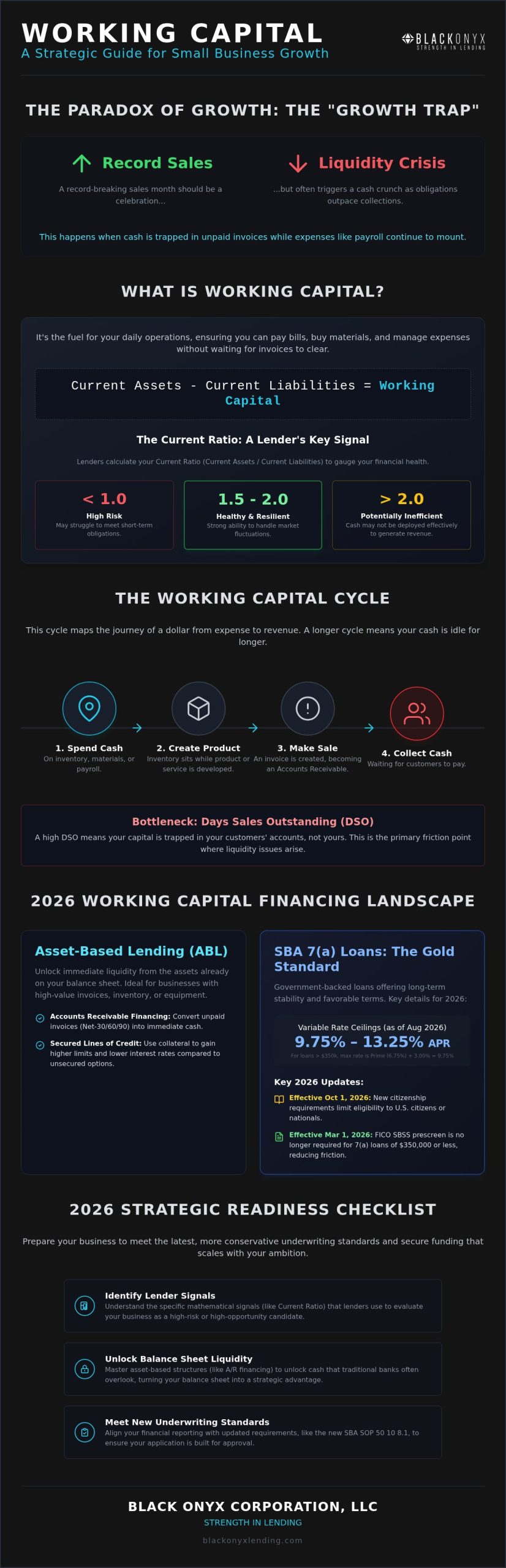
To understand your current position, you must master the mathematical foundation of What is Working Capital? by subtracting current liabilities from current assets. Lenders use this to calculate your “current ratio,” which serves as a primary signal of your creditworthiness. A ratio below 1.0 indicates you may struggle to meet short-term obligations, while a ratio closer to 2.0 suggests you have the resilience to handle market fluctuations. If your ratio is too high, it might actually signal that you aren’t deploying your cash efficiently enough to generate new revenue.
Maintaining positive working capital for small business health is the definitive indicator that your enterprise is self-sustaining. You also need to recognize the difference between permanent and temporary needs. Permanent working capital is the minimum level of current assets required to conduct operations even during your slowest months. Temporary working capital is the additional liquidity needed to cover seasonal peaks, sudden project surges, or bulk inventory opportunities that require immediate cash outlays.
The Working Capital Cycle Explained
This cycle maps the entire journey of a dollar, from the moment you spend it on inventory to the moment you collect it as revenue. Bottlenecks typically appear when inventory sits too long or when customers take their time to pay. Days Sales Outstanding (DSO) represents the average number of days your company takes to collect payment after a sale has been made; a high DSO indicates that your capital is trapped in your customers’ bank accounts instead of your own. Identifying these friction points allows you to optimize your collection process and reduce the time your cash stays idle.
Common Signs Your Business is Under-Capitalized
Many leaders don’t realize they’re under-capitalized until they hit a wall. If you’re experiencing any of the following, your current financial structure isn’t supporting your scale:
- Difficulty meeting payroll during seasonal lulls or in the gaps between major project milestones.
- Missing out on significant bulk-purchase discounts from suppliers because you can’t afford the upfront cash outlay.
- Turning down large, lucrative contracts because you lack the fulfillment capital to start the work or hire necessary staff.
Recognizing these symptoms early is the first step toward moving from a state of limitation to one of significant opportunity. Once you diagnose the gap, you can begin structuring the right financing to bridge it.
Types of Working Capital Financing for 2026
Selecting the right vehicle for working capital for small business growth requires a shift from reactive borrowing to strategic alignment. While a standard credit card might cover minor office expenses, high-growth operations require structures that leverage the balance sheet itself. Asset-based lending (ABL) allows you to unlock liquidity from accounts receivable, inventory, or equipment. If you choose a secured business line of credit over an unsecured option, you’ll typically benefit from higher limits and lower interest rates because the lender’s risk is mitigated by tangible collateral.
For long-term stability, SBA 7(a) loans remain the gold standard. As of August 2026, variable-rate ceilings for these loans range from 9.75% to 13.25% APR. If your loan amount exceeds $350,000, the maximum rate is capped at Prime plus 3.00%, which currently totals 9.75% based on the 6.75% prime rate. It is vital to recognize that starting October 1, 2026, new citizenship requirements will take effect, limiting eligibility to U.S. citizens or nationals. Additionally, as of March 1, 2026, the SBA no longer requires the FICO Small Business Scoring Service (SBSS) prescreen for 7(a) small loans of $350,000 or less, significantly reducing bureaucratic friction for agile firms.
Leveraging Your Assets for Growth
If your cash is trapped in net-30 or net-60 terms, accounts receivable financing converts those outstanding invoices into immediate working capital. This approach is particularly effective for companies that have outpaced their credit history but possess a strong roster of creditworthy customers. Similarly, using inventory financing for small business allows you to stockpile materials ahead of peak seasons without draining your operating cash. These Types of Working Capital Financing ensure that your balance sheet works as hard as your sales team.
Fulfillment-Based Financing
For manufacturers and distributors, the challenge isn’t just collecting cash; it’s funding the production of new orders. Purchase order financing provides the capital to pay suppliers directly, allowing you to accept contracts that would otherwise be out of reach. Unlike factoring, which relies on completed work, PO funding looks forward at your future revenue. This distinction is critical for scaling. Niche industries like medical or manufacturing benefit from this precision. If you need a partner who understands these nuances, consulting with a strategic bridge to capital can help you navigate the 100+ funding sources available to modern enterprises.
Why Traditional Banks Often Fail Small Businesses
Traditional institutions are currently operating under a cloud of caution. As the federal funds target remains at 3.50%-3.75% following the July 2026 meeting, banks have responded by widening the “Credit Gap,” making working capital for small business harder to secure through conventional channels. The new SBA SOP 50 10 8.1, effective October 1, 2026, reinforces this shift toward conservative underwriting by placing a greater emphasis on historical cash flow rather than future projections. If you rely solely on a local bank, then you are subject to rigid algorithms that prioritize past performance over your current growth trajectory.
A rejection from a traditional lender isn’t a verdict on your company’s viability; it’s often just a sign that you don’t fit their narrow risk profile. Banks typically demand “all-asset” liens or personal guarantees that put your private residence and savings at risk. This creates a state of limitation for owners who want to protect their families while growing their commercial interests. In contrast, alternative commercial lenders focus on the strength of your balance sheet. This difference in perspective allows for a much faster speed of execution. While a bank might take 90 days to process a term loan, an asset-based lender can often provide liquidity in a fraction of that time, moving you from stagnation to progress.
The Non-Bank Advantage
Alternative lenders prioritize your current assets and cash flow over a perfect FICO score. This flexibility is essential in a shifting economic landscape where traditional credit metrics often lag behind real-world performance. If you leverage structured finance, you can access capital based on the value of your accounts receivable or equipment rather than your personal credit history. Navigating this vast market requires professional consulting to ensure you find a source that matches your specific operational cycle. You can explore various Ways to Get Working Capital, but a strategic bridge to capital is often the most efficient route for busy professionals.
Overcoming the “Bad Credit” Stigma
“Bruised” credit or a short time-in-business shouldn’t stall your momentum. Asset-based financing provides a viable path to credit rehabilitation by focusing on the quality of your collateral, such as unpaid invoices or specialized equipment. If your business plan is compelling and your underwriting is handled by seasoned experts, then your personal credit score becomes a secondary concern. This approach allows you to secure working capital for small business expansion while simultaneously building the financial track record needed for future traditional financing. By moving beyond the stigma of a low score, you can focus on the tangible assets that drive your company’s value and competitive edge.
The Small Business Working Capital Readiness Checklist
Preparing for a capital injection requires more than just filling out a form. It demands a rigorous internal audit to ensure your business can actually digest the debt you’re seeking. If you want to secure working capital for small business operations in a conservative lending environment, you must follow a structured path to ensure your enterprise is “lender-ready.” Preparation prevents the friction of repeated rejections and positions you as a low-risk, high-opportunity candidate.
- Step 1: Conduct a comprehensive cash flow audit. You must determine your exact funding gap rather than guessing at a round number. A precise request signals professional management.
- Step 2: Organize your financial statements. Lenders expect current P&L statements, balance sheets, and AR aging reports to be accurate and ready for immediate review.
- Step 3: Define your specific ROI. If you’re borrowing to buy inventory, calculate the projected margin. If you’re covering payroll, identify the specific contract that will provide the repayment funds.
- Step 4: Evaluate your collateral. Leveraging tangible assets often lowers your cost of credit and improves your approval odds.
- Step 5: Identify the right funding partner to source working capital for small business needs. Decide if a direct lender or a strategic broker with a broader pool of resources fits your long-term goals.
Documentation You Must Have Ready
Lenders prioritize “The Big Three”: Balance Sheets, Income Statements, and Cash Flow Statements. However, your AR aging report is often your most valuable asset during the underwriting process. It proves the creditworthiness of your customers and the reliability of your future cash inflows. You should also prepare a formal use-of-funds statement. This document builds lender confidence by showing exactly how the capital will drive revenue or improve operational efficiency.
Selecting Your Financing Structure
Choosing the wrong structure can lead to a debt trap. You must compare interest rates against factoring fees and lease payments to find the lowest effective cost. For example, commercial equipment leasing can preserve your liquid cash for other needs by financing equipment separately. Match your loan terms to the life of the asset or your sales cycle. If your cycle is 60 days, a 30-day repayment schedule will create unnecessary friction. To find the structure that fits your specific cycle, you can consult with a professional underwriting specialist to review your options. Healthcare providers navigating these same decisions can benefit from exploring specialized medical practice financing options that are tailored to the unique cash flow dynamics of clinical operations.
Strategic Funding Solutions with Black Onyx Corporation, LLC
Local banks often operate within the narrow confines of their own balance sheets, which creates a “one-size-fits-all” trap for growing companies. If your business doesn’t fit their standard template, you’re likely to face a rejection that has nothing to do with your actual potential. Black Onyx Corporation, LLC removes these bureaucratic obstacles by acting as a strategic bridge to a global network of over 100 funding sources. This vast range of options ensures you receive competitive terms that align with your specific operational cycle rather than being forced into a rigid, outdated loan structure.
By focusing on personalized underwriting instead of automated “fintech” algorithms, we identify the value in your assets that traditional lenders miss. Our team provides specialized professional underwriting services that streamline the approval process, moving you from a state of limitation to one of significant opportunity. Whether you’re based near our localized consulting hub in Troy, MI, or operating across the US, Canada, Australia, or the UK, Black Onyx Corporation, LLC maintains a boutique consulting feel while delivering global reach. Our results-oriented approach emphasizes the removal of systemic hurdles to foster a sense of momentum for your enterprise.
Our Professional Consulting Approach
We don’t just provide a list of lenders; we act as your high-level consultant to navigate the commercial lending market. If you’re managing a complex growth stage, our fee-based finance management provides the precision needed to maintain your competitive edge. Black Onyx Corporation, LLC specializes in managing the complexities of SBA loans, ensuring your application meets the latest standards without the typical administrative delays. This supportive, advisory undertone ensures you aren’t just getting working capital for small business growth; you’re getting a long-term strategic ally focused on your success.
Ready to Fuel Your Growth?
The path to predictable cash flow starts with a clear assessment of your current financial standing. If you’re ready to secure a working capital for small business structure that scales with your sales, then a personalized consultation is the first step. Our rapid underwriting process is designed to respect the time of busy professionals, getting you from application to funding with precision and speed. Don’t let slow-paying customers or rigid bank policies stall your momentum. Schedule your strategic financing consultation with Black Onyx Corporation, LLC today and move your business toward its next phase of progress.
Mastering Your 2026 Growth Trajectory
The transition from liquidity limitations to significant opportunity depends on your ability to look beyond traditional bank constraints. By mastering the mechanics of your cash cycle and utilizing the 2026 readiness checklist, you’ve already taken the first step toward a more resilient balance sheet. If you align your funding structure with your actual operational needs, then you’ll ensure that growth never outpaces your ability to fund it. Strategic working capital for small business is the foundation of long-term stability and competitive edge in an evolving market.
Black Onyx Corporation, LLC acts as your strategic bridge, providing expert underwriting and personalized consulting to navigate over 100 commercial funding sources across the US, UK, Canada, and Australia. We specialize in removing bureaucratic obstacles so you can focus on scaling your enterprise with confidence. It’s time to move toward a future of predictable cash flow and sustainable expansion. Secure Your Strategic Working Capital with Black Onyx Corporation, LLC and take command of your company’s financial momentum today. Your next phase of progress is within reach.
Frequently Asked Questions
What is the standard formula for calculating working capital?
The standard formula for calculating working capital is Current Assets minus Current Liabilities. This calculation provides a snapshot of your company’s short-term liquidity and its ability to cover immediate operational costs. If your assets exceed your liabilities, then you have positive working capital. Lenders use this figure to determine if your business is healthy enough to manage debt without disrupting daily activities like payroll or inventory procurement.
How much working capital should a small business ideally have on hand?
Ideally, a small business should maintain a current ratio between 1.2 and 2.0 to ensure operational stability. The specific amount depends on your industry’s sales cycle and overhead. If you have significant seasonal fluctuations, then you may need a larger cash cushion to bridge revenue gaps. Maintaining enough liquidity to cover three to six months of operating expenses is a common benchmark for high-growth firms.
Can I qualify for a working capital loan with a low credit score?
Yes, you can qualify for working capital for small business growth even with a “bruised” credit score by utilizing asset-based financing. Alternative lenders prioritize the value of your collateral, such as accounts receivable or equipment, over your personal FICO score. If you have creditworthy customers or tangible assets, then your credit history becomes a secondary concern during the professional underwriting process.
What is the difference between a working capital loan and a line of credit?
A working capital loan provides a one-time lump sum of cash for a specific purpose, while a line of credit offers revolving access to funds. With a line of credit, you only pay interest on the amount you actually draw. If you need a predictable amount for a major project, then a loan is appropriate. If you face unpredictable cash flow gaps, a line of credit offers more flexibility.
How fast can a small business typically receive working capital funding?
Funding speed varies by lender, but alternative commercial sources can often provide liquidity within 24 to 72 hours. While traditional bank loans may take 60 to 90 days due to rigid underwriting, asset-based structures move much faster. If your documentation is organized and your assets are verifiable, then professional consultants can streamline the approval process to meet urgent payroll or inventory needs without delay.
Do I always need to provide collateral for a working capital loan?
No, you don’t always need collateral, but unsecured options typically carry higher interest rates and lower limits. Asset-based financing uses your balance sheet to secure more competitive terms and higher funding amounts. If you leverage your accounts receivable or equipment, then you can access larger pools of capital. This structure reduces the lender’s risk while preserving your personal assets from unnecessary liens.
How do working capital loans affect my business credit score?
Working capital loans can improve your business credit score if the lender reports your payment history to major credit bureaus. Consistent, on-time repayments demonstrate financial reliability and lower your perceived risk profile. If you use these funds to pay off high-interest debt or bridge gaps that would otherwise lead to late payments, then you are actively strengthening your company’s long-term creditworthiness.
What are the most common uses for working capital in 2026?
In 2026, the most common uses for working capital for small business include inventory stockpiling, payroll coverage during growth spurts, and capturing bulk-purchase discounts. Many firms also use these funds to bridge the gap created by slow-paying customers or to fund the production of large purchase orders. Strategic use of capital allows you to accept lucrative contracts that your current cash flow cannot immediately support.