


If you believe your financial statements speak for themselves, you’re likely handing a lender a reason to say no. In a 2026 market where commercial loan rates fluctuate between 5.41% and 12.75%, success requires more than just submitting paperwork. Engaging in professional commercial underwriting consulting allows you to identify red flags before a bank ever sees them. It’s frustrating to wait weeks for a rejection that feels arbitrary, but you can change the narrative by presenting a deal that is mathematically undeniable.
This strategic shift moves you from a hopeful applicant to a high-certainty investment. If you pre-package your risk according to modern liquidity and debt service coverage standards, then you gain the leverage to demand better interest rates and terms. This isn’t just about documentation; it’s about removing bureaucratic friction to foster immediate momentum for your business. When you approach a lender with a deal that is already vetted, you transform from a risky prospect into a strategic partner.
This article outlines the 2026 business loan readiness checklist to help you secure faster approvals and better funding. We’ll explore how to navigate the new CFPB 1071 data reporting rules and how a seasoned consultant acts as the bridge between your specific industry needs and the right global capital resources.
Key Takeaways
- Identify the critical shift from bank-centric to consultant-led underwriting to avoid the “slow no” from traditional lenders.
- Master the modern 5 Cs of Credit by aligning your operational cash flow with the disciplined risk metrics required in the 2026 market.
- Leverage commercial underwriting consulting to pre-package your loan application, turning complex deal structures into high-certainty investments for capital providers.
- Follow a comprehensive 2026 Readiness Checklist to ensure your financial hygiene and business narrative meet the strict documentation standards of global funding sources.
- Learn how a strategic bridge to over 100 specialized lenders can secure better interest rates and terms tailored to your specific industry.
What is Commercial Underwriting Consulting in 2026?
Commercial underwriting consulting is a professional service that pre-evaluates a business’s creditworthiness and financial health before any formal lender submission. It’s the difference between guessing your eligibility and knowing your standing. In a 2026 market where lenders have adopted more disciplined and conservative standards, this service has shifted from a bank-owned process to a consultant-led strategy. If you want to understand the foundational mechanics of risk assessment, you can explore What is Underwriting? to see how banks traditionally view your data. Today, that assessment has moved into the hands of independent experts who work for the borrower rather than the institution.
Many traditional lenders now rely on automated underwriting software to process applications. While this technology can decrease processing times, it frequently triggers false rejections for growing firms with complex deal structures or non-traditional assets. A consultant acts as a strategic advocate who “speaks lender” to bridge the communication gap. They ensure your financial narrative isn’t lost in a rigid algorithm, allowing you to present a case that highlights strength where a machine might only see risk. If a bank rejection has left you questioning your options, personalized business loan consulting can transform your financial narrative into a high-grade investment prospect that resonates with the right capital providers.
Underwriting vs. Brokering: Knowing the Difference
A broker typically focuses on the match between a borrower and a lender. In contrast, commercial underwriting consulting focuses on the “package” and comprehensive risk mitigation. This deep-dive financial analysis prevents the “slow no” that often comes from credit committees weeks after an application is filed. Black Onyx integrates both functions, providing a seamless path from strategic consulting to funding through a global network of over 100 sources. We don’t just find a lender; we prepare your business to be an irresistible investment for them.
The Value of Independent Financial Oversight
Lenders in 2026 have a heightened focus on liquidity and Debt Service Coverage Ratios (DSCR). Independent oversight allows you to identify “red flag” ratios before a bank officer ever sees them. By strategically positioning your debt-to-income metrics and capital reserves, you present a stronger case for approval. Underwriting consulting is the proactive management of lender expectations through rigorous financial preparation and risk transparency. This oversight ensures your business plan and use of proceeds align perfectly with the specific requirements of modern credit committees.
The Strategic Underwriting Framework: How Risk is Measured
Risk measurement isn’t a static calculation. In 2026, the traditional 5 Cs of Credit (Character, Capacity, Capital, Collateral, and Conditions) remain the bedrock of lending, but their interpretation has evolved into a more nuanced, data-driven exercise. While a bank officer might look for reasons to decline a file based on rigid character assessments, commercial underwriting consulting focuses on building a defensible narrative. This includes ensuring compliance with the Customer Identification Program Rule, which has become a foundational component of modern risk assessment at the federal level. If you can demonstrate high-level character through transparency and regulatory alignment, then you’ve already cleared the first hurdle of the credit committee.
Modern risk metrics have moved beyond the simple balance sheet to prioritize operational cash flow and market position. Consultants use industry-specific benchmarking to justify loan requests, comparing your performance against top-tier peers to prove stability. For instance, the latest medical equipment financing trends show that lenders now value specialized technology as a core driver of revenue rather than just a depreciating asset. This strategic positioning allows healthcare providers to secure capital by proving how new equipment will directly expand their capacity to serve patients.
Advanced Cash Flow Analysis
A standard bank algorithm often struggles with EBITDA adjustments and seasonal fluctuations. If you rely on raw tax returns alone, then you risk a rejection based on “one-time” expenses that don’t reflect your true repayment ability. Professional underwriting analyzes adjusted cash flows to show your actual liquidity. Integrating accounts receivable financing can also strengthen your balance sheet by accelerating cash cycles, making your business appear more robust to potential funders. This level of detail ensures that your funding request is backed by a realistic, high-velocity financial story.
Collateral Valuation Strategies
Lenders in 2026 are increasingly conservative regarding asset values. Underwriting consultants help you navigate the difference between liquidation value and fair market value to ensure you aren’t under-leveraged. By utilizing commercial equipment leasing, you can preserve working capital while still providing the lender with the security they require. This approach treats hard assets as strategic tools for growth rather than just static collateral. If you want to see how these valuation strategies apply to your specific industry, you can explore our business consulting services to begin your strategic preparation.
Consultant vs. Bank Officer: Why Independence Matters
The fundamental difference between a bank officer and an independent consultant lies in their primary mandate. A bank underwriter is a gatekeeper whose objective is to protect the institution’s capital by identifying reasons to decline risk. If your application has a single blemish, they’re incentivized to find a reason to say no. Conversely, the mandate of commercial underwriting consulting is to protect the client by finding ways to mitigate risk for a successful approval. A consultant works to identify and resolve red flags before the file ever hits a lender’s desk. This distinction is critical because bank officers often can’t provide the “real” reason for a decline due to internal liability policies or rigid corporate guidelines.
Access to information is another major hurdle. When you work with a single bank, you’re limited to their specific credit appetite and internal policy. An independent firm acts as a strategic bridge to a global network of over 100 funding sources, including private credit and non-bank institutional lenders. They understand how underwriters evaluate business risk across different platforms, allowing them to match your business with a lender that is actively seeking your specific industry profile.
Breaking the ‘One-Bank’ Bottleneck
Relying on a single institution creates a dangerous dependency. If that bank’s appetite for your sector changes, your funding dries up. Engaging in business financial consulting opens doors to institutional capital that traditional banks often overlook. Consultants know which lenders are currently “hungry” for your specific industry, whether you’re in healthcare or heavy manufacturing. Strategic pre-packaging has been shown to reduce loan processing times by as much as 40% because it eliminates the repetitive clarification cycles that stall traditional applications. For high-growth firms that have already encountered the limitations of traditional institutions, exploring commercial financing without bank involvement can open access to more agile and flexible capital structures that align with your operational pace.
Avoiding the Conflict of Interest
Bank officers are essentially product specialists for their specific institution. They’re often incentivized to sell certain loan products that might not be the most efficient fit for your actual capital gap. A consultant’s role is to negotiate the fine print, including interest rates, covenants, and personal guarantees, to ensure the deal favors your business. Independent oversight ensures the loan structure serves the business’s long-term growth, not just the lender’s security. This level of advocacy ensures that your funding partner understands your specific operational needs rather than just your collateral value.
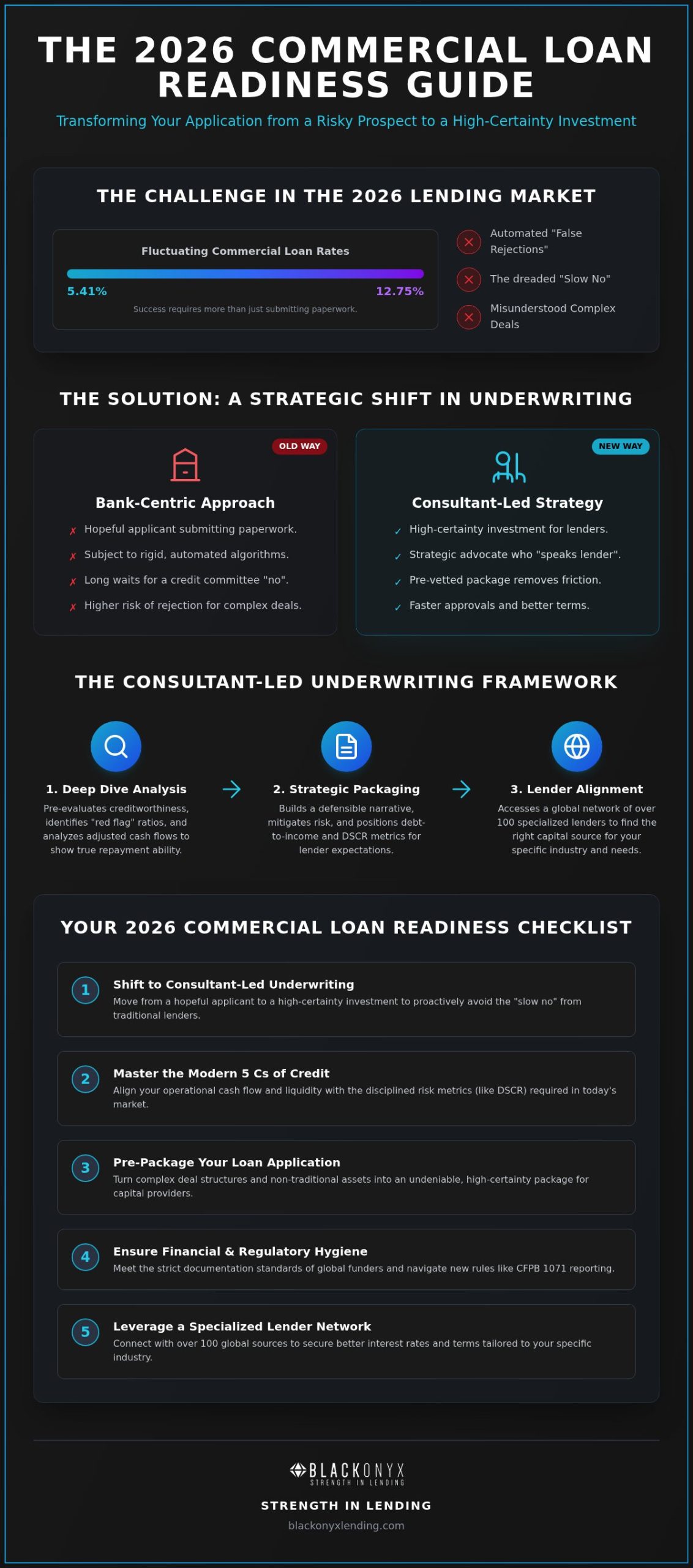
The 2026 Commercial Loan Readiness Checklist
Submission isn’t the beginning of the funding process; it’s the culmination of rigorous preparation. In a market where lenders have tightened their belts, commercial underwriting consulting ensures your application is bulletproof before a single bank officer opens the file. If you treat the application as a first draft, then you’re inviting a “slow no” that wastes weeks of operational time. This checklist serves as your roadmap to move from a risky prospect to a high-certainty investment by addressing five critical pillars: financial hygiene, strategic narrative, asset documentation, compliance, and the pro-forma stress test.
Phase 1: The Documentation Sprint
Clean data is the primary language of modern credit committees. You must gather three years of clean, consistent financial statements, including tax returns, P&L statements, and aging reports. If you’re pursuing SBA loans, preparing a precise Personal Financial Statement (PFS) is a non-negotiable requirement that often causes the most significant delays. Ensure all tax transcripts are ready for 4506-C verification to avoid bureaucratic hurdles. If your internal records don’t match your tax filings, then you must reconcile these discrepancies before submission to maintain your credibility.
Phase 2: The Strategic Narrative
Numbers tell part of the story, but the narrative provides the context that software algorithms often miss. Your “Use of Proceeds” statement must justify the ROI for the lender by showing exactly how the capital fuels measurable growth. Proactively addressing past credit issues or “hair” on the deal allows you to control the conversation rather than reacting to a lender’s concerns. A consultant helps refine your business plan to meet 2026 economic outlook standards, focusing on operational resilience and your specific competitive edge in the current market. Working with experts in personalized business loan consulting ensures your financial story is crafted to meet the precise expectations of today’s most active capital providers.
Phase 3: The Pre-Submission Audit
The final step is a mock “Credit Committee” review designed to identify weak points in your package. You must verify that all collateral values, from real estate to equipment lists and UCC filings, match current market appraisals rather than outdated book values. Conduct a sensitivity analysis on your pro-forma projections to ensure your Debt Service Coverage Ratio (DSCR) remains compliant even if interest rates shift or revenue targets are delayed. This level of independent oversight ensures that the loan structure serves your long-term growth. To begin your audit, connect with our business consulting team to secure a strategic advantage before you apply.
Partnering with Black Onyx: Your Strategic Underwriting Ally
Success in the 2026 lending environment requires a partner who understands the nuance of risk as well as you understand your business. Black Onyx provides specialized commercial underwriting consulting that bridges the gap between your operational goals and the strict requirements of institutional capital. We combine over 20 years of financial expertise with a global network of more than 100 third-party funding sources. This scale allows us to move beyond the limitations of local banks, providing you with direct access to decision-makers who are actively looking to deploy capital in your sector.
The “Black Onyx Advantage” is built on high-velocity precision. If you’ve struggled with the “slow no” from traditional institutions, then our proactive approach offers the transformation you need. We specialize in navigating complex deal structures, including SBA loans, asset-based financing, and equipment leasing. By pre-vetting your application against current market dynamics, we remove the bureaucratic obstacles that typically stall the funding process. This high-level commercial underwriting consulting ensures your business is positioned as a high-certainty investment from the very first submission.
A Tailored Approach to Commercial Capital
Our consulting begins with your specific business objectives rather than a rigid lender checklist. We provide specialized underwriting for niche industries such as medical, manufacturing, and logistics, where standard bank algorithms often fail to capture the true value of your assets. Being headquartered in Troy, MI, gives us a grounded, professional perspective, while our global reach ensures you aren’t limited by geography. We act as a bold innovator for our clients, challenging conventional lending wisdom to secure the interest rates and terms you deserve.
Getting Started: The Path to Funding
Your journey toward a strategic funding partnership begins with an initial diagnostic. We assess your current loan-readiness and identify any red flags that could hinder your progress. From there, we develop a strategic financing roadmap that aligns your capital needs with the most efficient funding sources available. This methodical progression creates clarity and steady forward movement for busy professionals who cannot afford to waste time on uncertain prospects. Contact Black Onyx today for a professional underwriting consultation and take the first step toward securing your business’s long-term competitive edge.
Securing Your Capital Advantage in 2026
The commercial lending landscape is more disciplined than ever, but your business doesn’t have to be a victim of rigid bank algorithms. By utilizing professional commercial underwriting consulting, you shift the power dynamic in your favor. Independence is your greatest asset. A consultant acts as your advocate to bridge the gap to over 100 third-party funding sources. If you pre-package your risk according to modern standards, then you gain the leverage to demand better terms. Whether you’re navigating SBA loans, asset-based financing, or equipment leasing, your success depends on a strategic package that forces a “yes” from credit committees. Businesses that have already outgrown their traditional lender’s appetite are increasingly turning to commercial financing without bank constraints to access the flexible capital structures that match their growth trajectory.
Black Onyx provides this high-velocity precision from our headquarters in Troy, Michigan, offering a global perspective that local banks simply can’t match. We remove the bureaucratic friction that stalls your progress and replace it with a clear roadmap to capital. It’s time to move from a state of limitation to one of significant opportunity with a partner who understands your specific industry.
Secure Your Commercial Funding with Black Onyx Consulting
Your business deserves a funding partner that is as ambitious as your growth plans. Let’s build your financial future together.
Frequently Asked Questions
What is the difference between a commercial loan broker and an underwriting consultant?
A commercial loan broker focuses on matching a borrower with a potential lender to earn a commission. In contrast, commercial underwriting consulting involves a deep-dive analysis into your financial health to mitigate risks before submission. While brokers focus on the “match,” consultants focus on the “package.” This proactive approach identifies red flags that lead to rejections. By pre-vetting your file, you ensure your business meets the specific criteria of modern credit committees.
How long does the commercial underwriting process typically take in 2026?
Timelines in 2026 vary based on the complexity of the deal and the lender’s technology. Digital lending platforms can decrease processing times by as much as 40%, but traditional SBA 7(a) or 504 loans still require meticulous documentation. Generally, the preparation phase takes one to two weeks. Once submitted, approval can range from a few days for asset-based financing to several weeks for government-guaranteed programs. Strategic preparation significantly reduces the back-and-forth cycles that stall most applications.
Can an underwriting consultant help if I’ve already been rejected by a bank?
Yes, a consultant is often most valuable after a rejection. Traditional banks often issue a “no” based on rigid software algorithms or narrow internal policies. A consultant analyzes the decline to identify the specific risk factor. They then restructure your narrative or match you with one of over 100 alternative funding sources that have a higher appetite for your industry. This strategic bridge moves you from a state of limitation to a successful funding outcome.
What are the specific SBA underwriting requirements for small businesses?
SBA underwriting for 7(a) and 504 loans requires extensive documentation of both business and personal financials. You’ll need three years of tax returns, a detailed business plan, and a Personal Financial Statement. Lenders also verify tax transcripts through 4506-C forms. In 2026, there is a heightened focus on your Debt Service Coverage Ratio and the strength of any guarantors. Professional consulting ensures these documents align with the latest SBA compliance standards for high-velocity approval.
How much does commercial underwriting consulting cost?
Fees for commercial underwriting consulting are typically structured based on the complexity of the project and the scope of the services required. This can include charges for specialized business planning, professional risk assessment, and lender negotiations. While costs vary depending on the deal size, the investment often pays for itself through better interest rates and more favorable loan covenants. You should view these fees as a means to secure long-term capital efficiency rather than a simple administrative expense.
Do I need an underwriting consultant for a simple equipment lease?
For a basic, low-dollar lease, you might not require a consultant. However, if the lease involves high-value medical or manufacturing technology, independent oversight is critical. A consultant helps you evaluate the impact of the lease on your balance sheet and DSCR. They ensure the structure preserves your working capital and doesn’t conflict with existing debt covenants. This strategic positioning is especially important for growing firms that plan to seek additional financing in the near future.
What is a DSCR ratio, and why is it critical for my loan approval?
The Debt Service Coverage Ratio (DSCR) measures your business’s ability to pay its current debt obligations using its annual net operating income. It’s calculated by dividing your net income by your total debt service. Lenders in 2026 prioritize this metric to ensure you have enough cash flow to cover payments even if revenue fluctuates. A ratio below 1.25 is often a red flag. Consultants help you adjust your projections to demonstrate consistent, reliable repayment capacity.
How does asset-based lending underwriting differ from traditional cash-flow lending?
Traditional cash-flow lending relies primarily on your historical and projected net income. Asset-based lending (ABL) underwriting focuses on the liquidation value of your specific collateral, such as accounts receivable, inventory, or equipment. ABL is often more flexible for businesses with high growth but thin margins. Underwriting for ABL requires detailed aging reports and equipment lists to verify asset quality. This approach allows you to leverage your balance sheet when your P&L doesn’t meet traditional bank standards.