


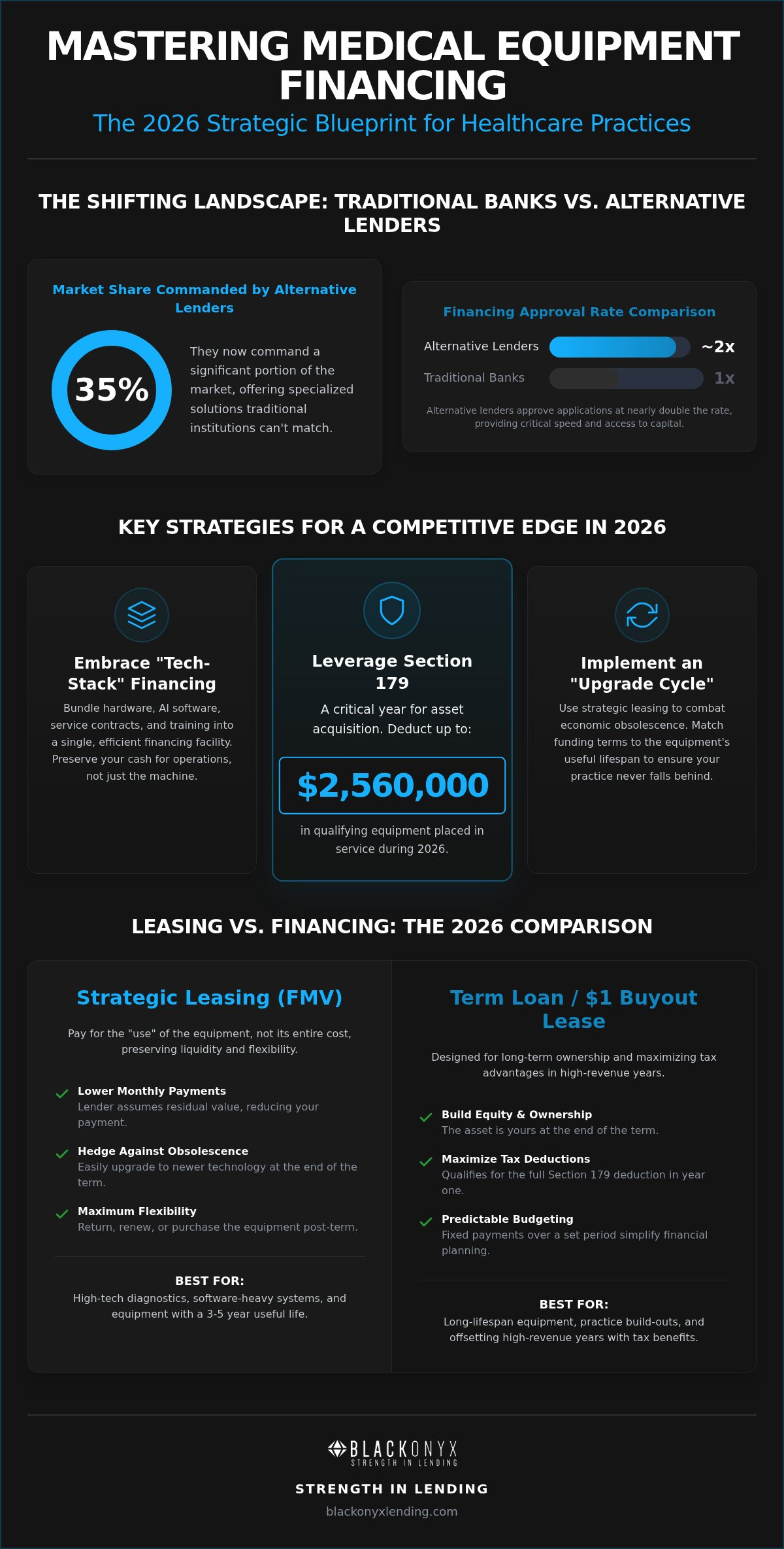
Did you know that alternative lenders now command 35 percent of the market because they approve medical equipment financing applications at nearly double the rate of traditional banks? It’s a sobering reality for practice owners who still rely on slow, legacy institutions. You’ve likely felt the pressure of rapid technological obsolescence, where the high-tech diagnostic tools you acquired three years ago already feel like relics. If you continue to tie up your operational cash in depreciating assets, then you’re inadvertently capping your own growth potential.
We understand that preserving liquidity is your top priority while you strive to provide the best patient care. This article provides the blueprint to master the 2026 landscape of medical financing so you can secure cutting-edge technology without a massive down payment. You’ll learn how to leverage 100 percent financing that covers soft costs, navigate the $2,560,000 Section 179 deduction limit, and connect with a network of specialized lenders who move at the speed of your business. We’ll break down the shift toward strategic leasing and show you how to match your funding terms to the actual lifespan of your equipment.
Key Takeaways
- Learn how the 2026 shift toward “tech-stack” financing allows you to bundle diagnostic hardware, software, and service costs into a single, efficient facility.
- Discover why the $2,560,000 Section 179 deduction limit makes 2026 a critical year for strategic medical equipment financing and asset acquisition.
- Implement an “Upgrade Cycle” strategy to combat economic obsolescence; this ensures your practice isn’t anchored to outdated technology as clinical standards evolve.
- Understand the specific documentation and performance metrics required to clear professional underwriting and secure high-limit medical loans with flexible terms.
- Position your practice for a competitive edge by using specialized lenders to bridge the gap between your clinical needs and global capital markets.
What is Medical Equipment Financing in the 2026 Healthcare Market?
Medical equipment financing is a specialized commercial funding mechanism designed to acquire diagnostic, surgical, and therapeutic technology. In 2026, the definition has evolved. It’s no longer just a hardware loan for a physical machine. The market has shifted toward comprehensive “tech-stack” financing. This includes the AI software, cloud integration, and proprietary licenses that make modern hardware functional. Ultimately, medical equipment financing is a strategic capital preservation tool that allows practitioners to keep their cash reserves for operational growth while utilizing the latest clinical tools.
Traditional banks often fail modern practices because their rigid underwriting models don’t account for these intangible components. If a bank only sees value in the physical chassis of an MRI, they’ll likely ignore the high-cost software suite required to run it. This leaves a massive funding gap that practices must cover out of pocket, which drains liquidity. Alternative solutions bridge this gap by recognizing the total value of the clinical implementation.
The Core Components of Medical Finance
Modern funding structures recognize that clinical excellence requires more than just a machine. Effective financing must cover the full ecosystem of the acquisition:
- Hardware: This remains the foundation, encompassing everything from high-resolution imaging and surgical robotics to specialized laboratory equipment.
- Soft Costs: Unlike legacy bank loans, alternative solutions finance the software licenses, complex installation, and the critical staff training required for implementation.
- Working Capital: By applying Asset-based lending principles, practices can often use their new or existing equipment as collateral to unlock broader liquidity for facility expansions or payroll.
Why Medical Practices Choose Alternative Financing
The healthcare market moves too fast for the 60 to 90 day approval cycles typical of traditional institutions. Speed of execution is a competitive necessity. If you’re waiting three months for a loan approval, your local competitor has already installed the tech and captured the patient volume. Non-bank lenders often provide approvals in days, not weeks.
Alternative lenders offer flexible underwriting that prioritizes the practice’s future potential and current performance metrics over static historical tax returns. This approach removes the bureaucratic hurdles that often stall progress. Perhaps most importantly, these solutions help you avoid restrictive bank covenants. Traditional loans often include blanket liens or debt-to-income ratios that limit your ability to borrow in the future. Strategic alternative financing keeps your balance sheet clean and your options open.
Medical Equipment Leasing vs. Financing: A 2026 Comparison
Practitioners in 2026 face a fundamental shift in procurement: the “Ownership vs. Access” debate. For decades, owning clinical assets was the gold standard of practice stability. Today, that logic is flawed for high-tech systems. If you purchase a diagnostic suite outright, you’re betting that its technology will remain relevant for the next decade. In a market where 72 percent of healthcare businesses now utilize some form of leasing, access to the latest utility often outweighs the pride of ownership. Choosing the right medical equipment financing structure is now a hedge against technological decline.
Tax strategy heavily influences this decision. The Section 179 deduction 2026 allows practices to deduct up to $2,560,000 of qualifying equipment in the year it’s placed in service. This applies to both direct purchases and certain lease structures. If you need to offset a high-revenue year, then a $1 Buyout lease or a term loan might be your strongest move. However, if you’re acquiring tech with a three-year lifespan, then the immediate tax break must be weighed against the cost of disposing of obsolete hardware later.
Fair Market Value (FMV) leases are trending for high-tech diagnostics because they prioritize liquidity and flexibility. These structures allow you to pay for the “use” of the machine rather than its entire cost. Since the lender accounts for a residual value at the end of the term, your monthly payments are significantly lower than a standard loan. It’s a strategic way to keep your practice at the cutting edge without over-leveraging your balance sheet.
Leasing Models: FMV vs. $1 Buyout
Fair Market Value (FMV) leases are ideal for equipment with a rapid three-year tech cycle, such as AI-powered imaging tools. You use the equipment, and at the end of the term, you return it or upgrade. Conversely, a $1 Buyout lease is a capital lease. It’s best for long-term assets like exam tables, cabinetry, or durable surgical tools that won’t be obsolete in five years. Operating leases also keep the debt off your main balance sheet, which can make your practice look more attractive to future investors or partners.
Traditional Financing and Equipment Loans
Term loans for medical equipment make the most sense when you intend to keep the asset for its entire useful life. In the 2026 economy, fixed-rate loans offer the predictability you need to manage long-term overhead. You might also explore SBA loan programs, which often provide favorable terms for qualified practices, though they typically involve longer approval times. Before committing to a specific path, it is often helpful to review your practice’s specific niche with a specialist who understands the 2026 market dynamics.
Combating Economic Obsolescence with Strategic Leasing
In 2026, the physical durability of a machine no longer dictates its clinical value. Economic obsolescence occurs when a piece of equipment remains functional but is rendered uncompetitive by newer, more efficient technology. If you purchase a high-end MRI today, it might be clinically outdated by 2029 due to breakthroughs in AI-enhanced resolution. This rapid cycle is why medical equipment financing has evolved into a tool for technological agility. You don’t want to be stuck with a ten-year note on a machine that patients and insurers consider obsolete in three.
Strategic leasing allows for an “Upgrade Cycle” approach. By structuring a lease with a mid-term refresh clause, you can swap out hardware before it becomes a liability. Consider the case of a regional surgical center that recently avoided a projected $2 million loss. Instead of purchasing robotic assistants that would have been outdated within 40 months, they opted for a strategic lease. When the next generation of robotics hit the market, they upgraded without the burden of selling used equipment at a fraction of its original cost.
Technological agility is the new medical currency.
The AI Revolution in Medical Hardware
Hardware in 2026 is essentially a vessel for sophisticated AI software. Traditional depreciation schedules, which often assume a seven-year lifespan, simply don’t match reality. If your equipment relies on cloud-based AI diagnostic tools, then the value lies in the software updates, not the steel frame. Utilizing medical equipment financing to acquire these tools allows you to shift the risk of disposal and resale to the lessor. You focus on patient outcomes while the financing partner manages the asset’s end-of-life cycle.
Sale-Leaseback for Medical Practices
Many practices are sitting on significant untapped capital tied up in existing assets. A Sale-Leaseback Financing arrangement allows you to sell your currently owned equipment to a lender and immediately lease it back. This provides an immediate cash infusion to fund new AI-enabled technology or facility expansions. To succeed here, you must accurately value older assets based on their current secondary market demand. It’s a powerful way to recycle capital without disrupting your daily operations.
The Medical Loan Approval Process: From Underwriting to Funding
Securing high-limit funding requires more than a simple application. It demands a strategic presentation of your practice’s clinical and financial health. Professional underwriting is the bridge between your equipment needs and the capital required to meet them. If you treat this process as a mere formality, then you risk delays or unfavorable terms. If you approach it with precision, then you unlock the best possible rates in the 2026 market.
The approval process begins with financial documentation. Underwriters examine your profit and loss statements, balance sheets, and patient volume trends to assess long-term stability. Next, the focus shifts to equipment valuation and vendor verification. This step ensures the medical equipment financing facility aligns with the asset’s actual market value. A strategic approach to medical equipment financing eliminates the friction between procurement and implementation. Finally, the deal is matched to a specialized lender within the Black Onyx network that understands your specific clinical niche.
Preparing Your Practice for Underwriting
Preparation is the key to speed. You must gather essential documents like your most recent tax returns and year-to-date financial statements. Underwriters also look at the interplay between personal and business credit. While strong business credit is vital, your personal history remains a factor in high-limit medical loans. Leveraging business financial consulting early in the process helps identify and fix potential red flags. This proactive stance significantly reduces the time from application to funding. For practices that want to go even further, engaging in commercial underwriting consulting before submitting your application can transform your financial package from a hopeful submission into a mathematically undeniable deal.
The Broker Advantage: Accessing 100+ Funding Sources
The biggest mistake practitioners make is relying on a single institutional bank. Traditional banks often have rigid “buy boxes” that exclude certain specialties or equipment types. In the Black Onyx network, one lender’s “No” is frequently another’s “Yes.” We maintain relationships with over 100 funding sources, including specialized lenders for dental, veterinary, oncology, and imaging practices. These private funding sources prioritize your practice’s future potential over rigid historical ratios. This flexibility allows for faster approvals and more generous limits. Practices that have previously faced bank rejections can benefit from personalized business loan consulting to reframe their financial narrative and access the right lender from the start. To get started, you can view our specialized funding options today.
Securing Your Competitive Edge with Black Onyx Medical Finance
Modern healthcare demands a fundamental shift in perspective. If you view medical equipment financing as merely a way to manage debt, then you’re missing the broader opportunity for market leadership. In 2026, the practices that thrive are those that maintain technological agility without draining their operational cash. Black Onyx Corporation, LLC serves as a seasoned consultant and a strategic bridge to a global network of over 100 funding sources. From our headquarters in Troy, MI, we provide individualized attention to practitioners who need more than just a loan; they need a partner who understands the nuances of clinical ROI. By acting as a high-level consultant rather than a mere service provider, we help you navigate the systemic hurdles that often slow down clinical expansion.
Tailored Solutions for Specialized Practices
Our approach is built on the reality that a veterinary clinic in Australia has different capital requirements than an oncology center in the UK or a startup in Canada. We provide tailored solutions that address these specific geographical and clinical demands. For new practice startups, we structure deals that preserve early-stage cash flow through flexible repayment terms. For established hospital expansions, we leverage asset-based financing to unlock the value of existing infrastructure and fund new growth. This versatility is why we’re positioned as a bold innovator. We don’t just provide capital; we provide a competitive edge by matching your specific niche with the right specialized lender from our extensive network.
Ready to Upgrade Your Technology?
The removal of bureaucratic obstacles is our primary mission. We’ve seen too many clinical breakthroughs stalled by slow approval times and restrictive bank covenants. If you’re ready to move from a state of limitation to one of significant opportunity, then our team is ready to facilitate that transition. Our consultants work to streamline the underwriting process, ensuring that your time is spent on patient care rather than paperwork. Our goal is to foster a sense of momentum for your business, allowing you to focus on the competitive edge that comes with the latest technology. Secure your future by choosing a partner who is deeply knowledgeable about market dynamics and focused on your long-term success. You can get a specialized medical equipment financing quote from Black Onyx to modernize your practice today.
Leading the Future of Clinical Excellence
Mastering the 2026 landscape requires moving beyond traditional bank limitations and embracing technological agility. By utilizing strategic medical equipment financing, you transform a potential debt burden into a powerful engine for practice growth. You’ve seen how personalized underwriting and the “Upgrade Cycle” strategy prevent your facility from being anchored to outdated hardware while preserving vital operational liquidity.
Black Onyx Corporation, LLC acts as your high-level consultant, providing global reach with localized expertise across the US, Canada, Australia, and the UK. We offer access to over 100 specialized funding sources to ensure your clinical vision is never stalled by bureaucratic red tape. If you’re ready to move from a state of limitation to one of significant opportunity, then it’s time to leverage our strategic consulting. Contact Black Onyx Lending to secure your medical equipment financing today and position your practice at the absolute forefront of modern medicine. Your clinical innovation starts with the right capital partner; let’s build that momentum together.
Frequently Asked Questions
How does medical equipment financing differ from a standard business loan?
Medical equipment financing differs from a standard loan by focusing on the specific asset as collateral rather than requiring a blanket lien on your entire practice. These facilities are tailored to the clinical lifespan of the technology, allowing for flexible repayment structures. Standard business loans are often rigid and slow. Specialized financing understands that a new MRI generates its own revenue, making it a safer bet for the lender and a more efficient tool for your practice.
Can I finance 100% of the costs, including installation and software?
Yes, you can secure 100 percent financing that covers hardware plus soft costs like AI software, installation, and staff training. Traditional bank loans typically exclude these intangibles, forcing practices to pay for them out of pocket. Alternative lenders recognize that modern medical technology is a comprehensive “tech-stack” where the software is as critical as the physical machine. This allows you to bundle all acquisition costs into a single, manageable monthly payment facility.
What is the typical term length for a medical equipment lease in 2026?
Term lengths in 2026 typically range from 36 to 84 months, depending on the equipment’s expected clinical lifespan. For high-tech diagnostic tools with rapid obsolescence cycles, shorter 36 or 48-month terms are common to facilitate frequent upgrades. For durable assets like surgical tables or cabinetry, practitioners often opt for 60 to 84-month terms. This range allows you to minimize monthly payments while matching the debt duration to the actual utility of the asset.
How does the Section 179 tax deduction apply to medical equipment in 2026?
In 2026, the Section 179 tax deduction allows you to deduct up to $2,560,000 of qualifying equipment in the year it’s placed in service. This deduction begins to phase out once your total equipment purchases exceed $4,090,000. It’s a powerful tool for reducing the after-tax cost of medical equipment financing. If you choose a qualifying lease or loan structure, then you can significantly lower your tax liability while modernizing your clinical capabilities.
Is it possible to finance used or refurbished medical equipment?
Financing used or refurbished medical equipment is entirely possible and often strategically sound for non-diagnostic assets. Many specialized lenders in our network provide competitive rates for certified refurbished technology. This allows practices to acquire reliable hardware at a lower price point while still benefiting from structured payments. It’s an excellent way to expand your facility’s capacity without the higher price tag associated with brand-new equipment, provided the asset meets the lender’s valuation standards.
What happens if the equipment becomes obsolete before the lease ends?
If your equipment becomes obsolete, a Fair Market Value (FMV) lease allows you to return the asset at the end of the term. Some strategic lease structures even include mid-term tech-refresh options. These allow you to swap out outdated hardware for the latest version before your original agreement expires. This flexibility shifts the risk of technological decline to the lessor. It ensures your practice remains at the cutting edge without being stuck with useless hardware.
How quickly can a medical equipment loan be approved and funded?
Approval for this type of specialized funding can occur in as little as 24 to 48 hours. While traditional SBA loans may take 60 to 90 days to close, private funding sources prioritize speed to help you capture market opportunities. Once underwriting is complete and documents are signed, funding often happens within days. This rapid execution ensures you can install your new technology and begin treating patients without the friction of long, bureaucratic institutional waiting periods.
Do I need a large down payment for high-end diagnostic equipment?
You don’t necessarily need a large down payment. While traditional banks often require 10 to 20 percent down, many alternative lenders offer zero-down or first-and-last-payment structures. This is especially true for established practices with strong performance metrics. By minimizing your upfront cash outlay, you preserve your liquidity for essential operational expenses. You gain immediate access to high-end diagnostic tools while keeping your cash reserves available for payroll and other critical practice growth needs. Practices that use a 2026 business loan readiness checklist through commercial underwriting consulting are often better positioned to qualify for these zero-down structures by presenting a pre-vetted, lender-ready financial package.