


Your business plan isn’t a marketing brochure; it’s a risk-mitigation tool designed specifically for an underwriter’s desk. If you want to secure high-level commercial financing, you must understand how to write a business plan for a loan that speaks the language of credit committees rather than customers. Most entrepreneurs treat these documents as creative exercises, but lenders view them as a roadmap of potential defaults. If your plan fails to address operational risk with surgical precision, it’ll likely end up in the rejection pile regardless of your actual revenue potential.
You’ve likely felt the frustration of staring at complex financial projection requirements or the fear that a minor formatting error will trigger a bureaucratic bottleneck. We’re here to eliminate that confusion by providing a strategic bridge between your vision and the lender’s requirements. This guide will show you how to craft a structured, persuasive document that secures faster approval times and more favorable loan terms. We’ll break down the 2026 standards for professional underwriting, moving from high-level strategic benefits to the specific, actionable financial data that transforms a raw plan into a funded deal.
Key Takeaways
- Shift your document’s focus from visionary storytelling to operational risk-mitigation to satisfy the rigorous standards of bank credit committees.
- Discover how to write a business plan for a loan that uses logical “if-then” structures to demonstrate a clear and reliable path to repayment.
- Develop three-year financial projections and cash flow analyses that provide a realistic, data-backed foundation for your specific funding request.
- Tailor your presentation to meet the unique regulatory standards of SBA loans or the collateral-heavy requirements of asset-based lending.
- Conduct a professional “Red Team” review to eliminate formatting errors and address potential red flags before they cause a bureaucratic bottleneck.
The Underwriter’s Perspective: Why Standard Plans Fail
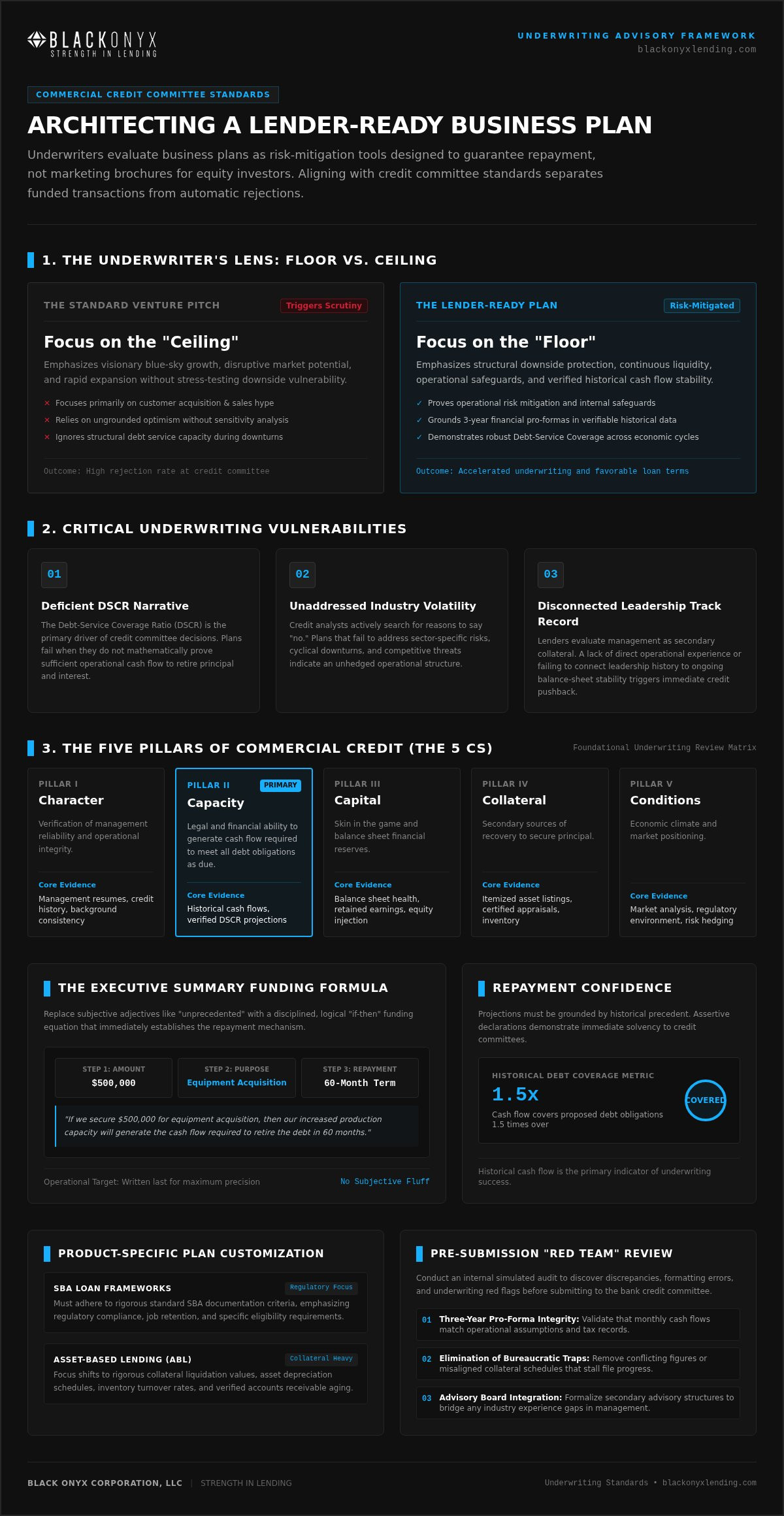
Underwriters don’t read business plans to find the next industry disruptor; they read them to find reasons to say “no.” Understanding how to write a business plan for a loan requires a fundamental shift in perspective. You aren’t selling a dream of future wealth. You’re selling a guarantee of repayment. While traditional business plan components often focus on marketing and “blue sky” potential, a lender-ready document is a risk-mitigation tool. It’s the difference between a visionary plan designed for equity investors and an operational plan designed for commercial credit committees.
Underwriters typically reject well-written plans for three specific reasons. First, the plan lacks a clear Debt-Service Coverage Ratio (DSCR) narrative, which is the primary driver of any funding decision. Second, it ignores specific industry risks that could impede repayment. Third, it fails to connect management’s character to financial stability. If you want to master how to write a business plan for a loan, you must lead with the numbers underwriters care about most. If your document doesn’t prove you can pay back the principal plus interest, it’s effectively useless for securing capital.
The Shift from Opportunity to Risk Mitigation
Lenders prioritize your floor, not your ceiling. They want to know how you won’t fail. If you focus solely on how big your company will get, you’re speaking the wrong language. High-level commercial financing depends on your ability to prove stability through every economic cycle. Underwriters look at historical performance as the primary indicator of future success. If your historical data is weak, your projections must be exceptionally grounded in reality to bridge the gap. Use assertive declarations like “Our historical cash flow covers the proposed debt 1.5 times” to build immediate professional confidence.
The Five Pillars of Commercial Loan Underwriting
The “5 Cs of Credit” form the backbone of every professional loan review. Your plan must evidence Character, Capacity, Capital, Collateral, and Conditions within every section. Character is proven through management resumes and credit history. Capital is shown via your balance sheet and equity injection. Collateral is detailed in your asset list and appraisals. Conditions are addressed in your market analysis and risk-mitigation strategies. Capacity is the most critical pillar for repayment. Capacity represents the legal and financial ability of the business to generate sufficient cash flow to meet all debt obligations as they come due. If your plan doesn’t clearly articulate these pillars, it won’t survive the scrutiny of a modern underwriting process.
Core Components of a Lender-Focused Business Plan
Success in commercial financing hinges on how you frame your core components. While many entrepreneurs follow a generic SBA business plan framework, they often miss the strategic nuance required for high-level commercial lending. Your goal is to build an “Operational Plan” that proves stability. This means your market analysis shouldn’t just show a massive opportunity; it must prove demand stability during economic downturns. Your operational section must detail the infrastructure that protects the lender’s capital, such as internal controls and inventory management systems. If your plan demonstrates a clear understanding of these operational safeguards, then the underwriter’s perception of risk decreases significantly.
Crafting an Assertive Executive Summary
Write your summary last. It serves as your strategic “hook” and must establish immediate momentum. Use a precise “Specific Funding Request” formula: Amount, Purpose, and Repayment. For example, “If we secure $500,000 for equipment acquisition, then our increased production capacity will generate the cash flow required to retire the debt in 60 months.” Avoid “fluff” adjectives like “unprecedented” or “revolutionary.” Precision and speed are your allies here. If you want to master how to write a business plan for a loan, keep this section concise and data-driven to respect the underwriter’s time.
The Management Team as Collateral
Lenders view your management team as secondary collateral. If the primary borrower lacks specific industry experience, the risk of default increases. You must highlight relevant experience that directly mitigates operational risk. If there are gaps in your team, address them through a formal advisory board. Utilizing Black Onyx consulting services positions you as a sophisticated borrower with access to high-level strategic support. This partnership signals to underwriters that you’ve bypassed the typical trial-and-error phase by securing professional guidance. If you’re unsure if your team profile meets lender standards, seeking professional Business Planning & Consulting can refine your raw narrative into a funded deal. Mastering how to write a business plan for a loan involves proving that your leadership is as reliable as your revenue.
Financial Projections: Building a Rock-Solid Pro-Forma
Numbers provide the objective proof for your narrative claims. When learning how to write a business plan for a loan, you must move beyond simple revenue targets to build a three-year pro-forma that balances ambition with historical reality. Underwriters look for “reasonable certainty” in your projections. According to FDIC small business lending guidance, realistic earnings projections are essential to demonstrate that your business can service debt comfortably through various market cycles. If your projections rely on unexplained, massive year-over-year growth, then your plan will likely face immediate rejection during the initial review phase.
Your cash flow analysis is the most scrutinized document in the entire loan package. It reveals whether you’ll have the liquidity to meet payroll and debt obligations during seasonal dips. To separate your plan from the competition, include a sensitivity analysis. This stress test proves your business model remains viable even if revenue drops by 20%. Providing this level of transparency shows a proactive approach to risk management. Your “Use of Proceeds” section must also be granular. Lenders don’t want to see “working capital” as a catch-all; they want a line-item breakdown of how every dollar spent increases your repayment capacity.
The Importance of the DSCR (Debt Service Coverage Ratio)
The Debt Service Coverage Ratio is the “Magic Number” for commercial lenders. It measures your ability to pay your debt with your net operating income. To calculate your DSCR, divide your annual Net Operating Income by your total annual Debt Service. If your ratio is below 1.25, then most traditional lenders will view the loan as high-risk. You can improve this ratio before submission by reducing existing short-term debt or increasing your equity injection. Mastering how to write a business plan for a loan means ensuring this ratio signals strength from the very first page.
Addressing 2026 Economic Obsolescence and Depreciation
Modern financial planning requires a sophisticated approach to asset management. Integrating equipment leasing strategies into your financial plan can preserve cash flow and improve your balance sheet’s flexibility. You must also explain how Section 179 and bonus depreciation impact your net income. While these tax benefits reduce your tax liability, they can also artificially lower your reported net income on paper. If you include a “Lease vs. Buy” analysis as an appendix, then you demonstrate a high level of operational maturity. This strategic approach ensures your business remains competitive while managing the rapid pace of technological obsolescence in 2026.
Tailoring Your Plan for Specific Loan Products
A generic approach is the fastest route to a rejection letter. If you want to master how to write a business plan for a loan, you must align your document’s structure with the specific financial product you’re pursuing. Each lending vehicle has a unique “primary driver” that dictates the underwriter’s focus. While an SBA loan officer prioritizes job creation and public benefit, an asset-based lender cares almost exclusively about the liquidation value of your balance sheet assets. If your plan fails to emphasize the right variables, then your application becomes a bureaucratic hurdle rather than a funded deal.
Writing for an SBA Loan Consultant
SBA 7(a) and 504 loans require a narrative that balances commercial viability with federal mission goals. You must specifically address the “Credit Elsewhere” test. This involves proving that the requested capital isn’t available through conventional channels on reasonable terms. If you don’t document this clearly, then the SBA may flag your application for a secondary review. Your plan should also highlight the “Public Benefit” of your growth, such as community revitalization or job retention. For a deeper dive into these requirements, review our strategic guide on 2026 SBA loans to ensure your narrative meets updated federal standards.
The Asset-Based Narrative: Collateral is King
Asset-Based Lending (ABL) serves as a powerful alternative for companies with tight cash flow but significant balance sheet strength. If you’re pursuing this route, then your plan must prioritize the quality and age of your collateral over long-term market forecasts. Your appendix should include detailed schedules of inventory or equipment, specifically focusing on their orderly liquidation value. This is also where you can bridge gaps in working capital by linking to accounts receivable financing. This strategy shifts the focus to your customers’ creditworthiness rather than your own. It’s a decisive advantage for growing firms with heavy invoices. If you’re ready to bypass traditional bank rejections, partner with our consulting team to refine your asset-based narrative.
Equipment finance and purchase order funding require a similarly narrow focus. For equipment, the plan must demonstrate the specific ROI of the asset being acquired. If the new machinery doesn’t directly increase production or reduce costs, then the lender’s risk increases. By contrast, purchase order financing focuses on the end-user’s ability to pay. If you tailor each section of your plan to these specific mechanics, then you move from a state of limitation to one of significant opportunity. Understanding these nuances is the core of how to write a business plan for a loan that actually gets funded.
The Final Polish: Professional Underwriting and Review
The final stage of mastering how to write a business plan for a loan is the rigorous review process. You’ve built the narrative and the numbers; now you must stress-test them through a “Red Team” review. This involves analyzing your document through the eyes of a skeptical credit officer. If you find a logical gap in your repayment strategy, then you must fix it before the lender sees it. Visual presentation serves as a silent ambassador for your brand. High-level commercial financing requires a document that looks as professional as the operations it describes. If your formatting is inconsistent, then the underwriter may question your attention to detail in other areas of the business.
Why Self-Underwriting is a Critical Mistake
Business owners are inherently optimistic. This bias often leads to “projection puffery,” where forecasts become untethered from historical reality. If your projections don’t align with industry averages, then you lose immediate credibility. Professional commercial underwriting consulting identifies these potential deal-killers before they reach a bank. A consultant provides an objective lens that most entrepreneurs lack. They also act as a strategic bridge to a vast network of funding sources. This allows you to match your specific plan to the lenders most likely to approve it, saving weeks of wasted effort.
Submitting with Confidence
Your submission must be a cohesive “Loan Package” rather than a single document. Underwriters appreciate a logical flow that respects their time. If your package is disorganized, then the approval process slows down significantly. Ensure you include a final checklist of supporting documents to accompany your plan:
- Three years of personal and business tax returns.
- A comprehensive list of collateral with current valuations.
- Interim profit and loss statements no older than 60 days.
- Legal documents including articles of incorporation and existing leases.
Preparation for the follow-up is vital. Lenders will have questions after they read your plan. If you answer them with data-backed precision, then you demonstrate the character and capacity required for a high-level deal. Let Black Onyx refine your business plan for maximum funding potential. We move your application from the bottom of the pile to the top by ensuring every detail meets the highest underwriting standards. Don’t let a formatting error or a projection gap stand between you and the capital you need to scale.
Transforming Your Strategy into Funded Capital
Securing high-level commercial financing requires more than just a good idea; it demands a document that withstands the scrutiny of the world’s most skeptical underwriters. By shifting your focus from visionary growth to operational risk mitigation, you position your business as a reliable partner for any lender. Remember that your Debt Service Coverage Ratio and the precision of your cash flow projections are the true drivers of your approval. Mastering how to write a business plan for a loan is the definitive first step toward removing bureaucratic obstacles and achieving significant opportunity.
Success in 2026 depends on your ability to bridge the gap between a raw plan and a funded deal. Black Onyx provides the specialized commercial underwriting and strategic consulting necessary to bypass traditional bank rejections. With access to 100+ funding sources and a proven track record in SBA and Asset-Based financing, we ensure your presentation meets the highest industry standards. Secure Your Funding with Expert Business Consulting today. Your roadmap to capital is ready; it’s time to move forward with professional confidence and precision.
Frequently Asked Questions
Do I really need a business plan for a commercial loan in 2026?
Yes, a formal document is essential for high-level commercial financing. While fintech has accelerated approvals, underwriters still rely on your plan to assess operational risk and character. If you don’t provide a structured narrative, then credit committees lack the necessary context to approve your request. In 2026, even automated systems require the specific data points found in a lender-ready plan to calculate your risk profile and determine interest rates.
How long should a business plan for a loan be?
Aim for 15 to 25 pages of core content, excluding appendices. Busy professionals respect brevity and precision. If your plan is too long, then the core message about repayment capacity gets lost in the noise. Focus on high-impact sections like the executive summary and financial pro-formas. Use your appendix for technical data, such as equipment specifications for leasing or detailed accounts receivable aging reports, to keep the main narrative brisk.
What is the most important section of a business plan for a lender?
The financial projections section, specifically the cash flow analysis, is the most critical component. Lenders prioritize your ability to service debt over your marketing strategy. If your plan doesn’t demonstrate a Debt Service Coverage Ratio (DSCR) of at least 1.25, then the deal is unlikely to move forward. This section provides the objective proof that your business can meet principal and interest obligations while maintaining sufficient liquidity for daily operations.
Can I get a business loan with a simple one-page business plan?
Most commercial lenders won’t approve a significant loan based on a one-page summary. While a “lean startup” plan works for internal strategy, high-level commercial financing requires a comprehensive document. If you want to know how to write a business plan for a loan that secures millions in capital, then you must provide detailed market analysis and multi-year projections. Professional underwriting demands a level of depth that a single page cannot accommodate.
How do lenders verify the financial projections in my plan?
Underwriters verify your projections by comparing them to your historical tax returns and industry-specific benchmarks. They often use Risk Management Association (RMA) data to see if your margins align with similar businesses. If your projected growth exceeds industry averages without a logical explanation, then the lender will flag your plan as high-risk. Professional consulting can help you calibrate these numbers to ensure they meet the rigorous standards of modern commercial credit committees.
Should I include my personal financial information in the business plan?
You should include a Personal Financial Statement (PFS) as a supporting document in your appendix. Lenders use this to evaluate the “Character” pillar of credit and determine your ability to provide a personal guarantee. If the business faces a temporary cash flow shortage, then the lender wants to know if you have the personal liquidity to support the debt. This transparency builds trust and signals your long-term commitment to the venture’s success.
How does a business plan for an SBA loan differ from a bank loan?
An SBA plan must address specific federal mandates, such as the “Credit Elsewhere” test and job creation targets. Traditional bank loans focus more strictly on the quality of your collateral and historical cash flow. If you’re pursuing an SBA 7(a) or 504 loan, then your narrative must emphasize how the funding serves a public benefit. Understanding these nuances is a vital part of how to write a business plan for a loan effectively.
What happens if my business plan shows I won’t be profitable for the first year?
Showing a first-year loss is acceptable if you demonstrate a clear path to profitability and have sufficient working capital. You must explain the “burn rate” and show how the loan proceeds provide the necessary runway. If your plan identifies the specific month you’ll reach the break-even point, then the underwriter sees a controlled risk rather than a failing business. Use this section to highlight your management’s ability to navigate early-stage operational challenges.