


If you believe a local bank’s “no” is the final word on your expansion plans, you’re operating on an outdated financial map. It’s frustrating to face an opaque commercial loan approval process where decision-making feels like a black box and waiting periods stretch into months. You’ve likely felt the anxiety of a potential rejection simply because your financial profile doesn’t fit a rigid, traditional mold. This sense of limitation is a hurdle we’re prepared to help you clear.
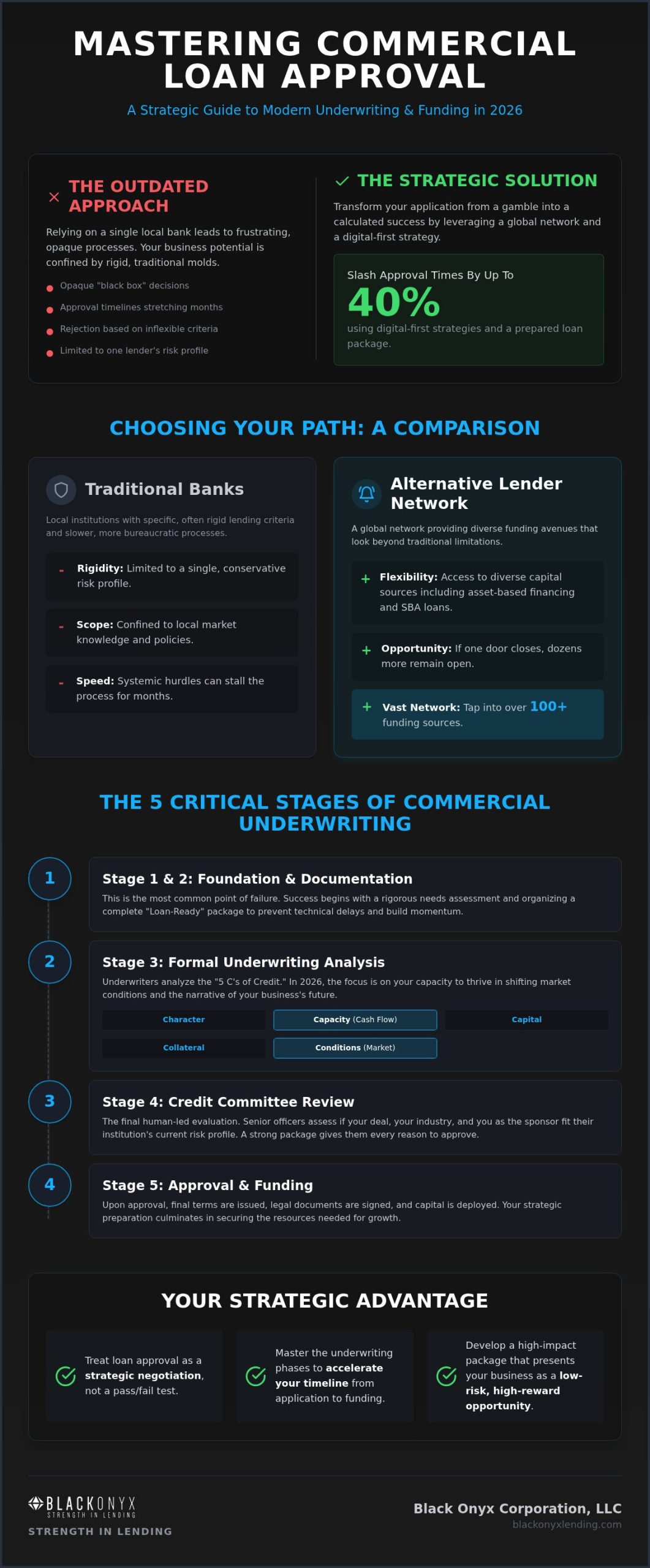
This guide provides the professional precision needed to master modern underwriting and secure funding from a global network of resources. If you apply the strategic frameworks outlined here, then you’ll transform your application from a gamble into a calculated success. We’ll break down the specific 2026 underwriting criteria, reveal how to slash approval times by up to 40% using digital-first strategies, and explore diverse funding avenues like asset-based financing that look far beyond the limitations of local institutions. You’re about to move from a state of uncertainty to one of significant opportunity.
Key Takeaways
- Understand why the 2026 commercial loan approval process is a strategic negotiation rather than a rigid pass/fail test.
- Master the five critical phases of underwriting to anticipate lender requirements and accelerate your timeline from application to funding.
- Compare traditional bank rigidity against the flexibility of alternative lenders to identify the most efficient path for your unique financial profile.
- Develop a high-impact executive summary and financial package that transforms your business into a low-risk, high-reward opportunity for lenders.
- Discover how leveraging a global network of over 100 funding sources can bypass local banking limitations and systemic bureaucratic hurdles.
What is the Commercial Loan Approval Process in 2026?
The commercial loan approval process is a multi-stage evaluation where lenders assess the viability and operational risk of a business entity. Unlike the standardized world of personal finance, commercial lending operates on the principle of unique negotiation. This assessment follows The Five Critical Stages of Commercial Underwriting, where your financial health is balanced against a lender’s specific capital constraints. If you treat this as a strategic matching exercise, you’ll find the capital source whose risk appetite aligns perfectly with your operational profile.
In 2026, lenders are maintaining disciplined and conservative standards. While over 65% of banks now utilize digital lending platforms to reduce processing times, the core decision still rests on a complex blend of quantitative data and your qualitative “business story.” This narrative is what separates a successful funding round from a flat rejection. It’s no longer just about the numbers; it’s about the momentum of your enterprise.
Commercial vs. Consumer Lending: The Strategic Shift
Personal loans often rely on a “black box” algorithm where your credit score dictates the outcome. In the commercial world, your credit score is merely a baseline. Underwriters look for the strength of your cash flow and the clarity of your “use of funds” narrative. If your proposal demonstrates how the capital will generate immediate ROI, then the lender views you as a strategic partner rather than a liability. Modern underwriting has shifted toward human-led analysis supported by AI, allowing for more nuanced decisions that favor unconventional financial profiles.
Key Stakeholders in Your Approval Journey
Understanding who holds the power is essential for steady forward movement. The Underwriter is the ultimate gatekeeper of risk and compliance. They don’t just look at what you’ve done; they look at what could go wrong. While a bank’s Loan Officer represents the institution’s interests, a Strategic Consultant acts as your advocate and bridge to a broader market.
Relying on a single local bank limits your options to their specific, often rigid, criteria. Working with a consultant provides access to over 100 funding sources, including asset-based lending, equipment leasing, and SBA loans. This diversity ensures that if one door closes due to a specific policy hurdle, another dozen remain open. This proactive approach removes the systemic obstacles that typically stall the commercial loan approval process.
The Five Critical Stages of Commercial Underwriting
Moving from a state of limitation to one of opportunity requires a disciplined approach to the five stages of underwriting. This isn’t a passive wait; it’s a strategic sprint. If you master each phase, then the commercial loan approval process becomes a predictable path to growth rather than a source of anxiety. Professional precision at this stage ensures that you aren’t just applying for a loan, but successfully securing a partnership.
Stage 1 & 2: Building the Foundation
Success begins with a rigorous strategic needs assessment. Before the first meeting, you must define exactly how much capital you need and how it will be deployed. If you can’t articulate the ROI of the capital, a lender won’t back the project. This leads directly into the documentation sprint. The information gathering stage is the most common point of failure for small businesses. Organizing a “Loan-Ready” package prevents the technical delays that kill momentum. For businesses exploring government-backed options, understanding the nuances between Banks vs. Alternative Lenders ensures your documentation aligns with federal standards from day one.
Stage 3 & 4: Navigating the Underwriting Gauntlet
Formal underwriting centers on the “5 C’s of Credit”: Character, Capacity, Capital, Collateral, and Conditions. In 2026, capacity and conditions carry more weight than ever before. Lenders want to see that your business can thrive even if market conditions shift. If you anticipate these concerns, you can build a narrative that addresses risk before it’s questioned. Utilizing specialized underwriting consulting helps you refine this story, ensuring it resonates with the gatekeepers of capital.
The Credit Committee review is the final hurdle. This is a human-led evaluation where senior officers decide if your deal fits their current risk profile. They don’t just look at spreadsheets; they look at the strength of the sponsor and the viability of the industry. If you’ve prepared a comprehensive package, you’ve already given them every reason to say yes. Decisions made behind closed doors are often based on the level of confidence your application inspires.
Stage 5: Final Approval and Closing
Once you pass the committee, you move to final approval and fund disbursement. This phase involves closing documents and verifying that all conditions have been met. It’s the moment of transformation where capital finally meets opportunity. Speed is essential here; bureaucratic friction can still occur if you lose focus. Stay proactive to ensure funds are released with efficiency and precision.
Banks vs. Alternative Lenders: Choosing Your Path
The choice of lender dictates the velocity of your growth. If you only look at local banks, you’re seeing less than 10% of the available capital market. The commercial loan approval process varies significantly depending on whether you’re dealing with a depository institution or a private credit fund. Identifying the right partner requires a clear-eyed assessment of your business’s current financials versus its future potential. If you align your needs with the right lender’s risk appetite, then the path to funding becomes a strategic advantage rather than a bureaucratic hurdle.
When to Choose a Traditional Bank
Traditional banks are ideal for “A-Paper” borrowers who can demonstrate high Debt Service Coverage Ratios (DSCR) and a clean, three-year financial history. If your primary goal is the lowest possible cost of capital, a bank is the logical choice. However, this comes with a trade-off. You must accept strict financial covenants and a significantly slower timeline. For those who need a balance between bank rates and improved flexibility, looking into 2026 SBA Loans: A Strategic Guide for Business Growth can provide a government-backed middle ground for long-term expansion. Success here requires meticulous preparation, specifically Preparing Your ‘Loan-Ready’ Package to meet their rigorous standards.
The Power of Alternative Financing
Alternative lenders thrive where banks hesitate. If your business has an unconventional profile or needs capital in days rather than months, non-bank sources are the superior path. They prioritize the value of your assets over the perfection of your tax returns. Asset-based lending (ABL) allows you to leverage accounts receivable or inventory to fuel rapid growth or bridge seasonal gaps. This flexibility is essential for businesses that don’t fit the rigid boxes of traditional underwriting. To fully evaluate which structure suits your situation, reviewing the types of business loans for small business available in 2026 can help you identify the most strategic vehicle for your capital needs.
Sale-Leaseback financing is another powerful tool that unlocks liquidity from existing real estate or equipment without adding new debt to your balance sheet. This approach transforms static assets into active working capital. For companies needing to modernize their operations, The Strategic Guide to Commercial Equipment Leasing in 2026 explains how to acquire high-value machinery without a massive upfront expenditure. By expanding your horizons beyond local branches, you move from a state of limitation to one of strategic momentum.
Preparing Your ‘Loan-Ready’ Package: A Strategic Checklist
A disorganized application is the primary cause of friction in the commercial loan approval process. If you present a polished, comprehensive package, you signal to the underwriter that your business is a low-risk, high-precision operation. This level of preparation moves you from a state of uncertainty to one of strategic momentum. You’re not just providing data; you’re building a case for your company’s future success.
- Comprehensive Financials: Provide three years of federal tax returns and interim P&L statements.
- The Executive Summary: A concise document explaining why your business is a winning bet.
- Collateral Documentation: Detailed appraisals, equipment lists, and aging reports.
- Personal Financial Statements: Evidence of guarantor strength to reinforce lender confidence.
Quantitative Requirements: The Data Lenders Crave
Lenders prioritize data integrity above all else. Your balance sheets and cash flow projections must be flawless to survive the scrutiny of a 2026 credit committee. If your accounts receivable aging report shows significant overdue payments, it’s essential to explain the mitigation strategy. For many firms, Accelerating Cash Flow: A Case Study in Strategic Accounts Receivable Financing demonstrates how to clean up your balance sheet before applying for larger facilities. Clean books don’t just facilitate approval; they accelerate the entire timeline to funding.
Qualitative Requirements: The Narrative Advantage
Numbers tell what happened, but your narrative explains what will happen next. You need a business plan that addresses current market dynamics and your specific competitive edge. If you identify potential “red flags” like a recent dip in revenue or a shift in management, then you must address them proactively. This “pre-underwriting” of your own file removes the element of surprise for the lender. Specialized consulting helps you refine this story, ensuring that qualitative factors like management experience and market positioning weigh heavily in your favor. To begin refining your application for maximum impact, speak with a strategic consultant today.
Streamlining Approval with Black Onyx Consulting
Black Onyx Corporation acts as a high-level strategic bridge between your business goals and a global network of financial resources. If you rely solely on a local bank, you are inherently limited by their specific, often rigid, risk appetite. We remove these bureaucratic obstacles by matching your enterprise with over 100 funding sources across the US, Canada, Australia, and the UK. This vast reach ensures that the commercial loan approval process remains fluid and results-oriented. We provide the personalized attention required to translate your operational momentum into a language that global underwriters respect and reward.
The Consultant Advantage: Why One Size Doesn’t Fit All
Every industry carries its own set of financial nuances and seasonal pressures. A “one-size-fits-all” approach at a traditional bank often leads to rejection for businesses with unconventional profiles. We specialize in matching your specific industry requirements with lenders who possess a deep understanding of your sector. For instance, if you are pursuing government-backed funding, Working with an SBA 7a Loan Broker: 2026 Guide explains how to navigate federal requirements with professional precision. We have a proven track record of moving clients from a frustrating bank “no” to a strategic “yes” by simply identifying the right capital partner who sees the value in your unique business story.
Expert Underwriting for Complex Scenarios
Complex financing needs, such as medical practice acquisitions or high-value equipment leasing, require a level of underwriting expertise that most generalist lenders lack. We act as your advocate throughout the commercial loan approval process, ensuring that your “use of funds” narrative is clear and compelling. Whether you need accounts receivable financing to bridge a cash flow gap or a sale-leaseback to unlock equity, our team manages the technical hurdles so you don’t have to. For those focused on physical expansion, How an SBA 504 Loan Consultant Simplifies Commercial Real Estate Financing in 2026 provides the specialized insight needed for successful real estate acquisition. Our goal is to move you from a state of limitation to one of significant opportunity with speed and efficiency.
The transition from application to funding should be a period of progress, not a source of bureaucratic friction. By partnering with a firm that understands market dynamics and maintains a decisive attitude, you secure your company’s long-term success. Don’t let systemic hurdles stall your growth. Partner with Black Onyx to secure your business future and gain the competitive edge you deserve.
Accelerate Your Business Transformation
The landscape of commercial finance in 2026 demands more than just strong financials; it requires a strategic alignment between your business story and the specific risk appetite of a lender. If you approach the commercial loan approval process with professional precision and a comprehensive package, you’ll effectively remove the systemic hurdles that stall most applications. Success isn’t just about finding capital. It’s about finding the right capital source that understands your momentum.
Moving from a state of limitation to one of significant opportunity is a decisive choice. If you partner with an expert who acts as a strategic bridge to a global network of over 100 funding sources, you gain an immediate competitive edge. We provide the personalized professional underwriting and specialized consulting needed to streamline your path to funding. Don’t let bureaucratic friction delay your expansion plans any longer.
Secure Your Commercial Funding with Black Onyx Strategic Consulting
Your growth is the priority. It’s time to secure the capital your enterprise deserves and move forward with confidence.
Frequently Asked Questions
How long does the commercial loan approval process typically take?
Timelines vary significantly based on the lender’s structure and your documentation readiness. Traditional banks often require 60 to 90 days to move from application to funding. However, alternative lenders and digital platforms can reduce this period to 10 to 30 days. If you utilize specialized consulting to pre-underwrite your file, you can bypass common technical delays that often stall the commercial loan approval process at the committee level.
What is the minimum credit score required for a commercial loan in 2026?
There is no universal minimum because commercial underwriting is a holistic evaluation of business health. Traditional institutions typically look for personal scores above 680 for their best rates. However, alternative paths like asset-based financing or equipment leasing are available for borrowers with scores as low as 600. If your enterprise demonstrates strong cash flow and clear ROI, your personal credit score becomes a secondary factor in the final decision.
Can I get a commercial loan without traditional collateral?
Yes, you can secure capital through alternative structures that prioritize your balance sheet over physical real estate. Accounts receivable financing and purchase order financing use your outstanding invoices and contracts as the primary security. Additionally, sale-leaseback programs allow you to convert existing machinery or property into liquid working capital. If you lack traditional collateral, then focusing on these liquid assets is the most efficient way to secure funding.
What is a Debt Service Coverage Ratio (DSCR) and why does it matter?
DSCR measures your company’s ability to cover its debt obligations using its annual net operating income. Lenders calculate this to ensure your cash flow can comfortably support new monthly payments. A ratio of 1.25 or higher is the benchmark for most traditional banks. If your ratio is lower, you’ll likely need to explore specialized lenders who focus more on the qualitative “story” and future growth potential of your enterprise.
How do loan terms affect the overall cost of credit for my business?
Loan terms dictate both your immediate cash flow impact and the total interest paid over time. While longer terms offer smaller monthly payments, they usually result in a higher cumulative cost of capital. Shorter bridge loans provide speed but require higher debt service coverage. If you choose a variable rate, you must account for benchmark fluctuations, such as the 6.75% prime rate seen in late 2026, which impacts your total repayment.
What happens if my commercial loan application is denied?
A denial is often a sign that your profile didn’t fit a specific institution’s current risk appetite rather than a reflection of your business’s viability. You should request a detailed explanation of the rejection to identify if the issue was credit, collateral, or cash flow. If a local bank says no, then pivoting to a global network of over 100 funding sources can help you find a partner with a more flexible mandate.
Do I need a business plan for a commercial loan approval?
A professional business plan is essential for almost every stage of the commercial loan approval process. It provides the qualitative narrative that underwriters need to understand your competitive edge and market dynamics. Lenders don’t just want to see your past performance; they need to see how the new capital will generate a return. If your plan includes clear cash flow projections, it significantly increases your odds of a successful approval.
Is an SBA loan harder to get approved than a traditional bank loan?
SBA loans aren’t necessarily more difficult to secure, but they do require more meticulous documentation to meet federal standards. Because the government guarantees a portion of the loan, banks are often more willing to approve businesses that might not meet traditional collateral requirements. If you work with a strategic consultant, the bureaucratic friction of an SBA application is managed professionally, which often makes the path to funding smoother than a conventional loan.