


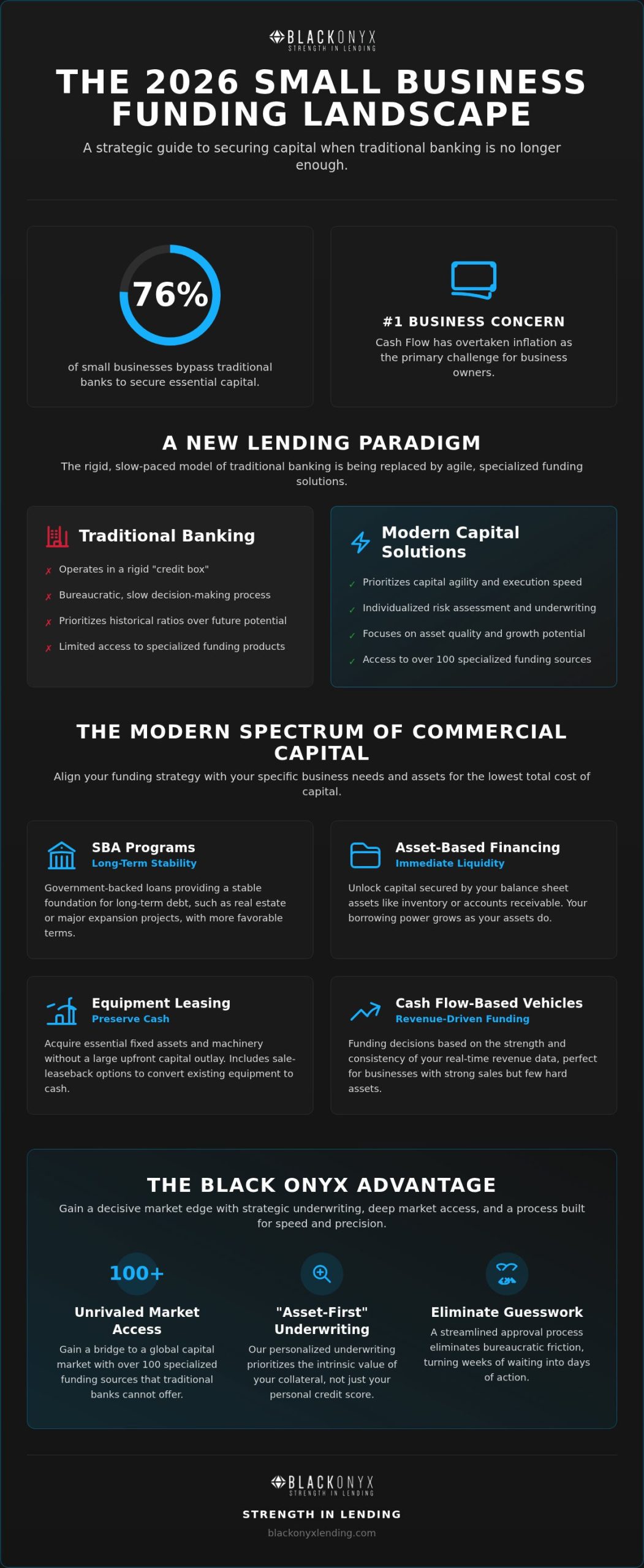
Did you know that 76% of small businesses now bypass traditional banks to secure the capital they need? In a 2026 economy where cash flow has overtaken inflation as the primary concern for owners, relying on a local branch’s rigid credit box is no longer a viable strategy. Understanding the modern types of business loans for small business is the difference between stalled growth and a decisive market advantage. You’ve likely felt the sting of bureaucratic delays or the frustration of a “no” from a lender who doesn’t grasp your operational nuances.
It’s true that the lending landscape feels more complex than ever, especially with the 2026 CFPB regulatory shifts and fluctuating SBA peg rates. We’re here to cut through that noise and provide a professional roadmap to immediate liquidity. This strategic roundup explores high-impact vehicles like asset-based financing, the latest SBA 7(a) and 504 program updates, and specialized structures like sale-leasebacks. By the end of this guide, you’ll have an expert-led path to the capital required to scale your operations without the typical friction of legacy banking.
Key Takeaways
- Learn how to evaluate various types of business loans for small business to ensure your capital structure matches your 2026 growth trajectory.
- Discover how to unlock immediate liquidity by leveraging your balance sheet through asset-based financing, bypassing the restrictive covenants common in traditional banking.
- Understand the strategic advantage of SBA loans for long-term debt, where private capital is secured by government guarantees for more favorable terms.
- Utilize a decisive selection framework to match your funding needs with the right vehicle, whether you require capital in under seven days or need to unlock equity from fixed assets.
- Learn how personalized underwriting and access to over 100 specialized funding sources can eliminate bureaucratic guesswork and streamline your approval process.
Navigating the 2026 Small Business Funding Landscape
Capital is no longer a static resource; it’s a strategic lever that determines your ability to capture market share. In the 2026 economic environment, successful leaders view small business financing as a broad spectrum of debt and asset-based vehicles rather than a simple bank balance. Relying on traditional bank loyalty is a legacy strategy that often fails in a climate demanding extreme capital agility. If your business needs to scale during a rapid market shift, waiting weeks for a committee decision isn’t an option.
Effective growth requires a clear distinction between short-term working capital and long-term capital investments. While payroll financing or accounts receivable structures provide immediate liquidity for operations, fixed assets typically require the structural stability of 2026 SBA loans or equipment leasing. Navigating these types of business loans for small business requires a bridge to the global capital market. A commercial broker provides this bridge, offering access to over 100 specialized funding sources that traditional branches simply cannot reach.
Why Traditional Banks Often Fall Short for Growth
Traditional institutions operate within a rigid “credit box” that often excludes high-growth companies with complex balance sheets. Their underwriting is inherently bureaucratic, prioritizing historical ratios over future potential. This sluggish pace kills momentum. When a bank’s internal policy creates a cash flow gap during rapid scaling, the cost isn’t just the interest rate; it’s the lost opportunity. We see a significant shift toward non-bank commercial lenders because they prioritize execution speed and individualized risk assessment over standardized check-boxes.
The Modern Spectrum of Commercial Capital
The 2026 lending market is segmented into specialized silos designed to match your specific asset profile. Understanding these various types of business loans for small business allows you to select the vehicle that offers the lowest total cost of capital. These include:
- SBA Programs: Government-backed stability for long-term debt.
- Asset-Based Financing: Liquidity secured by inventory or receivables.
- Equipment-Specific Leases: Preserving cash while acquiring fixed assets.
- Cash Flow-Based Vehicles: Funding driven by real-time revenue data.
Your funding strategy should align with the asset you’re leveraging. If you have heavy machinery, a sale-leaseback might be the most efficient path. If you have a stack of unpaid invoices, accounts receivable financing offers immediate relief. In this landscape, interest rates are only one part of the equation. You must weigh the cost of capital against the opportunity cost of moving too slowly. Precision and speed are the new benchmarks for commercial success.
Asset-Based Financing: Leveraging Your Balance Sheet for Liquidity
If your balance sheet is heavy with assets but your bank account is light, you’re sitting on untapped potential. Asset-based financing is capital secured by tangible or intangible business assets. Unlike traditional bank debt, which often comes with restrictive covenants that limit your operational freedom, this model focuses on the intrinsic value of what you own. It’s one of the most flexible types of business loans for small business because it scales naturally. As your inventory grows or your receivables stack up, your borrowing base expands automatically. This “Asset-First” underwriting approach prioritizes the quality of your collateral over the perfection of your personal credit score.
This shift in perspective allows companies to move from a state of limitation to one of significant opportunity. While SBA loan programs are excellent for long-term debt foundations, asset-based structures provide the precision needed for rapid operational shifts. It’s about turning your existing resources into a strategic bridge for future growth.
Sale-Leaseback Strategies for Immediate Cash Infusion
A sale-leaseback is a specialized form of commercial equipment leasing that converts existing machinery into a sudden cash infusion. You sell your equipment to a lender and lease it back immediately. This structure keeps the equipment on your floor while moving the equity into your operating account. It often provides significant tax advantages and improves your balance sheet by converting a fixed asset into liquid capital. This model is ideal for heavy equipment like medical devices, manufacturing lines, or construction fleets. It’s a decisive way to clear debt or fund an expansion without waiting on traditional bank approvals.
Accelerating Cash Flow with AR and PO Funding
Many high-growth companies fall into the “growth trap” where new orders outpace available cash reserves. To avoid this, you can accelerate cash flow with accounts receivable financing. This process involves selling your outstanding invoices to a funder for immediate payment. For manufacturers and distributors, purchase order financing takes this a step further by providing the capital needed to pay suppliers before the product is even built. These tools ensure that a large contract becomes a catalyst for growth rather than a cause of insolvency. If you’re ready to see how these structures fit your specific balance sheet, consulting with a strategic funding expert can clarify your best path forward.
SBA Loans: The Strategic Foundation for Long-Term Debt
SBA loans are the strategic anchor for any company’s capital stack. In the 2026 market, 2026 SBA loans remain the gold standard for long-term debt due to their extended repayment terms and lower down payment requirements. It’s a common misconception that the government lends the money directly. Instead, the SBA provides a partial guarantee to private lenders, which reduces their risk and allows them to offer more aggressive terms. While many business owners view other Types of Business Loans as faster, understanding the full range of types of business loans for small business reveals that SBA programs offer unmatched structural stability. The “slow” stigma often associated with these loans is largely a result of poor file preparation. A strategic broker accelerates this timeline by matching your file with the specific lender most likely to approve your industry and credit profile.
By September 2026, variable rates for 7(a) loans have settled between 9.75% and 13.25%. These rates make them highly attractive for business acquisitions and major real estate expansions. If you want to move from renting to owning your facility, the SBA 504 program provides a stabilized path to equity. These vehicles aren’t just loans; they’re instruments of transformation that move your business from a state of limitation to one of significant opportunity.
Choosing Between SBA 7(a) and 504 Programs
The 7(a) program is the most versatile vehicle, covering everything from working capital to debt refinancing. If your file involves multiple uses of funds, working with an SBA 7a loan broker is essential to navigate the complex documentation requirements. Conversely, the 504 program is specifically designed for fixed assets like real estate or heavy machinery. An SBA 504 loan consultant simplifies this by managing the dual-lender structure, which typically involves a private bank and a Certified Development Company (CDC). CDC rates for September 2026 are exceptionally low, ranging between 6.19% and 6.27%, making this the premier choice for fixed-asset growth.
Navigating the 2026 SBA Approval Process
Success in the SBA market depends on how you present your “business narrative.” Lenders don’t just look at numbers; they look for a cohesive story of growth and stability. The commercial loan approval process starts with a deep dive into your financial history and future projections. Professional consulting pre-vets your file before it ever hits a lender’s desk. This removes the bureaucratic guesswork and ensures that when your application is submitted, it’s already optimized for a “yes.” If you prep your file correctly, the transition from application to funding becomes a steady forward movement rather than a series of hurdles.
A Framework for Selecting the Right Funding Vehicle
Selecting the right vehicle requires a precise alignment of your business assets with your immediate objectives. Many generic guides suggest simply picking the lowest interest rate, but this advice ignores the critical impact of loan structure on your tax liability and operational cash flow. In the 2026 economy, the most effective types of business loans for small business are those that match your specific operational timeline and asset profile. If you’re moving too slowly, even a low-interest loan becomes a liability through lost opportunity.
We’ve developed a decisive framework to help you navigate these choices based on your current needs:
- If you need capital in under 7 days: Prioritize accounts receivable financing or bridge loans. These non-bank solutions bypass traditional bureaucratic delays.
- If you own heavy equipment: Utilize a sale-leaseback to unlock trapped equity. This converts fixed assets into immediate operating capital.
- If you’re purchasing real estate: Focus on the SBA 504 program or commercial mortgages to secure long-term, stabilized rates.
- If you have high-value contracts but low cash: Look at purchase order financing to fund the production phase without draining your reserves.
Evaluating Cost of Capital vs. Opportunity Cost
Smart leaders calculate the cost of “doing nothing” alongside the interest rate. If an asset-based loan at 12% allows you to secure a contract with a 40% margin, the capital is an investment, not an expense. Conversely, a 2026 Federal Reserve report noted that 22% of small business applicants received no funding at all; for those owners, the cost was 100% of their potential growth. The right structure also offers significant tax benefits. Utilizing depreciation on leased equipment or interest deductions on debt can lower your effective tax rate, making the true cost of capital much lower than the headline rate suggests.
The ‘Five C’s’ of Commercial Credit in 2026
While the fundamentals of credit remain, their application has shifted in the modern market. You should evaluate your business against these 2026 benchmarks:
- Character: Does your business narrative reflect stability and professional management?
- Capacity: Can your real-time bank statement data support the debt service?
- Capital: How much “skin in the game” do you have through retained earnings or equity?
- Collateral: This is the most critical “C” for asset-based lending. The quality of your inventory or receivables determines your limit.
- Conditions: How do current 2026 market dynamics and interest rates affect your industry’s specific outlook?
If you’re ready to move from a state of limitation to one of significant opportunity, connect with our strategic funding consultants for a personalized underwriting analysis. We act as the bridge between your current assets and the global capital required to scale your vision.
The Black Onyx Advantage: Strategic Underwriting and Consulting
Black Onyx Corporation, LLC acts as a strategic bridge between your vision and a global network of over 100 specialized funding sources. Mastering the different types of business loans for small business requires more than just a standard application; it requires a deep understanding of lender appetites and current market dynamics. Personalized underwriting removes the bureaucratic guesswork that often leads to rejection at traditional banks. If we pre-vet your file, we ensure that every document in your package serves a specific purpose in securing a “yes” from the right capital source.
We don’t just facilitate a transaction. We position ourselves as a long-term strategic ally focused on your competitive edge. For companies with multi-national footprints, our reach across the US, Canada, Australia, and the UK provides a significant advantage. We ensure your capital structure supports long-term success rather than creating a state of limitation. This proactive approach moves your business from a position of uncertainty to one of significant opportunity.
Why a Broker Outperforms a Single Bank Relationship
A single bank relationship limits you to one credit box and one set of internal policies. If that bank changes its risk appetite, your growth stops. A broker creates immediate competition among multiple lenders to secure the most aggressive terms possible. This creates a sense of momentum for your business. We provide access to non-bank commercial lenders that don’t market to the general public. These sources often offer higher speed and greater flexibility than legacy institutions. A single application through our channel reaches dozens of potential capital sources, saving you weeks of administrative effort and redundant paperwork.
Preparing Your Business for a Successful Funding Round
A successful round starts long before the application is submitted. Professional business planning and precise financial modeling are essential to prove your capacity for debt service. We consult on every aspect of file preparation to ensure your package is “bankable” from the start. If your financial story is cohesive and your projections are grounded in data, lender interest follows naturally. We remove the hurdles of systemic delays by presenting a file that addresses underwriting concerns before they’re even raised. Precision in preparation is the fastest path to liquidity.
Ready to transform your capital strategy and unlock new growth? Contact Black Onyx Corporation, LLC for a personalized funding consultation to align your assets with the right capital vehicle for the 2026 economy.
Securing Your Competitive Edge in the 2026 Capital Market
The 2026 commercial landscape rewards agility and precise asset alignment. You’ve seen how leveraging your balance sheet via asset-based structures or securing the foundation with SBA programs can remove bureaucratic limitations. Success requires moving beyond a single bank relationship to access a global network of capital. By matching your specific operational timeline with the right types of business loans for small business, you turn funding from a hurdle into a strategic catalyst.
Black Onyx provides the bridge to over 100 commercial funding sources with a global reach spanning the US, Canada, Australia, and the UK. Our specialized underwriting experts ensure your file is positioned for aggressive terms and rapid execution. We’re committed to your long-term success and competitive advantage.
Secure your business growth with a personalized funding consultation from Black Onyx. Your next phase of expansion is within reach. Let’s build the capital structure your vision deserves today.
Frequently Asked Questions
What are the fastest small business funding options available in 2026?
Accounts receivable financing and non-bank asset-based structures are the fastest options in 2026. These vehicles prioritize real-time cash flow and the quality of your collateral over the lengthy committee reviews required by traditional banks. Non-bank lenders often use data from payment processors or accounting software to make decisions in days. This speed allows you to bridge cash flow gaps or capture time-sensitive opportunities that would be lost during a standard 60-day bank approval cycle.
Can I qualify for business funding with a low credit score?
Yes, you can qualify for funding with a lower credit score by leveraging specific business assets. Asset-based financing and equipment leasing focus on the intrinsic value of the collateral rather than your personal credit history. If your business has strong accounts receivable or high-value machinery, lenders view the asset as the primary source of repayment. This shift from credit-based to asset-based underwriting is a decisive path for high-growth companies that don’t fit into traditional banking boxes.
What is the difference between asset-based lending and a traditional business loan?
The primary difference lies in what secures the capital and how the lender evaluates risk. Traditional loans rely on historical profitability, debt-to-income ratios, and restrictive financial covenants. Conversely, asset-based lending is secured by specific items on your balance sheet like inventory, invoices, or equipment. Asset-based structures are typically more scalable because your borrowing limit grows automatically as your assets increase. This provides greater capital agility for businesses experiencing rapid seasonal growth or sudden expansion.
How much does it cost to work with a business financing broker?
Business financing brokers generally generate revenue through loan origination fees and commissions paid at the closing of a transaction. This results-oriented model aligns the broker’s interests with your success; they only earn when you secure the capital you need. While fees vary based on the complexity of the deal, the value provided includes access to over 100 specialized funding sources and professional underwriting. This often results in more aggressive terms that offset the cost of the brokerage services.
What documents do I need to prepare for a commercial loan application?
A standard commercial application requires a comprehensive financial package to ensure your file is bankable. You should prepare three years of federal tax returns, current year-to-date profit and loss statements, and a detailed balance sheet. When evaluating different types of business loans for small business, you’ll also need a debt schedule and recent bank statements. For SBA programs, a professional business plan and a clear narrative of your growth strategy are essential to move through the underwriting process quickly.
Is purchase order financing better than a line of credit for manufacturers?
Purchase order financing is often superior for manufacturers facing massive, one-time inventory costs that exceed their existing credit limits. While a line of credit is excellent for recurring payroll and utilities, it’s often too small to fund a sudden, transformative contract. Purchase order financing is transaction-specific, providing the capital to pay suppliers before the product is built. This allows you to accept larger orders without draining your operational reserves or seeking expensive equity partners to fund production.
How does a sale-leaseback help with business cash flow?
A sale-leaseback improves cash flow by converting the equity trapped in your fixed assets into immediate liquidity. You sell your equipment or machinery to a lender and lease it back for a set term. This allows you to keep using the equipment for daily operations while receiving a lump sum of cash for expansion, debt consolidation, or working capital. It’s a strategic bridge that moves your business from a state of limitation to one of significant opportunity without interrupting production.
What is the maximum amount I can borrow through an SBA loan program?
The maximum borrowing limit for the SBA 7(a) program is currently $5 million. For the 504 program, the SBA portion is also capped at $5 million, although certain manufacturing or energy-efficient projects may qualify for up to $5.5 million. These are the premier types of business loans for small business seeking long-term debt foundations. Because the SBA provides a partial guarantee to the lender, you can often secure these high limits with lower down payments than traditional commercial mortgages.