


Your credit score is a historical record of your past, not a forecast of your business’s future potential. If you’ve faced a wall of bureaucratic rejections from traditional banks, you’re likely frustrated by a system that ignores your current performance. It’s a common struggle for entrepreneurs who need urgent working capital to fulfill orders but don’t meet the arbitrary 700+ credit threshold. Understanding how to get a business loan with bad credit requires a shift in strategy, moving away from traditional personal history and toward the actual value within your company.
We’ll show you how to bypass these outdated hurdles and secure high-impact commercial financing by leveraging your business assets and cash flow. This 2026 strategic guide explores modern alternatives like asset-based lending and sale-leaseback structures that look at where your business is going, not just where it’s been. We’ll break down which assets you can use as collateral and how to find a partner that values your operational momentum. By the end of this article, you’ll have a clear roadmap to move from financial limitation to significant opportunity.
Key Takeaways
- Learn why traditional credit scores are no longer the sole gatekeeper for commercial capital in the 2026 lending environment.
- Discover how to get a business loan with bad credit by shifting the lender’s focus from your personal history to your company’s hard assets and cash flow.
- Understand how specialized underwriting and “Global Cash Flow” analysis can transform a bank rejection into a strategic funding approval.
- Identify which balance sheet items, from accounts receivable to heavy equipment, serve as the most effective collateral for securing high-impact financing.
- See how a strategic bridge to a global network of over 100 funding sources can help you bypass bureaucratic obstacles and maintain operational momentum.
Beyond the FICO Score: Why Traditional Banks Say No
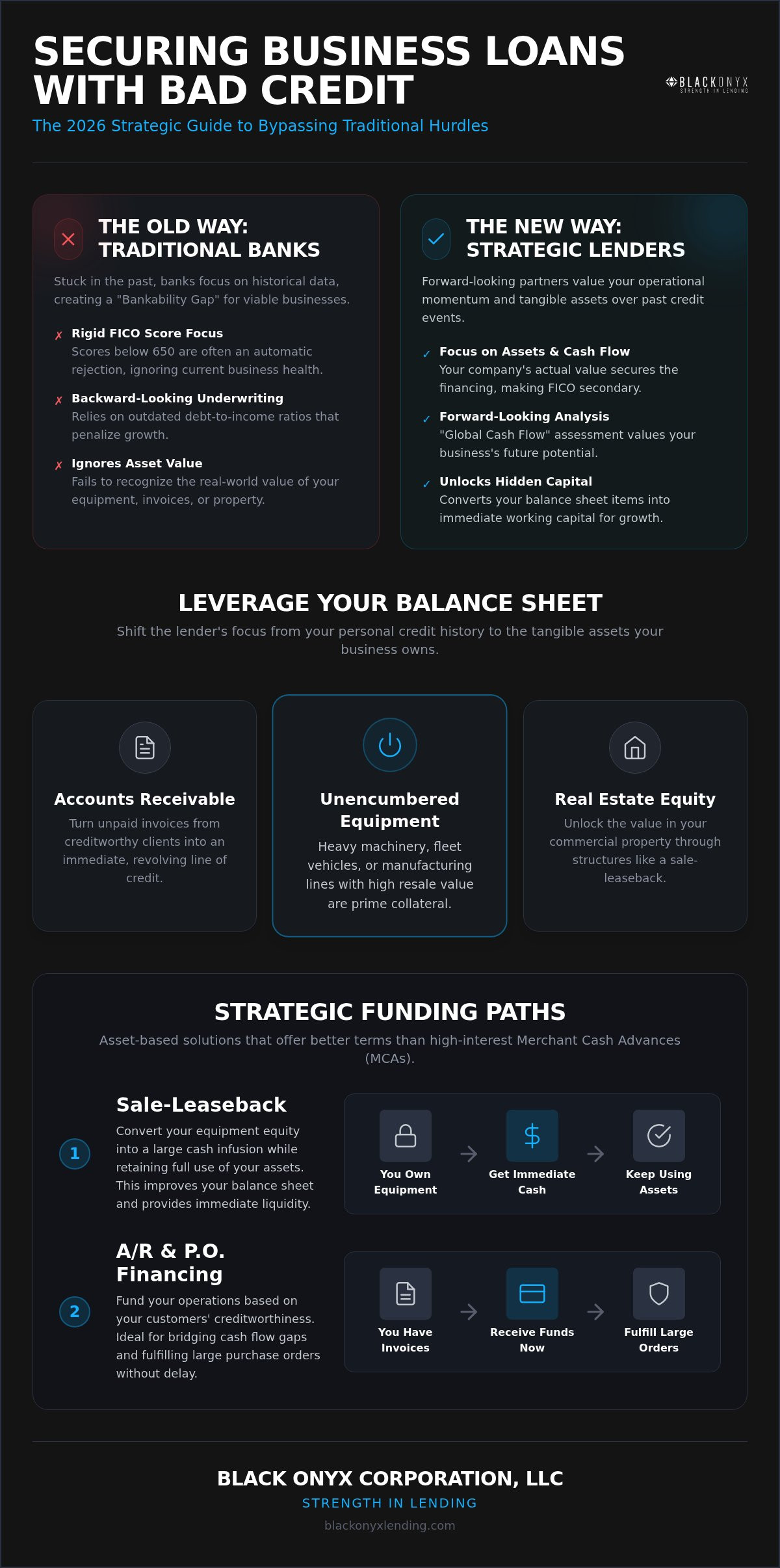
Banks are stuck in the past. In 2026, a FICO score below 620 to 650 is often an automatic rejection from a traditional institution. This rigid threshold creates a “Bankability Gap” where even profitable, growing companies find themselves locked out of capital. While banks obsess over historical credit data, they ignore the current operational health and future potential of your enterprise. Learning how to get a business loan with bad credit requires understanding that risk is a matter of perspective. If a bank sees a low score as a terminal flaw, a strategic lender sees an opportunity to secure the debt against tangible assets.
The Limitations of Traditional Underwriting
Traditional underwriting is a rigid, backward-looking process. It relies heavily on debt-to-income ratios that often fail to capture the true cash flow potential of a high-growth business. In 2026, banks have tightened their lending appetites due to shifting market volatility; this makes them even more risk-averse than in previous years. Credit-invisible businesses are those with robust operations that lack a lengthy traditional borrowing history or have been impacted by isolated historical events, and they are unfairly penalized because their financial narrative doesn’t fit into a standard checkbox. This systemic bias means your rejection probably isn’t about your business’s viability, but rather the bank’s inability to see beyond a three-digit number.
Moving from Limitation to Opportunity
You can change the narrative by shifting the focus from credit history to current liquidity. If you can demonstrate strong cash flow or significant equity in your equipment, the credit score becomes secondary. This is where a commercial finance consultant acts as your strategic bridge. They re-frame your application to highlight the hidden value on your balance sheet that banks typically ignore. Knowing how to get a business loan with bad credit is about identifying partners who prioritize your asset base over your FICO score. Key assets that can offset a poor credit history include:
- Unencumbered Equipment: Heavy machinery, medical devices, or manufacturing lines with high resale value.
- Accounts Receivable: Outstanding invoices from creditworthy clients that represent guaranteed future cash.
- Real Estate Equity: Property value that can be unlocked through specialized structures like a sale-leaseback.
By focusing on these tangible strengths, you move from a position of limitation to one of significant opportunity. We don’t look at where you were three years ago; we look at the strength of your operations today. When you leverage what you own rather than what you’ve done, you regain control over your company’s momentum.
5 Strategic Funding Paths for Businesses with Bad Credit
Most online guides suggest Merchant Cash Advances (MCAs) as the only solution for low credit. These products often carry predatory rates that can cripple your margins. In 2026, the commercial lending market has matured; asset-based lenders now offer sophisticated paths that focus on what your business owns rather than its credit history. If you need to know how to get a business loan with bad credit without sacrificing your equity, these alternative structures are the answer. Selecting the right path depends on whether you have equipment, invoices, or a specific contract to fulfill.
1. Asset-Based Financing and Sale-Leaseback
Sale-Leaseback Financing is a powerful tool for businesses with significant equity in their machinery or fleet. If you own your equipment outright, a lender buys it and leases it back to you. You get an immediate cash infusion while maintaining full operational use of the assets. This structure improves your balance sheet by converting fixed assets into liquid cash. It’s often the most cost-effective way to secure capital when traditional scores are low because the physical asset mitigates the lender’s risk.
2. Accounts Receivable and Purchase Order Financing
Accounts Receivable financing turns your unpaid invoices into a revolving credit facility. Instead of waiting 60 or 90 days for payment, you get funded immediately based on the creditworthiness of your customers. Similarly, Purchase Order (PO) financing allows you to fulfill large contracts even if you lack the cash to buy raw materials. It transitions your business from “waiting for payment” to “executing growth” without needing a 700+ FICO score. These paths are ideal for companies with strong sales but temporary cash flow gaps.
3. Equipment Leasing and SBA Microloans
Equipment leasing is often easier to approve than a standard loan because the equipment itself secures the deal. Under Section 179 tax rules in 2026, businesses can often deduct the full purchase price of qualifying equipment in the year it is placed in service, providing an immediate fiscal benefit. For smaller needs, SBA Microloans provide up to $50,000 with more flexible requirements than standard 7(a) loans. If you’re wondering how to get a business loan with bad credit, these smaller, government-backed options can provide a necessary foothold.
Choosing between these options requires a clear look at your cost of capital. While asset-based structures are significantly cheaper than unsecured “bad credit” loans, they require careful documentation. If you need a partner to help you evaluate which asset is your strongest lever, consulting with a strategic finance expert can help you secure the best possible terms.
The Underwriting Blueprint: How to Offset Credit Risk
Approval is not a matter of luck; it’s a matter of preparation. While traditional banks rely on automated scoring models, strategic lenders utilize a “Global Cash Flow” analysis. This method evaluates the total income available from all business operations and ownership interests to determine repayment capacity. Understanding how to get a business loan with bad credit requires more than just picking a product. It demands a professional presentation of your financial reality. By identifying and fixing “red flags” before submission, you position your company as a calculated risk rather than a gamble. Working with a consultant provides access to “common sense” lenders who prioritize current performance over historical data points.
Crafting a Compelling Executive Summary
Your narrative is just as important as your numbers. An executive summary allows you to address the “why” behind your credit score directly. If your history was impacted by a one-time market shift or a medical emergency, you must document these events as isolated incidents. Lenders in 2026 are looking for resilience and management experience. A strong application highlights your industry tenure and provides a precise “Use of Proceeds” that shows a clear return on investment. If you can prove that the capital will directly generate new revenue, the lender’s focus shifts from your past mistakes to your future profitability.
- Contextualize Credit: Define the specific events that led to the current score.
- Management Strength: Detail the years of experience your leadership team brings to the table.
- ROI Focus: Explain exactly how the funds will be deployed to increase cash flow.
Gathering the Right Documentation
Lenders can’t fund what they can’t see. Moving beyond outdated tax returns is essential for businesses with complex credit profiles. You should provide real-time accounting data from platforms like QuickBooks or Xero to show your most recent month-to-month performance. In the 2026 market, an updated asset appraisal is a high-value tool that confirms the current market worth of your equipment or real estate. Additionally, presenting an accounts receivable aging report builds lender confidence by showing a pipeline of incoming cash from reliable customers. This transparency makes it easier for a partner to see the logic in how to get a business loan with bad credit when the underlying fundamentals are strong.
- Real-Time Financials: Provide profit and loss statements that reflect the last 30 to 60 days.
- Asset Appraisals: Use certified valuations to prove the equity available in your machinery.
- Aging Reports: Show the creditworthiness of your own clients to validate your revenue streams.
Professional underwriting consulting bridges the gap between your current situation and a lender’s requirements. It’s about building a case that makes a “yes” the only logical conclusion for a strategic funding partner.
Leveraging Your Balance Sheet: Asset-Based Solutions
Hard assets serve as the ultimate credit equalizer in the commercial sector. While traditional lenders fixate on personal history, asset-based solutions focus on the liquidation value of what you own. If your business utilizes specialized machinery, you have a powerful lever to pull regardless of your FICO score. Understanding how to get a business loan with bad credit becomes significantly simpler when you stop selling your history and start leveraging your balance sheet. This approach provides far more flexibility than a traditional term loan because the borrowing base often expands as your asset value or inventory grows.
Lenders in 2026 prioritize equipment that maintains high resale value in secondary markets. Yellow iron, such as excavators and cranes, medical imaging devices, and automated manufacturing lines are prime examples. These assets allow you to manage economic obsolescence; by using strategic leasing or asset-backed structures, you can upgrade to newer technology before your current gear loses its competitive edge. This proactive management keeps your operations lean and your capital liquid, ensuring you aren’t tied to depreciating hardware.
The Sale-Leaseback Advantage
A sale-leaseback is a strategic liquidity tool, not a last resort for struggling firms. The process begins with a certified appraisal of your unencumbered equipment to determine its current market value. The lender then purchases these assets from you, providing an immediate infusion of working capital. Finally, you enter into a lease agreement to continue using the equipment for your daily operations. This structure offers significant tax implications; lease payments are often fully deductible as an operational expense, which improves your net income profile. It’s a sophisticated method of unlocking the “dead money” sitting on your factory floor to fuel active growth.
Securing a Line of Credit via Assets
If your business operations rely on a fleet of vehicles, you can discover Alliance Fleet Solutions to learn how their B2B leasing and management services can help you unlock capital while maintaining a modern fleet.
If you need a safety net for payroll or seasonal operational gaps, a secured business line of credit offers a more flexible alternative to a lump-sum loan. Unlike a fixed asset-based loan, a line of credit allows you to draw only what you need when you need it. You can use your existing inventory or equipment to back this facility, ensuring that your business has constant access to capital. This setup is particularly effective for companies wondering how to get a business loan with bad credit while maintaining a revolving source of funds. To see how your specific assets can be converted into a flexible credit facility, you can explore asset-based financing options with our advisory team.
Navigating the Approval Process with Black Onyx
Black Onyx functions as a strategic bridge between your business and a global network of over 100 funding sources. Most entrepreneurs feel overwhelmed by the sheer volume of alternative lenders, many of whom lack transparency or specialized expertise. We simplify this complexity by providing highly individualized attention to every file. If you’ve been searching for how to get a business loan with bad credit, our role is to filter out the noise and connect you with capital providers who value your operational momentum. Our established presence in the US, Canada, UK, and Australia means we can support your expansion across international borders with precision and speed. From the initial consultation to the successful closing, we manage the bureaucratic obstacles so you can focus on your core operations.
The Black Onyx Consulting Approach
Our professional underwriters don’t just process paperwork; they analyze your enterprise from the lender’s perspective. We identify the specific strengths in your balance sheet, such as unencumbered equipment or strong accounts receivable, that offset credit concerns. By leveraging our vast network, we can often pit multiple funding sources against each other to negotiate terms that reflect your potential rather than your past. This advisory layer is your best defense against predatory lenders who use aggressive tactics and unsustainable rates. We move you from a state of limitation to one of significant opportunity by ensuring every deal is structured to support your competitive edge.
Next Steps: Getting Loan Ready
Improving your funding odds starts with a proactive mindset and organized documentation. You can take immediate action today by reconciling your recent bank statements and gathering current valuations for your machinery or property. A strategic review of these assets allows our team to determine the maximum liquidity available to your business right now. If you’re ready to stop facing bank rejections and start fulfilling your customer orders, the path forward is clear. Understanding how to get a business loan with bad credit is far more efficient when you have an expert ally managing the systemic hurdles on your behalf. We provide the clarity and steady forward movement required to secure high-impact commercial financing in any market condition.
Consult with Black Onyx to unlock your capital and reclaim your business’s growth trajectory.
Reclaiming Your Operational Momentum
Credit scores are historical footnotes, not the final word on your enterprise’s viability. By shifting your focus toward balance sheet assets and current cash flow, you bypass the bureaucratic gatekeepers that stall progress. Understanding how to get a business loan with bad credit is essentially a lesson in leveraging what you own to secure the capital you need. Whether through proven Sale-Leaseback structures or specialized Asset-Based Lending, your company’s physical value provides the ultimate credit equalizer in a shifting 2026 market.
Black Onyx Corporation, LLC provides specialized commercial underwriting expertise and a strategic bridge to over 100 global funding sources. We have a proven track record of transforming complex credit profiles into high-impact approvals that fuel long-term success. It’s time to move from a state of limitation to one of significant opportunity. Secure your business’s future with a strategic funding consultation from Black Onyx. Your next phase of growth is within reach; let’s unlock the capital your business deserves today.
Frequently Asked Questions
Can I get a business loan with a 500 credit score?
Securing capital with a 500 credit score is entirely possible if you shift the focus from your personal history to your business assets. Traditional term loans are usually off the table at this level. Instead, you should explore asset-based financing where the equipment or inventory secures the deal. If your business has strong cash flow or unencumbered machinery, these tangible factors can outweigh a poor personal score and lead to a successful approval.
What is the easiest business loan to get with bad credit?
Equipment leasing and accounts receivable financing are often the most accessible paths for credit-challenged entrepreneurs. These structures are easier to obtain because the lender’s risk is mitigated by the asset itself. If you have unpaid invoices from reliable customers, invoice factoring provides immediate liquidity without a deep dive into your credit report. This allows you to maintain operational momentum while bypassing the rigorous scrutiny of traditional bank underwriting and automated rejection systems.
How much can I borrow if my business has bad credit?
The borrowing limit is primarily determined by the liquidation value of your assets rather than your credit score. If you utilize a sale-leaseback, you can typically access a significant portion of your equipment’s appraised value. For invoice-based products, your limit scales directly with your monthly sales volume. This means your funding capacity grows as your business performs, regardless of whether your personal score remains in a lower bracket during a growth phase.
Will a bad credit business loan help improve my credit score?
Some alternative lenders report your payment history to commercial credit bureaus, which can help strengthen your business credit profile over time. However, many asset-based structures are designed for speed and liquidity rather than credit building. If your goal is to understand how to get a business loan with bad credit while improving your score, you should verify that the lender reports to agencies like Experian Business or Dun & Bradstreet before signing.
Do I need collateral for a bad credit business loan?
Collateral is almost always required to secure competitive terms when your credit score is low. By providing a hard asset like manufacturing machinery or real estate, you offer the lender a safety net that offsets your credit risk. For real estate investors, partnering with Evoque Lending allows you to secure financing based on the strength of your investment properties rather than just your credit history. While some unsecured products exist, they often carry much higher rates and shorter repayment terms. Using collateral is a strategic move that allows you to access larger sums of capital with more manageable and predictable payment structures.
Funding timelines vary based on the complexity of your assets and the documentation provided. Simple equipment leasing or invoice factoring can often be finalized within 48 to 72 hours. More complex structures, such as a sale-leaseback involving multiple pieces of heavy machinery, might take one to two weeks to complete appraisals and legal reviews. Working with a consultant who has a global network helps accelerate this process by targeting the right lenders from the start.
What are the interest rates for bad credit business loans in 2026?
In 2026, rates for credit-challenged businesses are higher than traditional bank rates but significantly lower than predatory merchant cash advances. Asset-based loans typically range between 10% and 18% depending on the collateral’s quality and the specific industry. If you use high-value machinery or medical equipment as security, you’ll likely see more favorable terms. The goal is to balance the cost of capital against the return on investment the funds will generate for your company.
Can I get an SBA loan with a low FICO score?
You can obtain an SBA Microloan for amounts up to $50,000 even with a lower FICO score, as these are designed for underserved markets. However, standard SBA 7(a) loans usually require a score of at least 620. If you fall below this threshold, focusing on how to get a business loan with bad credit through asset-based alternatives is a more reliable strategy for securing the high-impact capital you need to scale operations.