


In 2026, many leaders still view collateral as a burden. However, the most successful enterprises recognize that security is actually a strategic lever for aggressive growth. You’ve likely felt the frustration of hitting a ceiling with unsecured financing, where high interest rates and restrictive limits stifle your momentum just as you’re ready to scale. If you’re tired of the slow approval processes at traditional banks, it’s time to reframe your approach. Utilizing a secured business line of credit allows you to convert stagnant balance sheet assets into immediate, high-limit liquidity.
This guide provides the blueprint to master the mechanics of asset-backed funding. You’ll learn how to secure superior rates and unlock the capital necessary to close cash flow gaps during rapid growth phases. We’ll examine the strategic shift from basic borrowing to building a sophisticated capital partnership. By the end of this analysis, you’ll have a clear path to maximizing your borrowing power while maintaining a competitive edge in an evolving market.
Key Takeaways
- Leverage your balance sheet to unlock aggressive growth capital through a secured business line of credit that offers higher limits than traditional unsecured options.
- Identify which asset classes, from accounts receivable to equipment, provide the most leverage in the current economic environment.
- Contrast the reporting flexibility of a revolving credit line with the structured oversight of asset-based lending to find your enterprise’s ideal fit.
- Master the underwriting process by learning how to present your financials as a strategic narrative that removes bureaucratic obstacles.
- Access a global network of over 100 specialized funding sources to ensure your liquidity isn’t tied to the limitations of a single institution.
The Strategic Value of a Secured Business Line of Credit in 2026
A secured business line of credit represents a sophisticated revolving capital tool that transforms your company’s balance sheet into active liquidity. Unlike stagnant cash reserves, this facility is backed by specific commercial assets, such as accounts receivable, inventory, or equipment. As we enter 2026, market volatility has made traditional, unsecured borrowing more restrictive and expensive. Lenders are tightening their belts, yet your need for capital hasn’t diminished. By providing security, you shift the conversation from perceived risk to tangible value. This transition is a core component of strategic commercial financing, where every asset is positioned to fuel long-term expansion rather than just covering short-term gaps.
Security as a Catalyst for Higher Limits
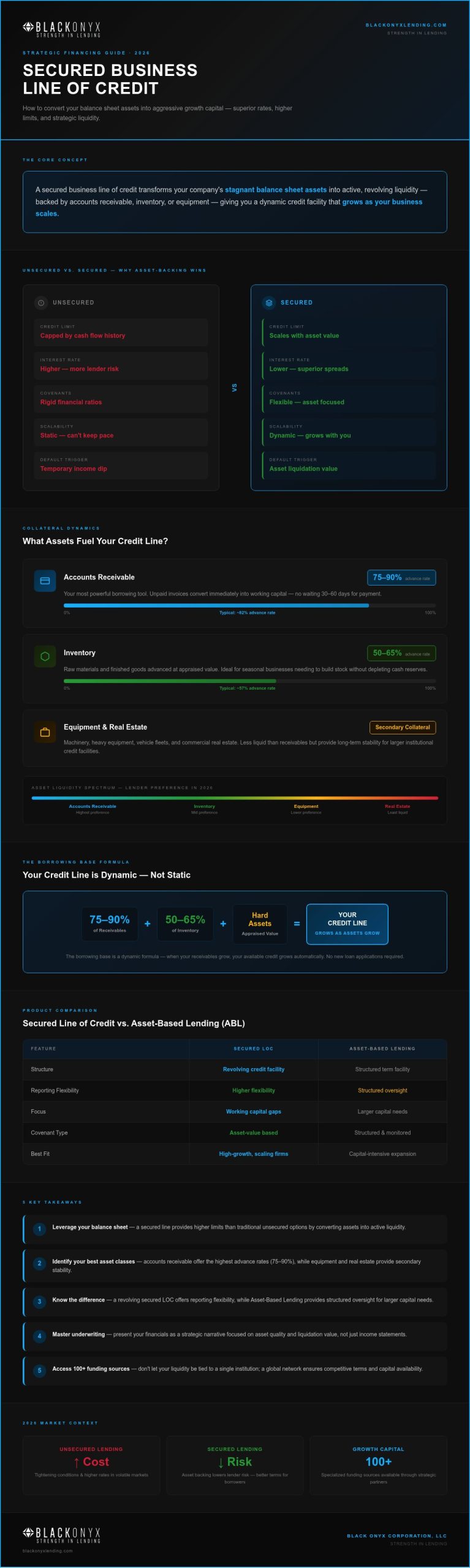
Collateral acts as a powerful catalyst for capital access. When you pledge assets, you effectively lower the lender’s risk profile, which triggers a significant increase in your credit ceiling. Most unsecured lines are capped by your historical cash flow, creating a “limit ceiling” that can’t keep pace with rapid scaling. In contrast, a secured business line of credit scales with your success. The facility’s size is determined by a borrowing base calculation; this is a dynamic formula that evaluates the current value of your pledged collateral. If your accounts receivable grow, your available credit grows alongside them. This allows high-growth firms to maintain aggressive momentum without the constant need for new loan applications or bureaucratic delays.
Unsecured vs. Secured: Why Asset-Backing Wins
The decision to pivot from unsecured debt to asset-backed structures often comes down to the bottom line. Secured options consistently offer superior interest rate spreads because the lender has a clear path to recovery. Beyond the cost of capital, security often buys you more favorable loan covenants. Unsecured lenders frequently impose rigid financial ratios that can trigger a default during a temporary dip. Secured facilities are generally more resilient. They focus on the asset’s liquidation value rather than just the quarterly income statement. If your enterprise is moving out of a startup phase and into a capital-intensive growth cycle, transitioning to an asset-based structure provides the repayment flexibility and liquidity depth that cash-flow-based borrowing simply cannot match.
Collateral Dynamics: What Assets Fuel Your Credit Line?
Identifying the right assets is the first step in optimizing a secured business line of credit. In the 2026 economic climate, lenders prioritize liquidity and marketability above all else. If your assets can be quickly converted to cash, they carry significantly more weight in your borrowing base calculation. This valuation process isn’t static; it requires constant monitoring. This is where business cash flow solutions become essential, as they help you manage the underlying strength of the assets you pledge. By maintaining high-quality receivables and efficient inventory turnover, you ensure your credit line remains robust and responsive to market shifts.
Leveraging Accounts Receivable and Inventory
Your unpaid invoices are often your most powerful borrowing tool. Instead of waiting 30 or 60 days for payment, you can turn these receivables into immediate working capital. This approach avoids the high costs of permanent factoring while providing the same liquidity benefits. Advance rates, which define the percentage of an invoice’s value you can borrow, typically range from 75% to 90% for accounts receivable. Inventory also serves as a viable security, though advance rates here are often lower, typically between 50% and 65%. Whether you hold raw materials or finished goods, lenders can advance funds against their appraised value. This ensures your capital isn’t trapped in warehouse shelves during critical growth phases. If your inventory is seasonal, a secured line provides the breathing room to build stock without depleting your cash reserves.
Equipment and Real Estate as Secondary Collateral
Hard assets provide a foundation of stability for larger credit facilities. If your business owns specialized machinery, heavy equipment, or a vehicle fleet, these assets can bolster your borrowing base significantly. While these assets are less liquid than receivables, they offer long-term security that appeals to institutional lenders. You should also consider how commercial equipment leasing can complement your strategy. By leasing new acquisitions while pledging existing machinery as collateral, you maximize your available capital from two different angles. Commercial real estate remains a premier option for securing the lowest possible interest rates on long-term lines. If you’re looking to optimize your asset mix for maximum funding, consulting with a strategic advisor can help you navigate the complexities of modern valuation and lender preferences.
Comparison: Secured Line of Credit vs. Asset-Based Lending (ABL)
While both facilities rely on collateral, a secured business line of credit and a structured Asset-Based Lending (ABL) facility serve different strategic objectives. A revolving line usually functions like a traditional bank account with a credit limit, whereas ABL is a more rigorous, formula-driven arrangement. Understanding the asset based line of credit requirements is critical because the reporting intensity varies significantly between the two. If your firm maintains a clean balance sheet and predictable cycles, a secured line offers lower management costs. If you’re a high-volume enterprise with complex inventory, the deeper liquidity of ABL justifies the additional audit fees and management expenses.
Flexibility vs. Structure: Choosing Your Path
A revolving secured business line of credit is often the superior choice for managing seasonal fluctuations. It provides immediate access to funds without the daily oversight required by full ABL structures. However, larger enterprises often opt for ABL because it allows for higher leverage against a broader range of assets. This choice directly impacts your debt-to-equity ratio. A well-structured facility can often be positioned as a working capital tool rather than long-term debt, which improves your overall financial appearance to stakeholders. Choosing the right path depends on whether you value operational simplicity or maximum capital depth.
Reporting and Monitoring in 2026
In 2026, the burden of reporting has shifted from manual spreadsheets to automated systems. Modern digital monitoring tools now integrate directly with your ERP system, simplifying the creation of monthly borrowing base certificates. This technology reduces the friction once associated with asset-backed funding. Frequent asset appraisals still play a role, as they provide real-time adjustments to your available credit based on current market values. A strategic advisor acts as the bridge here, ensuring that communication between your operations team and the lender remains fluid. This proactive management prevents funding freezes and ensures that your liquidity remains uninterrupted even during rapid market shifts.
The Underwriting Roadmap: Securing Approval in a Modern Market
Securing a secured business line of credit in 2026 requires more than just a strong balance sheet; it demands a clear, strategic narrative. Modern lenders have moved beyond simple credit scores to prioritize deep-dive analytics. If you enter the application process without a cohesive story for your data, you risk being categorized as high-risk regardless of your actual asset value. This is where business financial consulting becomes a critical asset. An expert consultant identifies and mitigates red flags, such as lumpy revenue cycles or aging receivables, before a lender’s automated system can flag them for rejection.
Essential Documentation and Financial Ratios
Preparation begins with the “Big Three” documents: detailed balance sheets, profit and loss (P&L) statements, and comprehensive accounts receivable (AR) aging reports. Lenders scrutinize these to calculate your Debt Service Coverage Ratio (DSCR), which measures your ability to cover interest and principal payments. They also look closely at your current ratio to ensure your short-term liquidity is sufficient to handle the revolving nature of the facility. Professional underwriting can improve approval odds by up to 40%. By organizing your financials into a lender-ready format, you remove the friction that often leads to delays or unfavorable terms.
The Role of Professional Underwriting Consulting
A professional consultant acts as a strategic bridge between your raw operational data and the lender’s specific expectations. If your business has unique asset strengths that don’t fit into a standard box, then a consultant’s role is to translate that value into a language the underwriter respects. This expertise extends beyond the initial approval to the negotiation of covenants and release clauses. You shouldn’t just focus on the interest rate; you need to ensure the facility’s structure doesn’t restrict your operational freedom. If you’re ready to move from a state of limitation to one of significant opportunity, partnering with a professional underwriting consultant is the most efficient path to success.
Maximizing Liquidity with Black Onyx Strategic Financing
Black Onyx Corporation, LLC functions as a strategic bridge, connecting your commercial enterprise to a vast network of over 100 third-party funding sources. In the volatile economy of 2026, relying on a single bank relationship is a significant strategic risk. Traditional institutions operate with rigid, internal-only rules that can change without notice. If your business suddenly falls outside their narrow risk appetite, your access to capital could vanish overnight. Working with a business financing broker allows you to bypass these systemic hurdles. We create competitive tension among multiple lenders, ensuring you secure the most aggressive terms for your secured business line of credit.
Our process is rooted in precision. We don’t just broadcast your data; we match your specific asset profile with the ideal commercial lender. Whether your strength lies in a high-quality AR aging report or a fleet of heavy machinery, we position those assets to maximize your borrowing base. This individualized attention transforms your balance sheet from a static report into a powerful engine for growth. By removing bureaucratic obstacles, we foster a sense of momentum that keeps your enterprise ahead of the competition.
Customized Solutions for Complex Commercial Needs
Many mid-market firms face the “unbankable” challenge because their rapid growth outpaces a traditional bank’s comfort level. We solve this by structuring multi-asset security packages that combine accounts receivable, equipment, and commercial real estate into a single, cohesive facility. This comprehensive approach unlocks deeper liquidity than single-asset lenders can provide. Speed is our primary objective. While a standard bank might take months to process a complex application, our personalized underwriting and consulting expertise allow us to move from initial application to funding in days. This efficiency ensures you have the capital to act on market opportunities the moment they arise.
Global Reach, Local Expertise
Our firm is proud of its Troy, Michigan heritage, where we offer the high-level consulting you expect from a dedicated partner. However, our reach is truly global. We leverage financing partners across the United States, Canada, Australia, and the UK to support your international expansion. Whether you require asset-based financing in the Midwest or equipment leasing for a facility in London, we coordinate the resources to make it happen. Strategic growth in 2026 requires a partner who understands the nuances of global capital markets and acts as a powerful ally in your success. Don’t let traditional banking limits dictate your future; it’s time to unlock the full potential of your commercial assets.
Mastering Your Capital Strategy for 2026 and Beyond
The transition from restrictive unsecured debt to a secured business line of credit is a decisive move to ensure long-term liquidity. You’ve seen how asset-backing removes bureaucratic obstacles and unlocks significantly higher borrowing limits. By leveraging your accounts receivable, equipment, or real estate, you convert stagnant value into a dynamic growth engine. Success in this landscape doesn’t happen by accident. It requires a strategic bridge between your complex operational needs and a global network of capital resources.
Black Onyx Corporation, LLC provides that bridge. We offer access to over 100 funding sources and provide the expert underwriting necessary for complex commercial deals. Whether you operate in the US, Canada, Australia, or the UK, we’re ready to act as your powerful ally. Don’t let traditional banking limitations hold your enterprise back when transformative opportunity is within reach.
Secure Your Strategic Growth Capital: Consult with Black Onyx Today. We’re here to help you navigate the 2026 market with precision and confidence.
Frequently Asked Questions
What is the difference between a secured and unsecured business line of credit?
A secured line requires collateral, while an unsecured line relies solely on your credit profile and cash flow. Secured options typically provide higher limits and lower interest rates because the lender has a secondary source of repayment. If you provide assets like inventory or receivables, you gain access to capital that cash-flow-based lending cannot match. This structure provides a safety net for lenders which results in better terms for you.
What types of assets can I use as collateral for a business line of credit?
Primary assets include accounts receivable, inventory, machinery, and commercial real estate. Specialized equipment and vehicle fleets also serve as viable security. Black Onyx matches your specific asset profile with lenders who prioritize those particular items. By pledging diverse assets, you can often secure a larger facility than you would by relying on a single asset class. This flexibility is key for multi-faceted commercial operations looking to scale.
How much can I borrow with a secured business line of credit in 2026?
Borrowing limits are determined by your borrowing base, which is a percentage of your asset’s appraised value. While unsecured lines often cap at a fraction of annual revenue, a secured business line of credit can reach significantly higher amounts depending on your collateral. If your accounts receivable grow, your limit scales automatically. This dynamic structure ensures your liquidity keeps pace with your operational expansion and current market demand.
What happens if my business cannot repay a secured line of credit?
If a default occurs, the lender has the legal right to liquidate the pledged assets to recover the debt. This is why professional consulting is vital during the underwriting phase. We help you structure covenants and repayment terms that provide breathing room during lean cycles. If you maintain transparent communication with your lender, you can often negotiate extensions or restructuring before your assets are actually at risk of seizure.
How do interest rates for secured lines compare to traditional business loans?
Secured lines typically offer lower interest rates than traditional unsecured loans or credit cards. Lenders charge a smaller risk premium because the debt is asset-backed. You’ll find that the spread between the prime rate and your cost of capital is much tighter with a secured business line of credit. This reduced interest expense directly improves your net margins and provides more predictable monthly operating costs for your enterprise.
Can I use my accounts receivable to secure a line of credit?
Yes, accounts receivable are a premier asset class for securing these facilities. Lenders typically advance between 75% and 90% of your eligible invoice value. This allows you to bridge the gap between service delivery and client payment without the high costs of permanent factoring. It’s an ideal solution for businesses with long billing cycles or those experiencing rapid growth that outpaces their available cash on hand.
How long does the approval process take for an asset-backed line of credit?
The timeline varies, but our personalized underwriting process can move from application to funding in just a few business days. Traditional banks may take weeks or months to evaluate complex collateral. By utilizing our network of 100+ funding sources, we bypass standard bureaucratic delays. If your documentation is prepared according to our roadmap, we can expedite the appraisal and legal review phases to ensure you get capital quickly.
Do I need a perfect credit score to qualify for a secured line of credit?
No, a perfect score isn’t required because the lender’s primary security is the asset itself. While your credit history is still reviewed, the quality and liquidity of your collateral carry more weight in the final decision. This makes asset-backed financing an excellent option for firms with strong operations but less-than-ideal credit profiles. We focus on the tangible value within your business rather than a single numerical score.