


What if your largest sales win didn’t trigger a liquidity crisis, but instead served as the immediate engine for your next stage of expansion? Many high-growth companies face the same agonizing hurdle; they have the demand, but they don’t have the upfront capital to satisfy demanding suppliers. If you’ve ever felt the sting of passing on a lucrative contract because of a cash flow gap, you know that traditional lending often moves too slowly to capture market momentum. This is where strategic purchase order financing steps in to bridge the divide between your current capacity and your true potential.
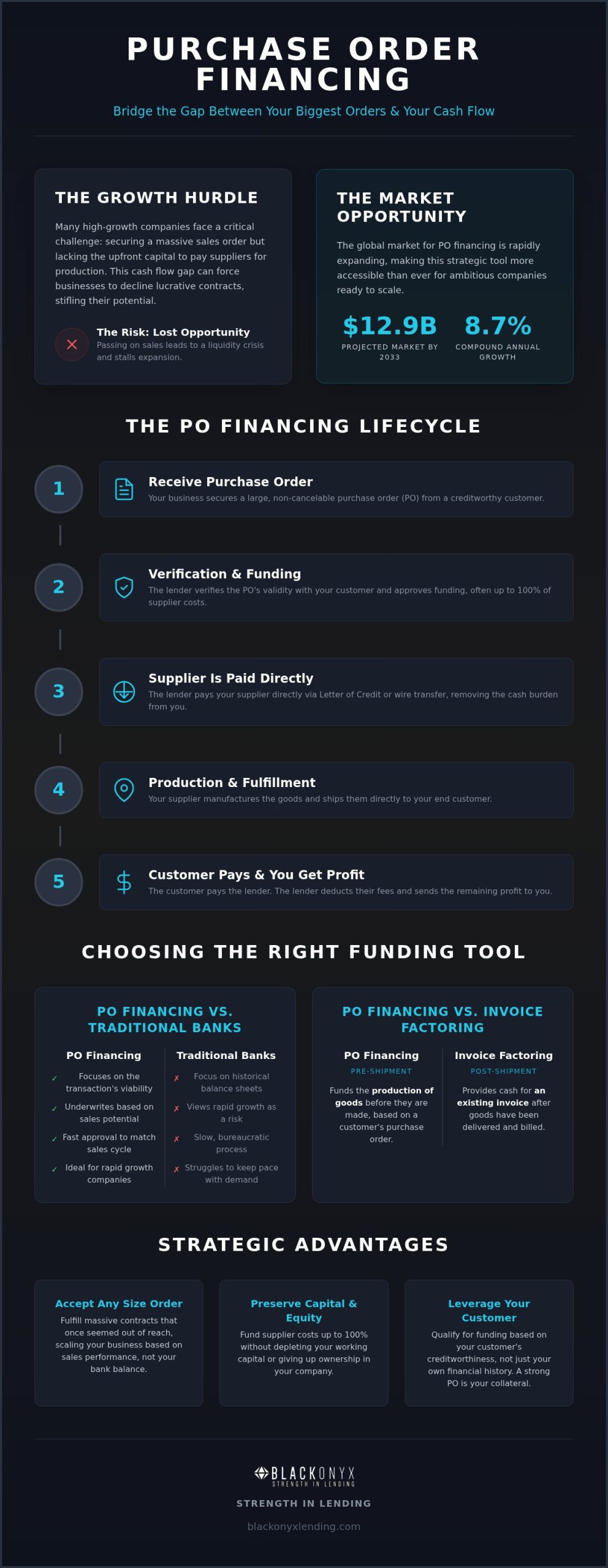
We understand that your business should scale based on your sales performance, not just your existing assets. This guide will show you how to fulfill massive orders and secure funding for supplier costs without depleting your capital reserves or diluting your hard-earned equity. With the global market for this solution projected to reach $12.9 billion by 2033 at an 8.7% annual growth rate, these tools for rapid scaling are becoming more accessible than ever. We’ll break down the mechanics of securing up to 100% funding for your production costs, maintaining a healthy balance sheet, and leveraging the creditworthiness of your customers to outpace your competition.
Key Takeaways
- Discover how direct supplier payments eliminate out-of-pocket burdens. You’ll learn to accept orders that once seemed out of reach.
- Master the step-by-step lifecycle of purchase order financing, from initial verification to the final payment from your customer.
- Identify the strategic differences between pre-shipment funding and invoice factoring. This ensures you don’t overpay for liquidity.
- Learn to leverage your customer’s credit profile and your supplier’s track record to qualify for funding based on sales potential.
- Gain access to more than 100 global funding sources through a single advisory bridge that prioritizes your competitive edge.
The Dynamics of Purchase Order Financing: Bridging the Capital Gap
Scaling a distribution or manufacturing business often feels like a race against your own bank balance. If you’ve secured a contract that exceeds your current cash on hand, you face a critical choice: decline the business or find a way to fund production. Purchase order financing is a non-equity funding strategy where a third party pays a supplier for goods required to fulfill a specific, verified customer order. It’s a short-term solution designed to bridge the capital gap by ensuring your suppliers are paid before you even touch the product. By facilitating the direct payment of costs associated with a specific Purchase Order, the lender removes the immediate out-of-pocket burden from your shoulders.
This model is particularly effective for wholesalers, distributors, and manufacturers who operate with high-margin orders but limited liquidity. Instead of waiting for a bank to approve a general line of credit, you leverage the strength of the transaction itself. If the order is profitable and the end customer is creditworthy, the funding follows the opportunity. This allows you to accept larger contracts than your current balance sheet would normally permit.
Why Traditional Banks Often Fail Growing Distributors
Traditional banks typically prioritize historical balance sheets and two years of tax returns. They look backward. If your business is growing faster than your previous year’s performance suggests, a bank will likely view you as a risk. This bureaucratic approach often misses the reality of a booming sales pipeline. In contrast, asset-based lenders maintain a transaction-first mindset. They focus on the viability of the current deal rather than the limitations of your past. Black Onyx acts as a strategic bridge to this non-bank capital, helping you bypass traditional red tape to secure the momentum your business deserves.
The Role of Working Capital in Supply Chain Stability
Rapid growth can be dangerous if it leads to “overtrading,” a state where your company expands faster than its cash reserves can support. Without adequate liquidity, you risk straining supplier relationships or missing delivery deadlines. Prompt payments foster trust and can even lead to better pricing or priority production slots. Utilizing purchase order financing ensures you maintain a healthy level of working capital for small business operations while fulfilling large-scale contracts. This stability allows you to scale based on sales demand without the fear of a cash flow collapse.
The Step-by-Step Lifecycle of a PO Financing Transaction
Successful purchase order financing requires more than just a capital injection; it demands a synchronized orchestration of your entire supply chain. If the logistics fail, the capital is irrelevant. Understanding this lifecycle ensures you can manage expectations with both your suppliers and your customers while maintaining a high level of professional efficiency. A comprehensive Purchase Order Financing Guide can provide additional context, but the practical application depends on precise execution within your specific industry.
From Purchase Order to Supplier Payment
The process begins when your business receives a substantial, non-cancelable purchase order from a creditworthy customer. This document serves as the primary collateral for the transaction. Once received, Black Onyx consults with you to structure the deal and identify the most compatible funding source from our global network. Unlike traditional bank loans, the speed of this assessment is designed to match the urgency of your sales cycle.
Before any funds move, the lender enters the critical verification phase. They confirm the validity of the order directly with your customer to ensure the contract is legitimate and the terms are clear. This step is vital for preventing the administrative delays that often plague unguided transactions. After successful verification, the lender issues a Letter of Credit or makes a direct payment to your supplier. This ensures that the capital is used exclusively for production, removing the financial burden from your company’s balance sheet.
Fulfillment and the Transition to Accounts Receivable
With the supplier paid, production commences. The goods are then shipped directly to your customer or a verified third-party logistics provider. At this stage, the transaction moves from a “pre-shipment” risk to a “post-shipment” reality. Once the customer accepts the delivery, the purchase order financing is typically repaid through accounts receivable financing. This transition is a strategic move that significantly lowers your overall cost of capital. Because a delivered good represents a lower risk than a work-in-progress, the interest rates for factoring are generally more favorable.
This seamless handoff allows you to settle the initial funding and secure immediate working capital from the resulting invoice. If you’re ready to streamline your fulfillment process, you can connect with our advisory team to discuss a tailored structure for your next major contract. By following this methodical lifecycle, you transform a single sales win into a repeatable engine for scalable growth.
Purchase Order Financing vs. Invoice Factoring: Choosing the Right Lever
Choosing between different liquidity tools requires a clear understanding of where your cash is currently trapped. While invoice factoring provides liquidity against work already completed, purchase order financing provides the capital necessary to begin production. The primary distinction lies in the timing of the funding relative to the shipment of goods. If you’ve already delivered the product and are simply waiting 30 to 60 days for a customer to pay, factoring is the appropriate tool. However, if you’re staring at a contract you can’t even start because your supplier demands payment upfront, you need the pre-shipment power of a PO-based solution.
The cost structures reflect the inherent risks of these two stages. Because production involves manufacturing risks, quality control issues, and potential delivery delays, purchase order financing typically carries higher fees than factoring. Lenders view a completed, accepted invoice as a much safer asset than a promise to build something. We often advise a strategic “if-then” approach for our clients. If you need to pay a third-party manufacturer to release inventory, use PO funding. If you need to cover immediate internal costs like payroll or rent while waiting on open invoices, factoring is the more cost-effective choice.
When to Use PO Financing Over a Line of Credit
A traditional secured business line of credit often feels like a safety net until it hits its ceiling. Banks set these limits based on your historical performance, which creates a paradox: you can’t get more credit until you grow, but you can’t grow without more credit. While SBA Funding Programs provide vital long-term support, they rarely offer the agility needed for a sudden 300% spike in order volume. In these scenarios, PO funding offers a distinct advantage because it scales “up” with your sales. The more orders you secure from creditworthy customers, the more capital becomes available. This funding can often be secured in days rather than the months required for traditional bank increases.
Integrating Multiple Funding Sources for Maximum Liquidity
The most sophisticated growth strategies don’t rely on a single product; they coordinate multiple tools into a seamless capital stack. Black Onyx acts as the strategic architect in these arrangements, often coordinating between PO lenders and factoring companies. This coordination requires “inter-creditor agreements” to ensure each lender knows exactly when their priority begins and ends. For example, strategic growth often requires more than just inventory capital. Utilizing commercial equipment leasing ensures you have the physical capacity to process the orders you’ve just funded, creating a comprehensive foundation for rapid expansion. Businesses that also carry significant stock should explore inventory financing for small business to unlock the dormant capital sitting on their warehouse shelves and further strengthen their overall liquidity position.
Strategic Underwriting: Qualify for High-Value PO Funding
Underwriting for purchase order financing differs fundamentally from traditional bank lending. Instead of scrutinizing your company’s debt-to-equity ratio, lenders focus on the creditworthiness of your end customer. This shift in focus allows emerging businesses to leverage the financial strength of their buyers as their primary collateral. If you’re selling to a Fortune 500 company or a major government entity, the strength of that contract becomes your most valuable asset during the approval process.
Beyond the customer’s credit, lenders evaluate the reliability of your supplier. A proven track record of on-time delivery and quality control is essential for securing approval. Additionally, most funding sources require a gross margin of at least 20% on the transaction. This margin acts as a safety net, ensuring that the deal can absorb minor fluctuations in shipping or material costs without jeopardizing the repayment. To begin the process, you must provide the original purchase order, detailed supplier quotes, and relevant credit reports for your customer. Understanding how your overall debt structure aligns with your cash cycle is equally important; reviewing the working capital for small business 2026 Strategic Readiness Checklist can help you identify gaps in your liquidity position before approaching lenders.
The Black Onyx Underwriting Advantage
Our team provides professional underwriting that acts as a strategic bridge between your business and over 100 global funding sources. We don’t just submit applications; we package your deal to highlight its strengths and mitigate its risks. Common red flags, such as cancelable clauses or ambiguous delivery timelines in a PO, can lead to immediate rejection by many lenders. We identify and resolve these issues before they reach a lender’s desk. Your transactional history also plays a vital role here. As you successfully fulfill more orders through our network, you build the credibility needed to secure lower rates and higher advance limits.
Handling International and Government Contracts
Qualifying for government contracts involves navigating specific regulatory hurdles that differ from private sector deals. Whether you’re working with federal or state agencies, the non-cancelable nature of these orders makes them highly attractive to lenders. For international trade, we facilitate the use of Letters of Credit to secure global supply chains. This ensures that your overseas manufacturers receive guaranteed payment once shipping conditions are met. Black Onyx serves businesses across the US, Canada, Australia, and the UK, providing the global reach necessary for modern trade. If you need an expert to review your current purchase orders for funding eligibility, our advisory team is ready to structure your next high-value deal.
Navigating 100+ Funding Sources with Black Onyx Consulting
Finding the right capital partner shouldn’t be a game of chance or a repetitive cycle of rejection. While many direct lenders restrict you to their specific, narrow risk appetite, Black Onyx operates as a strategic bridge to a network of over 100 global funding sources. This brokerage model provides a vast range of options through a single point of contact, ensuring your growth isn’t held hostage by one institution’s internal policy. If your current lender’s criteria don’t align with a specific high-value contract, we pivot to a specialist that understands your unique market dynamics and industry requirements.
Our personalized consulting approach, headquartered in Troy, Michigan, is built on the principles of speed and precision. We recognize that purchase order financing is a time-sensitive tool that requires immediate action to satisfy supplier demands. By matching your specific order type with a specialist lender, we facilitate a faster path to production and fulfillment. We don’t just find money; we structure the deal for long-term success. This moves beyond a one-time transaction, positioning us as a proactive ally in your scalable growth strategy for 2026 and beyond.
Beyond the Local Bank: A Global Network of Capital
Local banks in Troy or other regional hubs often lack the specialized underwriting expertise needed for complex trade finance. They tend to focus on historical assets and backward-looking balance sheets, which can leave growing distributors in a lurch when a massive order arrives. Our reach extends into Canada, the UK, and Australia, providing the international infrastructure required for modern, global supply chains. We challenge conventional wisdom by finding liquidity where others see systemic hurdles. If you’re dealing with international suppliers or complex government agencies, we have the resources to bridge those gaps and keep your production on track.
Take the Next Step Toward Scalable Growth
The transformative potential of this strategy is clear. It allows you to fulfill massive orders and bridge cash flow gaps without depleting your capital reserves or diluting your equity. Our results-oriented approach is designed to remove the bureaucratic obstacles that typically slow down expansion for wholesalers and manufacturers. If you’re ready to secure your competitive edge and move from a state of limitation to one of significant opportunity, consult with a Black Onyx expert to review your current purchase orders. We’ll provide the individual attention and professional underwriting needed to turn your biggest sales wins into lasting momentum.
Accelerate Your Market Momentum with Strategic Capital
Scaling your operations in 2026 shouldn’t be limited by the size of your current bank account. By leveraging purchase order financing, you transform confirmed sales into immediate production power. We’ve explored how this tool bridges the gap between massive contracts and supplier demands, allowing you to maintain a healthy balance sheet while fulfilling global orders. If you shift your focus from historical assets to future transaction potential, you unlock a level of scalability that traditional lenders simply can’t match.
Black Onyx provides the expertise needed to navigate this complex financial landscape. With access to 100+ commercial funding sources and professional underwriting services, we structure deals that secure your competitive edge across the US, Canada, UK, and Australia. Our results-oriented approach removes the bureaucratic hurdles that often stall momentum. Don’t let a lack of upfront capital stand between you and your next major sales win. Consult with a Black Onyx Financing Expert Today to review your current purchase orders and build a foundation for sustainable growth. Your next stage of expansion is ready to begin.
Frequently Asked Questions
What is the typical cost of purchase order financing in 2026?
Fees typically range from 1.5% to 6% for every 30-day period the funding remains outstanding. This cost is determined by the creditworthiness of your customer and the complexity of your supply chain logistics. If your customer pays the final invoice quickly, your total expense stays low. While the annualized rate may exceed 20%, it functions as a transactional cost that doesn’t require monthly interest payments from your working capital.
Can I get PO financing if my business has bad credit?
Yes, you can qualify for purchase order financing even if your business has a limited or poor credit history. Lenders prioritize the credit profile of the end customer who issued the order and the reliability of your supplier. If the transaction is profitable and involves a reputable buyer, your corporate credit score becomes a secondary factor. This makes it a powerful tool for startups or companies in turnaround phases.
Is purchase order financing considered a loan on my balance sheet?
This funding is typically viewed as a transactional advance rather than a traditional term loan. It doesn’t usually appear as debt on your balance sheet in the same way a bank loan would. Instead, it’s an asset-based transaction tied to a specific, verified order. This structure helps you maintain a healthy debt-to-equity ratio, which is crucial if you plan to seek larger corporate financing or SBA loans later.
What is the minimum purchase order size that Black Onyx can fund?
Most funding sources in our global network require a minimum order size of $50,000 to initiate a transaction. This threshold ensures that the gross margins can cover the administrative and underwriting costs while still providing a significant profit for your business. If you have multiple smaller orders from the same customer, we can often package them together to meet the requirements for our 100+ global sources.
How long does it take to get approved for PO funding?
The initial approval process typically takes between five to ten business days. Once your account is established and the initial underwriting is complete, subsequent orders can often be funded within 48 to 72 hours. This speed is a primary advantage over traditional banking bureaucracy. Our team in Troy, Michigan, works to streamline the verification phase so you can meet your supplier’s production deadlines without any unnecessary delays.
Will my customers know that I am using purchase order financing?
Your customer will be aware of the arrangement because the lender must verify the purchase order’s validity directly with them. However, this is a standard practice in commercial trade and is often viewed as a sign of professional maturity. It demonstrates that you have the financial backing to fulfill large-scale contracts. We manage this communication with high efficiency to ensure your customer relationship remains focused on the delivery.
Can PO financing be used for service-based businesses or just goods?
This solution is specifically designed for businesses that sell finished goods or raw materials, such as wholesalers, distributors, and manufacturers. It’s not typically suitable for service-based businesses because there is no physical product to serve as collateral. If you run a service-oriented company and need liquidity, we generally recommend accounts receivable financing or payroll financing to bridge your cash flow gaps while waiting for client payments.
What happens if my customer cancels the purchase order after it is funded?
Most lenders require the purchase order to be non-cancelable to mitigate this risk. If a customer cancels after the supplier has been paid, you are generally responsible for the outstanding balance. This is why our underwriting team scrutinizes the terms of every contract before approval. We focus on securing orders from creditworthy entities to minimize these outcomes and ensure that the transaction remains a safe engine for your scalable growth.