
What if the heavy machinery or high-tech hardware you purchased yesterday is already costing your business more in lost opportunity than it’s worth in salvage value? For many growing firms, the traditional model of ownership has become a quiet drain on the bottom line. If your capital is trapped in depreciating assets, you’re likely struggling with rising maintenance costs and the frustration of falling behind more agile competitors. By leasing equipment to avoid obsolescence, you can stop treating technology as a permanent fixture and start viewing it as a fluid, strategic advantage.
It’s a common frustration to watch your fleet age while newer, faster alternatives hit the market. This guide will show you how to transform that technological depreciation into a sharp competitive edge. You’ll discover how to maintain a modern fleet and preserve your cash flow for growth by transferring the risk of outdated hardware to a third party. We’ll break down the 2026 landscape, including the $2,560,000 Section 179 limit and the 100% bonus depreciation rules, to ensure your next move is both tax-efficient and strategically sound.
Key Takeaways
- Identify the specific financial drains of technological, functional, and economic obsolescence to prevent them from eroding your bottom line.
- Shift your focus from Total Cost of Ownership to Total Cost of Access to better align equipment expenses with actual productive life.
- Master the 2026 tax landscape by using Section 179 and bonus depreciation to maximize the fiscal benefits of your leasing strategy.
- Learn how to categorize your assets by “Innovation Speed” so you can prioritize leasing equipment to avoid obsolescence in high-growth areas.
- Access a global network of over 100 funding sources to secure flexible, asset-based financing tailored to your specific operational needs.
The Invisible Drain: How Equipment Obsolescence Erodes Your Bottom Line
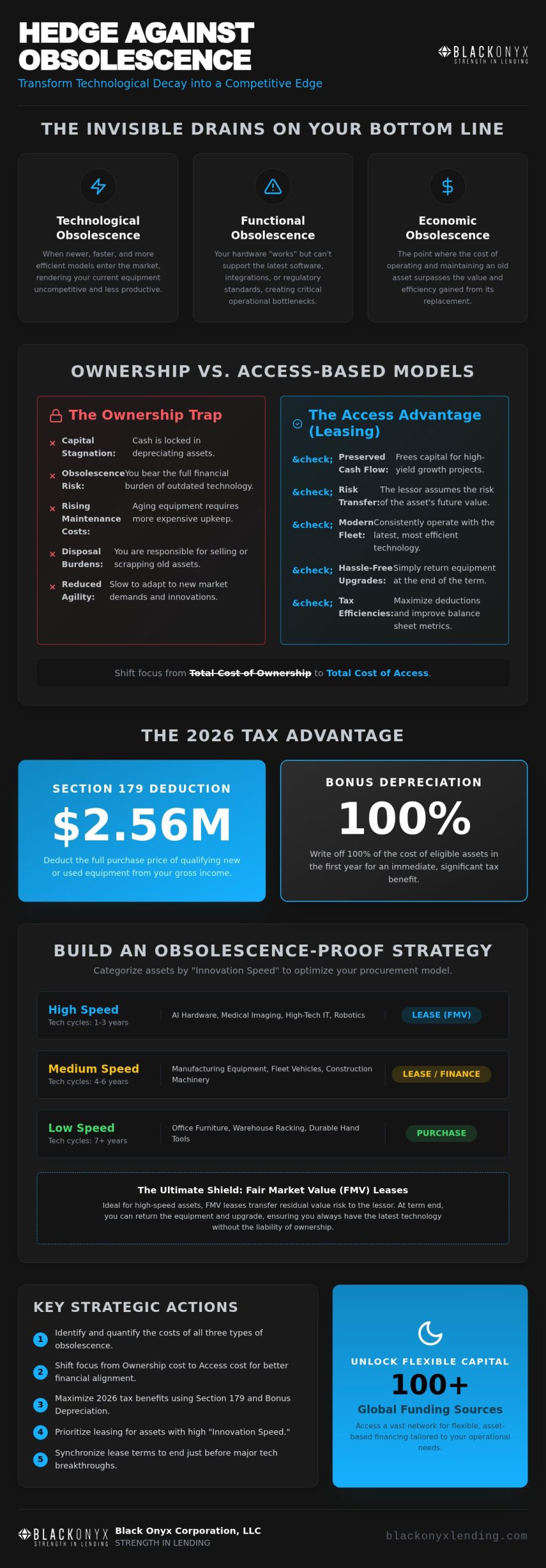
Ownership is often a financial trap. In the commercial sector, holding onto a physical asset until it is fully depreciated can actually bleed your company dry. If you’re relying on a traditional seven-year depreciation schedule in 2026, you’re likely falling behind. Innovation in equipment and software is projected to increase by 6.2% this year alone. This rapid pace means that the equipment obsolescence you face isn’t just a future risk; it’s a current financial drain that compounds every month you delay an upgrade.
Most executives recognize technological obsolescence, where a newer model simply outperforms the old one. However, functional and economic decay are equally dangerous. Functional decay occurs when your hardware can’t support the latest software updates or regulatory standards. When you find yourself in this position, your “paid-for” equipment has become a liability that slows down your entire operation. By leasing equipment to avoid obsolescence, you ensure your infrastructure evolves at the same speed as your industry.
Technological vs. Functional Decay
Equipment that “still works” is often a silent profit killer. In sectors like medical imaging or precision manufacturing, the gap between functional and optimal is massive. Modern machines are now deeply integrated with AI-driven analytics and specialized software. If your hardware lacks the sensors or processing power to run these 2026-standard programs, you’re operating at a massive competitive disadvantage. You aren’t just slower; you’re less precise. Transitioning to a lease model allows you to cycle out these “zombie” assets before their maintenance and energy costs spiral out of control.
Opportunity Cost and Capital Stagnation
Capital tied up in aging hardware is capital that isn’t growing your business. Many firms fall into the “sunk cost” trap, believing they must keep using an asset simply because they spent heavily on it years ago. This mindset ignores the high-yield projects you could fund if that cash wasn’t locked in a depreciating box. Economic obsolescence is the point where an asset’s operation costs more than its replacement’s value. By shifting to a model focused on access rather than ownership, you free up liquidity and move from a state of limitation to one of significant opportunity.
The Mechanics of a Hedge: How Leasing Outpaces Technological Decay
Ownership forces you to gamble on the future value of your assets. If you buy, you’re betting that the equipment will still be valuable and productive in five years. In 2026, with a projected 6.2% increase in equipment investment driven by rapid replacement cycles, that gamble is riskier than ever. Leasing serves as a financial hedge by transferring the residual value risk to the lessor. When you choose leasing equipment to avoid obsolescence, you aren’t just paying for the use of a machine; you’re paying for the right to walk away when the technology matures.
This risk-transfer mechanism is the most effective way to protect your balance sheet. By shifting the burden of the asset’s end-of-life value to a third party, you insulate your firm from the sudden drops in market value that occur when a breakthrough model is released. You gain the utility of the hardware without the long-term liability of a depreciating “zombie” asset.
FMV Leases: The Ultimate Obsolescence Shield
Fair Market Value (FMV) leases are the premier tool for high-tech assets. Unlike a $1 buyout lease, which functions as a financed purchase, an FMV structure gives you multiple end-of-term options: return the equipment, renew the lease, or buy it at its current market price. For assets with high innovation rates, such as AI-powered risk analytics hardware or specialized medical devices, the ability to simply return the unit is invaluable. The lessor assumes the burden of managing the secondary market for used equipment, sparing you the headache of disposal while your competitors are already adopting the next generation of tools.
Synchronizing Lease Terms with Innovation Cycles
Timing is everything in procurement. If your lease outlasts the equipment’s technological relevance, you’re stuck paying for a bottleneck. You must forecast the technological “half-life” of your specific tools by analyzing the interval between major hardware generations. The ideal lease term ends exactly 10% before the next major technological breakthrough is forecasted. This precision ensures you’re never the last to upgrade. To navigate these complex cycles, many firms utilize specialized equipment leasing consulting to match their lease terms with the actual productive life of the hardware.
By building a “Refresh and Rotate” cycle into your capital budget, you turn a one-time expense into a predictable operational cost. This perpetual upgrade path ensures your team always has access to the fastest, most energy-efficient tools available. It removes the bureaucratic friction of massive capital requests, replacing them with a steady, manageable rhythm of innovation that keeps your business agile.
Strategic Comparison: Asset Ownership vs. Access-Based Models
Ownership is often a misleading financial goal. When you buy hardware outright, you’re committing to the Total Cost of Ownership (TCO), which includes maintenance, storage, and the inevitable loss in value as the asset ages. By contrast, the Total Cost of Access (TCA) provides a transparent, predictable expense that aligns perfectly with your revenue cycles. When you prioritize leasing equipment to avoid obsolescence, you’re choosing to pay for the utility of the asset rather than the burden of the title. This shift allows you to stay at the cutting edge without the heavy anchor of depreciating hardware.
Accounting standards like ASC 842 and IFRS 16 have changed how leases appear on the balance sheet, but the fundamental strategic advantage remains. Leasing preserves your primary borrowing capacity. If you exhaust your bank lines on physical hardware, you won’t have them available for critical strategic initiatives like acquisitions, market expansion, or payroll. Keeping your equipment financing separate from your primary credit lines ensures you maintain a diversified and resilient capital structure.
Cash Flow and Liquidity Analysis
Liquidity is the lifeblood of any growing firm. Owning a fleet of aging trucks or servers is effectively burying your cash in the ground where it can’t earn a return. If you already own hardware that is losing value, a Sale-Leaseback Financing: Unlocking Hidden Liquidity strategy can help you recover that equity. This move converts static assets into immediate working capital while keeping the equipment in service. It’s a proactive way to move from a state of limitation to one of significant opportunity.
Tax Efficiency and the 2026 Landscape
The 2026 tax landscape offers powerful incentives for those who move decisively. The federal Section 179 deduction limit has reached $2,560,000, allowing you to deduct the full cost of qualifying equipment from your gross income. Coupled with the 100% bonus depreciation available for equipment placed in service in 2026, the fiscal benefits of a lease can often offset the financing costs. Leasing equipment to avoid obsolescence isn’t just a technology strategy; it’s a sophisticated tax play. You don’t need to wait years to see a return on your investment when you can realize these benefits in the first year. Consulting with a specialist is the best way to navigate these codes and ensure your procurement strategy is as lean as your operations.
Building an Obsolescence-Proof Procurement Strategy
Moving from financial theory to operational execution requires a structured framework. You can’t simply guess which assets will become outdated; you need a data-driven approach to rotation. By leasing equipment to avoid obsolescence, you transform procurement from a one-time capital drain into a recurring strategic advantage. This shift ensures your team always has the fastest tools available without the bureaucratic friction of constant capital requests.
A resilient procurement strategy follows five critical steps:
- Step 1: Audit. Conduct a comprehensive review of your current asset age and performance to identify hidden bottlenecks.
- Step 2: Categorize. Group your assets by “Innovation Speed.” High-speed assets like IT or medical hardware require shorter cycles, while low-speed assets like racking can have longer terms.
- Step 3: Roadmap. Align every procurement decision with your three-year and five-year competitive goals.
- Step 4: Source. Secure flexible financing that includes specific clauses for mid-term upgrades or add-ons. Understanding how to finance business equipment with structures that include upgrade provisions is essential to keeping your fleet modern without disrupting your cash flow.
- Step 5: Consolidate. Establish a “Master Lease” agreement to streamline continuous equipment rotation.
Auditing Asset Performance and Competitive Gap
If your hardware can’t keep pace with your software, it’s a bottleneck. Identifying these “zombie” assets is the first step in reclaiming your efficiency. You must benchmark your current tech stack against industry leaders to see where your infrastructure lags. It’s a simple calculation. Once the maintenance costs and energy inefficiencies of an old machine exceed the cost of a modern lease payment, you’ve reached the point of diminishing returns. Keeping that equipment on your floor is no longer a cost-saving measure; it’s a competitive liability.
Master Lease Agreements for Scalability
Complexity is the enemy of speed. A Master Lease agreement allows you to add new equipment over time without renegotiating a full contract for every single piece of hardware. This structure is the gold standard for leasing equipment to avoid obsolescence while maintaining a predictable budget. You can manage diverse equipment types, from heavy machinery to AI-powered analytics servers, under a single financing partner. It keeps your monthly payments consistent even as you constantly upgrade your fleet. Secure your company’s future by exploring our customized equipment leasing solutions today.
Securing Competitive Advantage Through Flexible Capital Solutions
Traditional banks often operate with a rigid, “cookie-cutter” mentality that fails to account for the unique lifecycle of high-tech assets. If your business relies on specialized or high-risk equipment, a single-lender approach is a strategic bottleneck. You need a financing partner that understands that leasing equipment to avoid obsolescence is a dynamic process, not a static transaction. By utilizing a multi-lender network, you can access underwriting that’s tailored to your specific industry risk rather than being forced into a generic commercial loan structure.
Black Onyx acts as a strategic bridge, matching your specific obsolescence concerns with funders who specialize in your asset class. Traditional lenders often lack the appetite for specialized machinery or rapidly evolving tech, but a multi-lender approach bypasses these limitations. Whether you’re operating in the US, Canada, the UK, or Australia, having a global reach ensures you aren’t limited by local market fluctuations. This personalized approach to underwriting removes the bureaucratic obstacles that typically slow down procurement. It allows you to move from a state of limitation to one of significant opportunity by accessing capital that actually understands your business model.
The Consultant Advantage: Sourcing the Right Terms
Sourcing the right terms requires more than a simple application. Black Onyx leverages a global network of over 100 funding sources to find lease structures that prioritize flexibility. In a market where innovation cycles are accelerating, having access to diverse capital is the only way to maintain a modern fleet. Our specialized consulting helps you navigate complex negotiations, ensuring that the residual value risk is handled by the party best equipped to manage it. For a deeper dive into these structures, consult The Strategic Guide to Commercial Equipment Leasing in 2026.
Future-Proofing Your Business Growth
Agility is the ultimate currency in 2026. Moving from reactive, emergency purchasing to a proactive system of strategic equipment rotation allows you to pivot when market conditions shift. Flexible capital solutions provide the liquidity needed to invest in new opportunities without being weighed down by legacy hardware. By leasing equipment to avoid obsolescence, you ensure that your infrastructure remains a catalyst for growth rather than a drain on your resources. This strategy is about more than just hardware; it’s about maintaining the financial freedom to lead your industry. It’s time to stop managing decline and start engineering progress. Contact Black Onyx today to build your obsolescence-proof leasing strategy.
Engineering Your Competitive Advantage for 2026 and Beyond
Ownership shouldn’t be an anchor that drags down your operational speed. By shifting to a model focused on access, you transform a depreciating liability into a scheduled upgrade cycle. This strategic approach to leasing equipment to avoid obsolescence ensures that your team always operates with the most efficient, high-performance tools available. Strategic tools like Fair Market Value leases and master agreements protect your cash flow while keeping you ahead of the innovation curve.
Black Onyx provides the specialized consulting and expert commercial underwriting needed to navigate these complex markets. With access to over 100 diverse funding sources and a global reach spanning the US, Canada, UK, and Australia, we bridge the gap between your current limitations and your future growth. Schedule a Consultation with Black Onyx to Modernize Your Fleet and take the first step toward a more agile, resilient business. Your next technological breakthrough is just one strategic decision away.
Frequently Asked Questions
What is the primary difference between technological and economic obsolescence?
Technological obsolescence occurs when new hardware introduces superior performance or features that your current tools lack. Economic obsolescence is the specific point where the operational costs, maintenance, and energy consumption of an old asset exceed the cost of a modern replacement. While one is about capability, the other is about the bottom line. Distinguishing between them helps you decide if you need an immediate upgrade to stay competitive or to stop a financial drain.
How does leasing help a business avoid the risk of owning outdated equipment?
Leasing provides a risk-transfer mechanism that shifts the burden of an asset’s declining value to the lender. When you prioritize leasing equipment to avoid obsolescence, you’re essentially paying for the productive life of the hardware without the long-term liability of ownership. At the end of the term, you simply return the outdated unit. This strategy ensures your balance sheet isn’t weighed down by “zombie” assets that have lost their market value.
Can I upgrade my equipment before the lease term ends?
Yes, many lease structures include mid-term upgrade or “swap” clauses specifically designed for high-innovation sectors. These provisions allow you to trade in your current hardware for the latest model before your contract expires. If your initial agreement lacks this clause, a consultant can often restructure the deal through a new lease that incorporates the remaining balance of the old one. It’s a proactive way to maintain your competitive edge without waiting for a contract to expire.
Is an FMV lease better than a $1 buyout lease for tech equipment?
An FMV lease is almost always superior for technology equipment because it offers maximum flexibility at the end of the term. A $1 buyout lease is effectively a financed purchase where you’re guaranteed to own the hardware. Since tech assets often have little value after three or four years, owning them is a liability. FMV leases allow you to return the equipment, ensuring you aren’t stuck with hardware that is functionally or technologically dead.
How do current 2026 tax laws impact the decision to lease versus buy?
The 2026 tax landscape makes leasing highly attractive through the $2,560,000 Section 179 deduction limit and 100% bonus depreciation. These rules allow businesses to deduct the full cost of qualifying equipment in the year it’s placed in service. If you lease, your payments may also be fully deductible as an operating expense depending on the structure. Consulting with a specialist ensures you maximize these incentives while keeping your fleet modern and your capital liquid for other growth initiatives.
What happens to the equipment at the end of an FMV lease?
You have three primary options at the end of a Fair Market Value lease: return the equipment, purchase it at its current market price, or renew the lease. For businesses focused on leasing equipment to avoid obsolescence, returning the asset is the most common choice. This allows you to immediately transition into a new lease for the latest hardware. The lessor handles the disposal and secondary market sales, removing that administrative burden from your internal team.
Can I lease equipment if my business has a complex financial history?
Yes, complex financial histories don’t automatically disqualify a business from securing a lease. Specialized brokers like Black Onyx leverage a network of over 100 funding sources to find lenders with different risk appetites. If a traditional bank has denied your application, personalized underwriting can often find a path forward. This consultative approach looks at the value of the asset and your current revenue potential rather than just relying on a historic credit score.
Does leasing equipment impact my business’s ability to get other loans?
Leasing generally preserves your primary borrowing capacity because it is often treated as a separate line of credit from your bank. If you use a bank loan to buy equipment, you might exhaust the credit you need for payroll, inventory, or expansion. By using asset-based financing for your hardware, you keep your traditional bank lines open for strategic growth. This diversified approach to capital ensures your business remains resilient and agile in a volatile market.