


Your warehouse shelves aren’t just holding products; they’re currently holding your next growth phase hostage. Every pallet of seasonal stock represents dormant capital that could be used to negotiate bulk-buy discounts or scale your operations. If your cash flow is trapped in slow-moving inventory, then you’re essentially acting as a bank for your suppliers without receiving any of the interest.
We understand the frustration of watching opportunities slip away because traditional banks rely on rigid, outdated criteria. This 2026 guide delivers a professional framework to help you secure the best inventory financing for small business by treating your stock as a strategic asset rather than a liability. You’ll learn how to unlock the capital tied up in your warehouse through specialized underwriting and global lender networks that prioritize asset value over simple credit scores.
This article breaks down the exact steps to qualify for advance rates of up to 80% and choose the right financing structure for your specific model. We’ll move from high-level strategic benefits to actionable advice, ensuring you have the clarity to bypass bureaucratic hurdles and maintain a decisive competitive edge.
Key Takeaways
- Transform your warehouse from a cost center into a strategic asset by leveraging modern asset-based lending frameworks.
- Identify whether a lump-sum loan or a revolving facility best fits your needs using logical “if-then” decision models based on seasonal demand.
- Discover how to secure the best inventory financing for small business by integrating it with accounts receivable and purchase order funding strategies.
- Accelerate your path to capital by mastering the professional underwriting requirements for clean inventory records and aging reports.
- Bypass traditional banking limitations by accessing a strategic bridge to a global network of over 100 specialized funding sources.
What is Inventory Financing for Small Business?
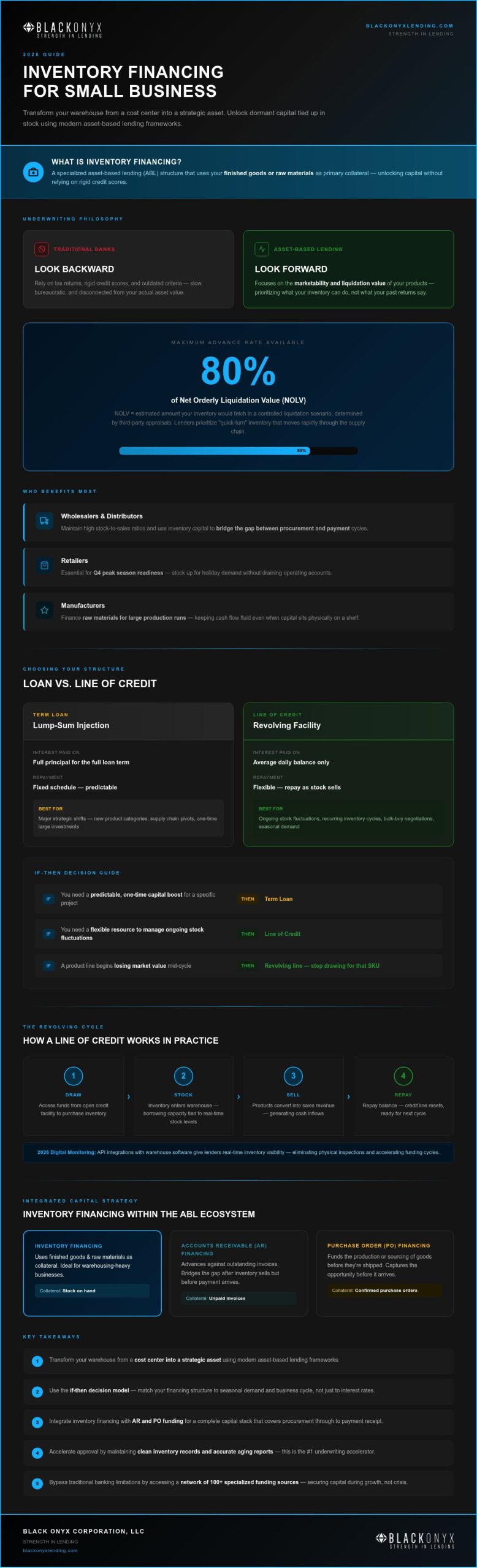
Inventory financing for small business is a specialized category of asset-based lending (ABL) that transforms your warehouse from a cost center into a liquid resource. Instead of relying on rigid credit scores, this structure uses your finished goods or raw materials as the primary collateral for capital. It’s a strategic shift. While traditional lenders look backward at your tax returns, asset-based structures look forward at the marketability and liquidation value of your products.
We view this as a strategic bridge rather than an emergency measure. Many owners wait until they’re in a cash crunch to seek funding, but the most successful operators secure these facilities during periods of growth. If you have capital ready before you need it, then you can capitalize on supplier discounts or sudden market shifts without hesitation. In the 2026 market, the ability to act with precision is your greatest competitive advantage.
How Inventory Financing Works in 2026
Modern underwriting focuses heavily on the Net Orderly Liquidation Value (NOLV). This metric represents the estimated amount your inventory would fetch in a controlled liquidation scenario, typically determined by third-party appraisals. Lenders prioritize “quick-turn” inventory, products that move rapidly through the supply chain, as they represent lower risk compared to specialized or bespoke goods. If you utilize an Inventory revolving line of credit, your borrowing capacity fluctuates based on real-time stock levels. The 2026 shift toward digital monitoring means your lender can see inventory levels through API integrations with your warehouse software, removing the need for disruptive physical inspections and accelerating the funding cycle.
Who Benefits Most from Inventory-Backed Capital?
Specific industries find this model particularly transformative. Wholesalers and distributors, who must often maintain high stock-to-sales ratios, use this capital to bridge the gap between procurement and payment. Retailers find it essential for Q4 readiness, allowing them to stock up for peak seasons without draining their operating accounts. Manufacturers also gain a significant edge by financing the raw materials required for large production runs. Healthcare providers managing medical supply inventory can similarly benefit; those seeking specialized medical practice financing options will find that asset-based strategies apply equally well to clinic equipment and supply chains. This approach ensures that your cash flow remains fluid, even when your capital is physically sitting on a shelf. By removing the bureaucratic obstacles of traditional banking, these businesses maintain a sense of momentum and progress.
Inventory Loans vs. Inventory Lines of Credit
Choosing the right structure for inventory financing for small business determines how effectively you can respond to market fluctuations. A term loan provides a single, lump-sum injection of capital, whereas a revolving line of credit acts as an open facility you can tap into as needed. The fundamental difference lies in how you access and repay the funds. If you require a predictable, one-time boost for a specific project, then a loan is your best tool. If you need a flexible resource to manage ongoing stock fluctuations, then a line of credit is superior.
Interest calculations reflect these structural differences. On a term loan, you typically pay interest on the full principal amount for the life of the loan. With a line of credit, interest is usually calculated based on your average daily balance. This means you only pay for the capital you’re actively using. This flexibility is vital for managing economic obsolescence. If a particular product line begins to lose market value, a revolving facility allows you to stop drawing capital for that stock and pivot your resources toward more profitable items. Finding the right fit requires a professional evaluation of your capital structure to ensure your debt remains a tool for growth.
The Case for an Inventory Line of Credit
A revolving line of credit offers a high level of operational precision. You draw down funds to purchase stock and repay the balance as that stock converts into sales. This cycle supports aggressive bulk-buy negotiations. Suppliers often offer deep discounts for larger orders; having an open line of credit allows you to secure these terms without depleting your operating cash. It’s the ideal choice for businesses with recurring, predictable inventory cycles where speed of execution is a priority. It ensures you aren’t paying for capital that’s sitting idle during your slower sales months.
When a Term Inventory Loan Makes Strategic Sense
While lines of credit offer agility, term loans provide the heavy-duty capital needed for major strategic shifts. If you’re launching an entirely new product category or navigating a significant supply chain pivot, a term loan offers a fixed repayment schedule that aligns with longer-term growth projections. This is particularly effective for high-margin, slow-turn goods where the sales cycle might exceed six months. It provides the stability to hold inventory until the market is optimal for sale. This structure removes the pressure of immediate repayment, allowing the asset to mature and reach its full market potential.
Inventory Financing vs. AR and PO Financing
Managing a growing enterprise requires a deep understanding of exactly where your capital is currently tied up. While inventory financing for small business is essential for maintaining shelf levels, it’s often most effective when integrated into a broader asset-based lending strategy. You shouldn’t view these tools as mutually exclusive alternatives. Instead, think of them as specialized levers you pull depending on where your cash flow is currently bottlenecked in the supply chain cycle. By identifying the specific point of friction, you can deploy the most cost-effective capital.
If you have already fulfilled an order but are waiting on a 60-day payment term, accounts receivable financing allows you to access that cash immediately. It’s a post-sale tool designed to bridge the gap between delivery and payment. Conversely, purchase order financing addresses the opposite end of the cycle. It provides the capital to pay your suppliers before the goods even reach your warehouse. This ensures you never have to turn down a large contract due to a lack of production capital. Stacking these tools creates a seamless flow of liquidity from procurement through to final collection.
The Asset-Based Lending Hierarchy
We categorize these tools into a logical progression that follows the physical movement of your goods. Understanding this hierarchy allows you to match your funding to the specific stage of your operation:
- PO Financing: The “Pre-Inventory” stage. Use this to fund the manufacturing or acquisition of products for confirmed orders you can’t currently afford to fulfill.
- Inventory Financing: The “Warehouse” stage. This supports holding costs and seasonal stock builds while goods are in your possession but not yet sold.
- AR Financing: The “Post-Sale” stage. This bridges the 30, 60, or 90-day invoice gap after the product has left your facility.
Strategic Selection: Matching the Tool to the Need
Effective capital management relies on simple if-then logic. If you’ve secured a massive purchase order but lack the cash to pay your manufacturer, then PO financing is your primary solution. If your warehouse is stocked with high-value goods but your bank account is empty, then inventory financing for small business provides the necessary liquidity to keep operations running. If your sales are booming but slow-paying corporate clients are draining your reserves, then AR financing is the most logical bridge. This strategic approach removes systemic hurdles and transforms your balance sheet into a dynamic engine for growth. To ensure your entire cash cycle is optimized, reviewing the working capital for small business 2026 Strategic Readiness Checklist will help you align your debt structure with your actual cash flow needs.
The Underwriting Process: Getting “Loan Ready”
Achieving approval for inventory financing for small business requires more than just a healthy balance sheet. It demands a professional presentation of your operational health. Underwriting in 2026 is a precise science where lenders scrutinize the liquidity of your warehouse with digital precision. If you provide fragmented records, then you invite high interest rates or outright rejection. To ensure your books are professionally managed and ready for lender review, you can learn more about Skyplex Management. A specialized consultant acts as a strategic bridge, translating your complex operational data into a format that resonates with a network of over 100 potential funding sources. This professional positioning removes bureaucratic obstacles and moves your application from the “maybe” pile to the priority list.
Lenders look for specific indicators of stability. You must demonstrate that your stock isn’t just sitting; it’s moving. High-quality underwriting typically requires the following documentation:
- Detailed Inventory Aging Reports: These reports categorize your stock by how long it has been in the warehouse. Lenders prioritize “fresh” inventory over “stale” items that may be subject to markdowns.
- Sales Velocity Data: You need to prove the speed at which your inventory converts to cash. Consistent turn rates provide the lender with confidence in their collateral.
- Comprehensive Financial Statements: While asset-based lending focuses on collateral, your debt-to-equity ratio provides context for your overall leverage. If your ratios are high, we focus the narrative on the specific margins of the inventory being financed.
Overcoming Underwriting Hurdles
Economic obsolescence is a common hurdle that can stall an application. If a portion of your stock is outdated, then we must isolate those items and highlight the velocity of your high-performing lines. Strategic positioning often involves commercial equipment leasing to restructure your balance sheet. By leasing instead of owning heavy machinery or technology, you free up additional collateral and improve your debt profile. This methodical approach ensures that even complex business models find the right match within a global network. To begin this transformation, you should consult with a professional underwriting specialist who can refine your presentation before it hits a lender’s desk.
The Multi-Lender Advantage with Black Onyx
Relying on a single financial institution is a high-risk strategy for any scaling firm. If your local bank changes its internal risk appetite or faces regulatory shifts, your access to capital can vanish overnight. We’ve seen many businesses hit a dead-end because they didn’t fit a traditional lender’s narrow underwriting box. Black Onyx challenges this conventional wisdom by serving as a strategic bridge to a global network of over 100 third-party funding sources. This variety ensures that your quest for inventory financing for small business isn’t dependent on a single person’s approval but on a competitive market of specialized lenders.
Bypassing Local Bank Limitations
Local banks often lack the specialized expertise required to accurately value niche inventory or raw materials. They tend to rely on historical cash flow and personal credit rather than the actual marketability of your assets. Our network includes national and global non-bank lenders who specialize in specific industries, from high-tech components to seasonal consumer goods. If your inventory has a high market demand, then we match you with a lender that has an appetite for that specific asset class. This precision allows us to bypass the bureaucratic hurdles that typically stall traditional loan applications, providing a sense of momentum for your operations.
A Consultant-Led Approach to Growth
We position ourselves as a powerful ally rather than a mere service provider. A strategic partnership means we don’t just find you a loan; we help you build a diversified capital stack that supports long-term resilience. By combining different asset-based tools, you create a financial structure that isn’t easily disrupted by market volatility. Our seasoned consultants handle the commercial lender negotiations, ensuring you receive terms that reflect the true value of your warehouse. It’s about moving from a state of limitation to one of significant opportunity. To secure your competitive edge, you should consult with Black Onyx for a personalized funding strategy and unlock the capital tied up in your supply chain.
Transforming Your Inventory Into a Strategic Growth Engine
Your warehouse inventory represents more than just physical products; it’s the untapped liquidity required to scale your operations. By shifting from a defensive borrowing mindset to a proactive asset-based strategy, you position your business to capture bulk-buy discounts and navigate seasonal surges with precision. We’ve explored how professional underwriting and a diversified lender network allow you to bypass the rigid, bureaucratic limits of traditional banking.
Securing the right inventory financing for small business requires a partner who understands the intricacies of complex asset-based lending. Black Onyx acts as your strategic bridge, providing access to over 100 funding sources and specialized consulting to ensure your file is loan ready. If you’re ready to move from a state of limitation to one of significant opportunity, then it’s time to leverage your existing assets for maximum impact.
Secure Your Strategic Inventory Capital with Black Onyx and take the first step toward a more resilient, well-funded future. Your next phase of growth is already sitting on your shelves.
Frequently Asked Questions
What is the typical interest rate for inventory financing for small business?
Interest rates in 2026 fluctuate based on the specific structure of your facility and the liquidity of your warehouse stock. Secured inventory lines of credit typically offer lower rates than short-term unsecured options. If your inventory has high marketability and a documented sales history, then you’re likely to secure more favorable terms. These rates are determined by the specific risk profile of the asset rather than just the business credit score.
Can I get inventory financing with a low credit score?
You can often qualify for inventory financing for small business with a lower credit score because the loan is secured by the asset itself. Traditional banks prioritize credit history, but asset-based lenders focus on the Net Orderly Liquidation Value of your products. Professional underwriting helps position your inventory as strong collateral. This allows you to bypass the rigid bureaucratic hurdles that typically stop businesses with less-than-perfect credit from accessing the capital they need.
How does inventory financing differ from a standard business line of credit?
A standard business line of credit is often unsecured or relies on your company’s overall financial health. In contrast, inventory financing is a specialized form of asset-based lending where your products serve as the primary collateral. This structure often allows for higher borrowing limits because the lender has a physical asset to secure the debt. If your business has significant capital tied up in stock, this tool is strategically superior for maintaining cash flow.
What happens if I cannot sell the inventory used as collateral?
If you can’t sell the inventory used as collateral, the lender may exercise their right to liquidate the stock to recover the outstanding balance. This is why lenders focus heavily on the marketability of your products during the underwriting process. They typically lend a percentage of the appraised value, such as 50% to 80%, to create a safety margin. Maintaining high sales velocity ensures you stay in compliance with your specific loan covenants.
Is inventory financing available for ecommerce startups?
Inventory financing is highly accessible for e-commerce startups, especially those with consistent sales data and high-demand products. Modern lenders use digital platforms to monitor real-time sales and inventory levels, which makes it easier for online businesses to qualify. Revenue-based models are particularly popular in this sector. If your startup can prove that your stock turns over quickly, then you can leverage that velocity to secure the capital needed for aggressive bulk purchasing.
How long does the approval process take for an inventory-based loan?
The approval process for an inventory-based loan typically ranges from a few days to several weeks depending on the complexity of your stock. If you have clean aging reports and digital inventory tracking, the process moves much faster. Working with a consultant to prepare your documentation ensures you’re “loan ready” before approaching a lender. This professional preparation removes systemic hurdles and speeds up the transition from a state of limitation to funded capital.
What is the minimum amount of inventory needed to qualify for financing?
Minimum inventory requirements vary across the 100+ funding sources in our network, but most lenders look for a total asset value that supports a sustainable credit line. While some facilities start at lower thresholds, specialized asset-based lenders often prefer larger portfolios. The focus is less on the quantity of items and more on their total market value. If your inventory has high demand, even smaller volumes can serve as effective and valuable collateral.
Do I need to provide a personal guarantee for inventory financing?
While many lenders require a personal guarantee, some asset-based structures allow you to limit this requirement if the collateral is exceptionally strong. The decision depends on the lender’s appetite for your specific industry and the liquidation value of your stock. If your inventory is easily sold on the open market, then you have more leverage to negotiate terms. Professional consulting helps you find lenders willing to offer more flexible and individualized guarantee structures. Furthermore, for business owners who need to manage personal liquidity or are considering homeowner-based financing, I Need Cash provides a professional guide to personal credit products in the UK.