


The most expensive piece of equipment your business will ever own is the one you paid for with your own liquid cash. While traditional banks often stall growth with restrictive lending criteria and mountains of paperwork, high-performing firms view capital allocation as a precision tool rather than a burden. If you’ve felt the sting of high upfront costs or the fear of technology becoming obsolete before it’s even paid off, you’re facing the same hurdles as many ambitious leaders. Mastering how to finance business equipment is the strategic move that turns these obstacles into a significant competitive advantage for 2026.
We recognize that maintaining liquidity is your primary driver for operational success. This guide will help you master the step-by-step process of securing equipment financing that preserves your cash flow and accelerates your expansion. You’ll learn how to secure 100% financing that includes soft costs like installation, leverage Section 179 to minimize tax liability, and select the right asset-based structures to bypass bank bureaucracy. We’re moving beyond basic debt to explore a sophisticated framework for sustainable business growth and long-term competitive edge.
Key Takeaways
- Shift your perspective from viewing equipment as a debt burden to a strategic capital tool that preserves essential liquidity for operational growth.
- Discover how to finance business equipment by selecting between long-term loans for permanent assets and flexible leasing for high-turnover technology.
- Accelerate the approval process by conducting an internal ROI audit and preparing a comprehensive package of financial statements to demonstrate creditworthiness.
- Maximize your 2026 cash flow by utilizing Section 179 deductions and bonus depreciation to recover equipment costs in the first year of operation.
- Gain a competitive edge by leveraging personalized underwriting and a global network of over 100 diverse funding sources to bypass traditional bank bureaucracy.
Understanding the Landscape of Equipment Financing in 2026
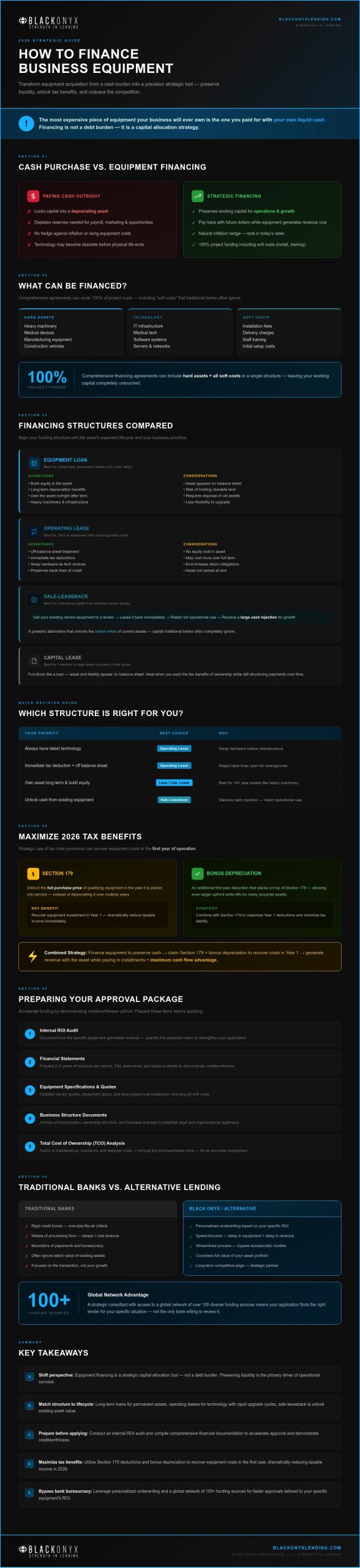
Equipment financing is the strategic acquisition of revenue-generating assets without the immediate depletion of your cash reserves. In the current 2026 economic environment, the decision of how to finance business equipment has shifted from a simple credit choice to a core pillar of corporate strategy. If you purchase an asset outright, you lock your capital into a depreciating item. If you finance, you retain that liquidity for marketing, payroll, and unexpected market opportunities. This approach transforms a significant capital expenditure into a manageable, predictable operating expense.
Financing also acts as a natural hedge against inflation and rising equipment costs. By locking in today’s rates for tomorrow’s technology, you pay back the obligation with future dollars while the equipment generates immediate value. This strategy is particularly effective for “hard” assets like heavy machinery and medical devices. However, modern structures now go further by covering “soft” costs. A comprehensive agreement can include installation, delivery, and initial staff training, allowing for 100% project funding that leaves your working capital untouched.
The Shift from Ownership to Access
Modern enterprises prioritize the utility of an asset over the title of ownership. Rapid technological cycles mean that a machine’s competitive edge often expires before its physical life does. To remain agile, many leaders are leasing equipment to avoid obsolescence. This approach ensures you always have access to the latest capabilities without the burden of disposing of outdated hardware. If your industry relies on cutting-edge tech, then access-based models provide the flexibility required to pivot as the market evolves.
Traditional Banks vs. Alternative Lenders
The traditional banking model often fails the modern business owner through rigid credit boxes and slow processing times. While a bank might take weeks to review a single application, alternative lenders prioritize speed and precision. They understand that a delay in equipment acquisition is a delay in revenue. Working with a strategic consultant provides access to a global network of over 100 funding sources. This “Strategic Bridge” approach bypasses bureaucratic hurdles, offering personalized underwriting that considers the unique ROI of your specific equipment. This shift toward specialized capital is seen in firms like Level 4 Funding, which provides real estate investors with private financing options that traditional banks often lack. When you understand how to finance business equipment through alternative channels, you gain a partner focused on your long-term competitive edge rather than just a transaction.
Selecting the right vehicle for acquisition is as critical as the equipment itself. When determining how to finance business equipment, you must align your funding structure with the asset’s expected lifecycle. If you’re investing in heavy machinery with a ten-year utility, a traditional equipment loan provides the benefits of ownership and long-term depreciation. Conversely, if you’re acquiring IT infrastructure or medical tech prone to rapid updates, leasing offers the agility to swap hardware before it becomes a liability. These choices aren’t just about interest rates; they’re about maintaining the operational flexibility required for a 2026 growth trajectory.
Sophisticated firms often look beyond standard debt to unlock capital already residing on their balance sheets. A Sale-Leaseback structure allows you to turn existing machinery into immediate working capital. In this arrangement, you sell your owned equipment to a lender and lease it back immediately. You retain full operational use of the asset while gaining a massive cash injection for payroll, marketing, or expansion. This is a powerful alternative to traditional bank loans that often ignore the latent value of your current assets. For organizations with significant equity in their fleet, specialized providers like V8Loans offer asset-based solutions to convert vehicle titles into immediate liquidity, supporting rapid growth without the wait of traditional bank approvals.
If-then logic dictates the strategic choice: if your priority is immediate tax deductions and off-balance-sheet treatment, then an operating lease is your best path. If you intend to keep the asset indefinitely and want to build equity, a capital lease or loan is superior. Utilizing commercial equipment leasing preserves your existing bank lines of credit, keeping them open for emergencies or rapid-response opportunities. Always calculate the Total Cost of Ownership (TCO) by factoring in maintenance, disposal costs, and the time-value of money rather than looking only at the monthly payment.
Strategic Asset-Based Solutions
Asset-based structures are significantly more resilient to market fluctuations than unsecured credit lines. By anchoring your financing to tangible value like inventory or accounts receivable, you create a dynamic credit limit that grows alongside your revenue. This approach is ideal for businesses that have strong operations but don’t fit into the narrow “credit box” of a traditional bank. Exploring asset-based financing options can turn a stagnant balance sheet into a high-velocity growth engine. These structures provide a level of security and scalability that standard equipment loans simply cannot match, positioning your firm to capitalize on 2026 market shifts with precision and speed.
Step-by-Step: Preparing Your Business for Commercial Funding
Preparation is the bridge between a rejected application and a funded project. Before you look at external markets, conduct a rigorous internal audit of your equipment needs. You must quantify the projected ROI of the new asset with precision. If the equipment increases output by a documented margin or reduces labor costs, your case for funding becomes undeniable. Once your internal logic is sound, assemble a “Loan-Ready” package. This isn’t just a collection of tax returns and balance sheets. It’s a cohesive narrative of growth that proves your ability to service the debt while expanding your market share.
High-value equipment requests often require a detailed business plan. Lenders want to see how this specific acquisition fits into your 2026 objectives. Simultaneously, you must review your commercial credit reports from agencies like Dun & Bradstreet or Experian. Errors are common. Outdated information can artificially depress your score and lead to higher interest rates. Correcting these discrepancies before submission ensures your profile reflects your actual operational strength. When you understand how to finance business equipment, you realize that the work done before the application is just as important as the funding itself.
Professional Underwriting and Consulting
Many lenders promote “application-only” processes for smaller amounts. While these are fast, they often lack the nuance required to secure the best possible terms. Professional underwriting is the strategic alternative. By having a consultant structure your file, you present your business in a way that highlights strengths and mitigates perceived risks. This expert intervention allows you to negotiate on a higher level, often removing restrictive covenants that could hinder your future agility. A consultant acts as your advocate, ensuring the final agreement supports your long-term success rather than just the lender’s security.
Identifying the Right Funding Source
Every lender has a specific industry appetite. A bank that specializes in medical imaging might have no interest in heavy construction machinery. Matching your equipment type to a lender’s preference is vital for approval; for instance, residential builders often benefit from the specialized development financing provided by Evoque Lending. In the 2026 economic environment, you must also weigh the benefits of fixed versus variable rates based on current market volatility. This is where a network of over 100 funding sources provides a decisive advantage. Accessing a global pool of resources ensures you find a lender whose goals align with yours, providing a level of speed and precision that a single local bank cannot match. Knowing how to finance business equipment through a diverse network is the ultimate hedge against localized credit crunches.
Tax planning is a core component of your acquisition strategy rather than a mere end-of-year afterthought. If you leverage Section 179, you can deduct the entire purchase price of qualifying equipment from your gross income in the first year it’s placed in service. This immediate expensing significantly reduces your total tax liability, effectively lowering the net cost of the asset. When you evaluate how to finance business equipment, the distinction between a capital lease and an operating lease becomes a primary tax-saving pivot point. While traditional loans focus on long-term depreciation, certain lease structures allow you to deduct monthly payments as a direct business expense.
Bonus depreciation remains a vital tool in the 2026 tax landscape, allowing for accelerated cost recovery on new and used assets. Aligning these deductions with your fiscal year-end requires precision and foresight. If you time your acquisition correctly, you can realize the tax benefits almost immediately, providing a significant boost to your year-end cash position. You should always consult with a tax professional to ensure your financing structure aligns with your specific revenue cycles and current tax bracket to maximize these incentives.
Avoiding Economic Obsolescence
Ownership is often a strategic trap in technology-driven sectors. If you own “stale” equipment, you’re forced to compete with outdated tools while your peers leverage the latest innovations. The hidden costs of maintaining aging machines, including increased downtime and specialized repair fees, often far exceed the monthly payment of a new, financed model. Structuring leases with specific upgrade clauses allows you to swap out hardware without a massive capital hit. This flexibility ensures your business remains at the cutting edge without the burden of disposing of obsolete assets.
Soft Cost Financing Strategies
Many traditional lenders only fund the “hard” asset, which leaves you to pay for delivery, installation, and training out of pocket. This can create a significant drain on your working capital at the very moment you need it most. Soft cost financing is the inclusion of all non-tangible expenses into a single lease agreement. This approach facilitates 100% financing, ensuring your liquid reserves remain intact for operational expenses and marketing. By folding these expenses into your financing plan, you turn a complex setup process into a single, predictable payment. Consult with our strategic advisors today to build a tax-efficient equipment plan that maximizes your 2026 deductions and preserves your liquidity.
Navigating the Approval Process with Black Onyx Corporation
Navigating the complexities of how to finance business equipment requires more than a standard credit check; it demands a strategic ally. At Black Onyx Corporation, we replace the rigid “no” of traditional institutions with a personalized underwriting process designed to find the “yes.” We act as a strategic bridge, connecting your specific operational needs to a global network of over 100 third-party funding sources. This approach moves your business from a state of bureaucratic limitation to one of significant opportunity, ensuring that capital is a catalyst for your 2026 growth rather than a hurdle to it.
The transition from initial consultation to equipment delivery is structured for maximum efficiency. If you need a rapid response to a market opportunity, our streamlined process provides the speed necessary to outpace the competition. We handle the heavy lifting of lender communication and paperwork, allowing you to remain focused on your core operations. This results-oriented framework ensures that your equipment is on-site and generating revenue while others are still waiting for a bank’s committee to meet.
The Consultant Advantage
Why settle for a generic bank product when you can have a bold innovator negotiating on your behalf? Traditional bank applications often stall due to systemic hurdles or narrow industry appetites. Our role is to challenge conventional wisdom and present your business case with the sophistication it deserves. By providing highly individualized attention, we ensure your application is structured to bypass the standard credit box. If your business has a complex financial history or unique equipment requirements, then a consultant-led approach is the only way to secure terms that actually support your long-term competitive edge. We act as your advocate, removing bureaucratic obstacles to foster a sense of momentum for your firm.
Ready to Transform Your Operations?
Strategic financing is not just about acquiring assets; it’s about fueling the momentum of your entire enterprise. By aligning your acquisition with professional business planning and consulting, you ensure every dollar spent drives a measurable return on investment. Whether you’re looking for asset-based financing or specialized equipment leasing, the path to a transformed operation begins with a single strategic decision. Precision in capital allocation today defines your market position tomorrow. Contact Black Onyx to secure your 2026 equipment financing and move your business forward with confidence.
Accelerate Your 2026 Growth Trajectory
The blueprint for scaling your operations in 2026 relies on precision in capital allocation. By mastering how to finance business equipment as a strategic tool rather than a debt burden, you protect your firm’s liquidity and maintain a modern, competitive edge. We’ve explored how the right mix of asset-based structures and specialized tax knowledge, including Section 179 benefits, can transform your balance sheet. These methods ensure that your cash remains available for payroll, marketing, and unexpected opportunities while your new assets generate immediate revenue.
Success in the modern market demands speed and access to a vast range of options. With expert commercial underwriting and a strategic bridge to a network of 100+ third-party funding sources, you can bypass bureaucratic delays and move toward significant opportunity. Don’t let aging technology or restrictive bank lending criteria stall your progress. It’s time to leverage a more sophisticated approach that prioritizes your long-term success and operational agility.
Secure your competitive edge with strategic equipment financing from Black Onyx.
Your next phase of expansion is within reach. We’re ready to provide the individualized attention and financial resources your business deserves to lead the industry.
Frequently Asked Questions
What credit score is needed to finance business equipment in 2026?
Most traditional lenders require a score of 680 or higher, but alternative funding sources offer much more flexibility. If you have a score in the 600s, you can still qualify by leveraging strong cash flow or existing assets. Strategic underwriting focuses on the equipment’s revenue-generating potential rather than just a single number. This approach allows ambitious firms to bypass the rigid credit boxes that often stall growth in the current economy.
Can I finance used equipment or must it be brand new?
You can finance both new and used equipment depending on the asset’s remaining useful life. Lenders typically evaluate used machinery based on its current market value and projected longevity. If the equipment is well-maintained and essential for your operations, it’s a prime candidate for asset-based financing. This strategy is particularly effective for heavy machinery or medical devices that retain value, allowing you to preserve capital while expanding your capabilities.
How do I qualify for the Section 179 deduction when leasing?
To qualify for the Section 179 deduction while leasing, you must use a specific structure like a $1 Buyout or a Capital Lease. These agreements treat the business as the owner for tax purposes, allowing you to deduct the full purchase price in the first year. It’s a powerful way to reduce tax liability while maintaining the cash flow benefits of monthly payments. Always verify that the equipment is placed in service before your fiscal year-end.
What is the difference between an equipment loan and an equipment lease?
The primary difference lies in ownership and balance sheet treatment. An equipment loan results in immediate ownership, with the asset appearing on your balance sheet as both an asset and a liability. A lease, particularly an operating lease, allows you to pay for the use of the equipment over time without the burdens of ownership. If you want to avoid technological obsolescence, a lease is often the superior choice for high-turnover assets like IT hardware.
How long does the equipment financing approval process typically take?
Approval times vary by lender, but alternative sources typically provide decisions within 24 to 48 hours. While traditional banks may take weeks to navigate internal committees, a consultant-led approach streamlines the process through professional underwriting. If your documentation is “Loan-Ready,” including recent financial statements and tax returns, the path to funding is significantly faster. This speed is essential for businesses looking to capitalize on immediate market opportunities or urgent equipment needs.
Can I finance 100% of the equipment cost including installation?
Yes, you can often secure 100% financing that covers the total project cost. This includes “soft costs” such as delivery, installation, and initial staff training, which traditional banks frequently exclude. By folding these expenses into a single agreement, you avoid significant out-of-pocket drains on your working capital. Understanding how to finance business equipment with all-inclusive terms is a critical strategy for maintaining the liquidity needed for other operational expenses during a growth phase.
What happens to the equipment at the end of a lease term?
Your options depend on the specific lease structure chosen at the beginning of the term. You can typically purchase the equipment for a predetermined amount, return it to the lender, or renew the lease at a lower rate. If you’ve opted for a Fair Market Value lease, returning the equipment allows you to upgrade to the latest technology without disposal costs. This flexibility is a core advantage for industries where equipment utility is more important than long-term title.
Is a personal guarantee always required for business equipment financing?
While personal guarantees are common for small to mid-sized firms, they aren’t always a strict requirement. Established companies with strong balance sheets or significant collateral may qualify for non-recourse financing. If your business demonstrates consistent revenue and strong commercial credit, you have more leverage to negotiate these terms. Working with a consultant who has access to a diverse network of 100+ funding sources increases your chances of finding a structure that minimizes personal risk. Furthermore, to see how firms like Evoque Lending handle specialized asset-backed costs, you can explore Mortgage Loan Origination and Interest Fees as a reference point for your financial planning.