


Your loan application isn’t just a stack of paper; it’s a strategic asset that dictates your cost of capital and your speed to market. If you treat the specific documents needed for commercial loan application in 2026 as a mere formality, you risk falling into the trap of endless bureaucratic delays and technical rejections. Most professionals understand the frustration of vague lender requirements and the fear that a minor oversight might derail a critical expansion. It’s time to stop guessing what underwriters want and start providing the precision they demand.
Mastering this process allows you to bypass traditional banking hurdles and accelerate your time-to-funding. We’ll show you how to build a bulletproof package that reduces back-and-forth and positions your business as a low-risk, high-opportunity partner. This article provides a clear, actionable checklist and professional underwriting insights to ensure your next capital raise is defined by momentum rather than frustration. By preparing effectively, you move from a state of limitation to one of significant opportunity.
Key Takeaways
- Transform your loan package from a standard filing into a strategic asset that commands lower interest rates and faster approval times.
- Identify the core financial documents needed for commercial loan application, including the critical 60-day window required for current interim statements.
- Master the specialized documentation required for equipment leasing and asset-based financing to maximize the leverage of your physical inventory and machinery.
- Secure your funding by auditing your legal and operational paperwork to eliminate the minor technicalities that often lead to automatic underwriter denials.
- Leverage professional underwriting consulting to identify deal-killers early and match your document profile with the most compatible funding source.
The Strategic Importance of a Precision-Engineered Loan Package
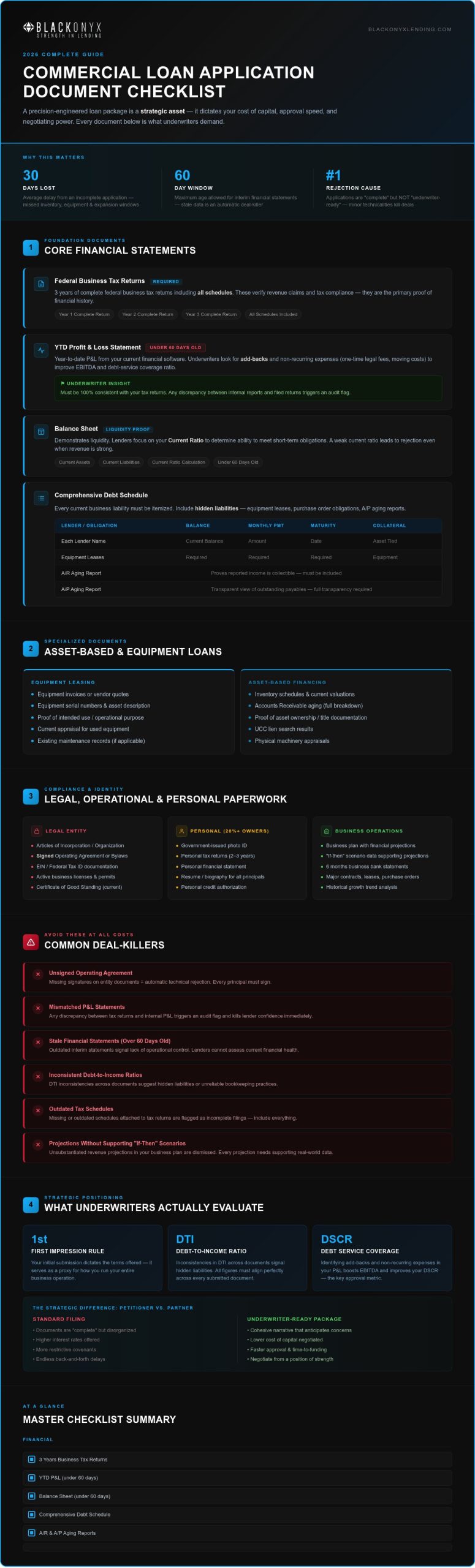
Speed is a currency in commercial finance. When you submit the documents needed for commercial loan application with precision, you aren’t just saving time; you’re actively lowering your cost of capital. Lenders interpret a disorganized file as a sign of operational risk. If your paperwork is scattered, they’ll likely hedge their bets by offering higher interest rates or more restrictive covenants. A precision-engineered package removes these bureaucratic obstacles by building immediate confidence in your leadership and financial oversight.
The “First Impression” rule is absolute in underwriting. Your initial submission dictates the terms you’re offered because it serves as a proxy for how you manage your business. An “underwriter-ready” application goes beyond a simple checklist. It provides a cohesive narrative that anticipates a lender’s concerns and addresses them with data. This proactive approach transforms you from a petitioner into a strategic partner, giving you the leverage needed to negotiate from a position of strength.
Bypassing the Traditional Bank Bottleneck
Traditional local banks often operate on rigid, outdated criteria that prioritize collateral over cash flow. This creates a systemic hurdle for fast-growing firms. In contrast, modern alternative funding sources look for strategic potential and operational efficiency. By utilizing professional underwriting consulting, you can identify red flags, such as inconsistent debt-to-income ratios or outdated tax schedules, before a lender ever sees them. In 2026, digital document management is no longer optional. It’s the standard for maintaining the momentum required to secure competitive terms in a global market.
The Cost of Incomplete Applications
A 30-day delay in funding isn’t just a scheduling inconvenience. It’s a missed opportunity for inventory acquisition, equipment upgrades, or market expansion. If your application is rejected due to a technicality, like an unsigned operating agreement or mismatched P&L statements, you’re forced to restart the clock. Most rejections happen because the documents needed for commercial loan application were “complete” but not “underwriter-ready.” An underwriter-ready package includes supporting data for “if-then” scenarios in your business plan. This level of detail justifies your financial projections and proves that your request is grounded in real-world application rather than academic theory. Precision at the start prevents the back-and-forth that kills deals.
Core Financial Statements: The Foundation of Your Application
Underwriters use your financial history to predict your future performance. To secure approval, you must provide three years of federal business tax returns, including all schedules. These aren’t just records; they’re the primary documents needed for commercial loan application that verify your revenue claims and tax compliance. Alongside these, you need interim financial statements, specifically a Year-to-date (YTD) P&L and Balance Sheet that are less than 60 days old. Stale data is a deal-killer. It suggests a lack of operational control and forces lenders to guess at your current health.
Analyzing the Profit and Loss (P&L) Statement
Your P&L statement is a window into your operational efficiency. Underwriters scrutinize this document to identify “add-backs” and non-recurring expenses. If you had a one-time legal fee or a major moving expense, identifying these can boost your EBITDA and improve your debt-service coverage ratio. You must ensure total consistency between your tax returns and internal financial software reports. Discrepancies trigger audits. Lenders also look for trend analysis. They want to see that your 2026 revenue projections are supported by historical growth. Strategic Business Planning & Consulting can help align these narratives before an underwriter ever sees them.
The Balance Sheet and Debt Schedule
While the P&L shows performance, the Balance Sheet demonstrates liquidity. Lenders focus on your current ratio to determine if you can meet short-term obligations. A weak ratio often leads to rejection, even if revenue is high. You must also include a comprehensive Debt Schedule. This list should detail every current business liability, including lenders, current balances, monthly payment amounts, maturity dates, and specific collateral tied to each loan.
Don’t overlook “hidden” liabilities. Equipment leases, purchase order obligations, and Accounts Payable (A/P) aging reports must be transparent. Similarly, your Accounts Receivable (A/R) aging report proves that your reported income is actually collectible. If your A/R is top-heavy with overdue accounts, underwriters will discount that asset’s value. Presenting a clean, categorized debt schedule proves you have a firm handle on your capital structure. This transparency removes doubt and moves your application to the top of the pile.
Specialized Documentation for Asset-Based and Equipment Loans
Standard bank checklists often fail because they don’t distinguish between cash-flow lending and asset-backed structures. If you’re leveraging physical collateral, the documents needed for commercial loan application shift from your past performance to the current value of your assets. Precision here is non-negotiable. Underwriters aren’t just looking at your credit score; they’re evaluating the liquidation value and operational utility of your collateral. Providing high-quality, specialized data prevents the valuation gaps that often lead to reduced funding amounts or outright denials.
Equipment Leasing and Sale-Leaseback Essentials
When pursuing commercial equipment leasing, your documentation must include technical specifications and serial numbers. Underwriters need to know exactly what they’re financing to assess depreciation schedules accurately. For a Sale-Leaseback, you’ll need original purchase documents and a current market valuation to prove the asset’s equity. Unlike standard term loans, these applications require environmental reports or site inspections if the machinery is industrial or heavy-duty. Providing detailed quotes or invoices for intended equipment ensures the funding amount matches the market reality. This level of detail proves you’ve done the due diligence required for a high-level capital move.
Asset-Based Financing and A/R Verification
Asset-based financing requires a granular look at your balance sheet items. You’ll need detailed inventory lists and professional appraisal reports for physical assets. For those specializing in property-backed assets, companies like KC Home Offers LLC provide tailored investment and lending solutions that leverage real estate value. If you’re seeking Accounts Receivable Financing, a master customer list and sample invoices are required to verify the creditworthiness of your debtors. Lenders aren’t just looking at your business; they’re looking at who owes you money. If your customers have strong credit profiles, your documentation should highlight this to secure more favorable terms. This transparency transforms your receivables into a powerful tool for immediate liquidity.
Growth requires execution. For Purchase Order Financing, you must provide confirmed POs from creditworthy customers. Supplier agreements and manufacturing timelines are also essential to prove you have the capability to deliver. Underwriters look for inventory turnover ratios and storage location details to assess risk. If your inventory sits in a third-party warehouse, you’ll need a bailee waiver or similar legal access document. These specific documents needed for commercial loan application remove the guesswork for the lender. By presenting a clear path from production to payment, you move your application toward a “yes” faster than any generic financial statement ever could.
Legal, Operational, and Personal Paperwork
Financial data tells the story of your performance, but legal and operational paperwork proves your business’s legitimacy and stability. To move forward, you must provide foundational entity documents, including your Articles of Incorporation, Operating Agreements, and Bylaws. These are essential documents needed for commercial loan application because they define who has the authority to borrow on behalf of the company. If your corporate structure is complex, a clear capitalization table or stock certificates showing all owners with a 20% stake or more is mandatory. Lenders need to know exactly who is behind the wheel before they commit capital.
Your physical footprint is also under scrutiny. You must provide current office or warehouse lease agreements that clearly state expiration dates and renewal options. If your lease expires before the loan matures, it creates a significant risk factor that underwriters will flag. Additionally, Personal Financial Statements (PFS) are required for all individuals with a significant stake in the business. Unlike a simple credit check, the PFS provides a holistic view of your global cash flow and personal liquidity. This transparency is vital for establishing the trust necessary to bypass traditional banking bureaucracy.
Business Plan and Projections
A precision-engineered business plan is your most persuasive tool. It must feature an executive summary detailing the “Use of Proceeds,” explaining exactly how the capital will generate ROI. Lenders don’t just fund requests; they fund outcomes. You should include 12-month cash flow projections that are aggressively optimistic yet grounded in your historical data. Management bios are equally important. They should highlight the strategic expertise of your leadership team to prove you have the operational depth to execute your growth strategy. If your team has successfully navigated market shifts before, your application becomes significantly more attractive to high-level funding sources.
Compliance and Background Documentation
Regulatory compliance is a non-negotiable hurdle. You must provide valid business licenses and permits specific to your industry, whether you operate in medical finance or heavy manufacturing. Personal tax returns for all owners are also required to verify total financial health. If you have historical credit issues or existing UCC-1 filings, don’t wait for the underwriter to find them. Provide a proactive, written explanation to maintain control of the narrative. Addressing these systemic hurdles through professional Business Planning & Consulting can fix a weak document package before a lender ever sees it, ensuring your path to funding remains clear and fast.
Navigating the Underwriting Process with Black Onyx
Submitting a file is not the end of the process; it’s the beginning of a high-stakes negotiation. While gathering the documents needed for commercial loan application is a critical first step, the quality of their presentation determines your success. Black Onyx Corporation, LLC acts as your strategic bridge, matching your specific document profile with a global network of over 100 third-party funding sources. This isn’t a generic submission process. It’s a targeted strike designed to place your application in front of the lenders most likely to offer aggressive terms based on your unique asset mix and financial narrative.
Our role is to serve as a proactive ally. We don’t just pass paperwork along; we stress-test your package to identify deal-killers before a lender ever sees them. If your debt schedule has inconsistencies or your interim statements lack the necessary detail, Black Onyx Corporation, LLC fixes those issues in the pre-submission phase. This meticulous approach removes the friction that typically leads to bureaucratic delays. By the time your package reaches an underwriter, it’s already been refined into a precision-engineered asset that commands respect and results.
The Role of Professional Underwriting Consulting
Complex deals require a second pair of eyes. A seasoned consultant understands the nuances that internal accounting teams might miss, especially when translating raw data into a lender-ready format. Black Onyx Corporation, LLC streamlines the flow of information between your team and the funding source, ensuring that every request is met with speed and precision. This preparation is vital for the “Q&A” phase. When an underwriter begins their deep dive, you’ll have the data-backed answers ready to defend your projections and justify your requested terms. If you’re prepared for the scrutiny, the lender’s confidence grows, often resulting in lower interest rates and more flexible covenants.
Next Steps: Moving from Preparation to Funding
Transitioning from preparation to funding requires a final, disciplined review. Black Onyx Corporation, LLC utilizes a 24-hour “Pre-Flight” checklist to ensure every signature is in place and every schedule is current. Once verified, you’ll submit your package through the Black Onyx Corporation, LLC secure portal for rapid review. This digital-first approach respects your time and maintains the momentum necessary for a successful closing. Don’t leave your capital raise to chance or settle for the limited options of a local bank. Speak with a Black Onyx Corporation, LLC consultant to review your document package today. Our expertise ensures you move from a state of limitation to one of significant opportunity with speed and professional confidence.
Securing Your Competitive Edge Through Precision
Your loan package is more than a folder of requirements; it’s the primary indicator of your business’s operational health. If you treat the documents needed for commercial loan application as a strategic asset, you move from a state of limitation to one of significant opportunity. We’ve established that precision in your financial statements and transparency in your legal paperwork are the foundations of speed. A well-organized submission doesn’t just bypass traditional banking bureaucracy; it commands the interest rates and terms your business deserves.
Black Onyx Corporation, LLC acts as your authoritative ally, providing specialized consulting for complex commercial deals through our global financing network. We match your unique profile with over 100 third-party funding sources to ensure momentum never stalls. By identifying potential deal-killers early, we turn your documentation into a catalyst for growth rather than a bottleneck. Get Your Professional Underwriting Consultation today to align your vision with the capital required to achieve it. Your next phase of growth is within reach, and we’re here to bridge the gap.
Frequently Asked Questions
What are the most common documents needed for a commercial loan application?
The core documents needed for commercial loan application typically include three years of federal business tax returns, interim financial statements like a Year-to-date P&L and Balance Sheet, and a detailed debt schedule. You’ll also need entity documents such as Articles of Incorporation and proof of ownership for anyone with a 20% stake or more. Providing these with precision ensures underwriters can verify your revenue and liquidity without requesting additional, time-consuming clarifications.
Do I need a business plan for a commercial equipment lease?
Yes, a business plan is often required to demonstrate how the leased equipment will generate a return on investment. While some small-ticket leases might only require a credit application, larger transactions or strategic expansions demand a “Use of Proceeds” summary. Lenders want to see that the equipment isn’t just a cost but a tool for revenue growth. Including management bios can also reinforce your team’s ability to operate the new machinery effectively.
How far back do lenders look at business tax returns?
Most commercial lenders require the last three years of federal business tax returns to establish a baseline for your company’s performance. This window allows underwriters to identify growth trends and verify consistency between your reported income and internal financial software. If your business is less than three years old, you’ll likely need to provide personal tax returns and more aggressive cash flow projections to bridge the data gap and prove your long-term viability.
What is a Personal Financial Statement (PFS) and why is it required?
A Personal Financial Statement (PFS) is a document that outlines the assets, liabilities, and net worth of the business’s principal owners. It’s required because most commercial loans involve a personal guarantee, making your individual financial health a critical factor in the risk assessment. Underwriters use the PFS to verify your global cash flow and ensure you have the personal liquidity to support the business during market shifts or unexpected operational challenges.
Can I get a commercial loan if some of my financial documents are missing?
Securing a loan with missing documents is difficult but not impossible if you utilize alternative funding sources rather than traditional banks. While missing tax returns are usually deal-killers, specialized mortgage brokers like Simplified Commercial Lending offer loan products for rental and investment properties without requiring tax returns. Professional underwriting consulting can also help you reconstruct missing data or provide alternative proof of cash flow, such as bank statements or accounts receivable aging reports. The key is to address the gap proactively with a written explanation to maintain the underwriter’s confidence in your transparency.
Your “Use of Proceeds” dictates which specific documents needed for commercial loan application you must submit. If you’re seeking equipment leasing, you’ll need detailed quotes or invoices from suppliers. For asset-based financing, you’ll provide appraisal reports for the specific inventory or machinery being leveraged. Clear documentation of how the funds will be used proves to the lender that the capital will be deployed efficiently to drive measurable business growth and ROI.
What specific documents are required for an SBA 7(a) loan in 2026?
For an SBA 7(a) loan in 2026, you must provide SBA Form 1919, three years of business and personal tax returns, and a current P&L statement. You’ll also need a detailed schedule of collateral and a statement of personal history. Because the SBA process is highly regulated, any minor technicality in your paperwork can lead to immediate rejection. Professional consulting ensures your package is underwriter-ready and meets the specific compliance standards of the global network.
How long does it take for underwriters to review my document package?
Underwriting review times vary based on the complexity of the deal and the quality of your submission. A precision-engineered package can often be reviewed within 48 to 72 hours by alternative lenders. However, a disorganized file with missing schedules or outdated balance sheets can drag the process out for weeks as underwriters request clarifications. Using a secure portal for rapid review and maintaining a pre-flight checklist are the best ways to ensure a brisk funding timeline.