


What if the lowest interest rate you secure this year actually hinders your long-term liquidity? While it is tempting to fixate solely on the headline number, equipment financing rates 2026 are part of a much broader strategic equation. With the U.S. Prime Rate currently at 7.00% and traditional banks tightening their belts, the pressure to find affordable capital is real. You likely feel the weight of Fed rate uncertainty and the frustration of comparing complex lease structures against traditional loan APRs. If you focus only on the cost of debt, then you might overlook the structural flexibility needed to scale.
We are here to bridge that gap by providing a clear roadmap through the 2026 commercial credit landscape. This analysis delivers expert insights into market volatility and strategic capital allocation to ensure your next acquisition fuels growth rather than draining reserves. You will learn how to secure predictable monthly payments while maximizing tax benefits like the $2,560,000 Section 179 deduction limit. We will preview the shift toward usage-based billing and show you how to preserve working capital through sophisticated underwriting that bypasses bureaucratic hurdles.
Key Takeaways
- Analyze the transition from traditional bank lending to private credit and how this shift directly impacts equipment financing rates 2026.
- Identify the updated credit factors and asset types that dictate your borrowing power and influence loan-to-value ratios in the current market.
- Evaluate the total cost of ownership by comparing lease and loan structures, accounting for maintenance, insurance, and long-term tax implications.
- Explore strategic mitigation techniques like sale-leaseback financing to convert existing machinery into immediate liquidity for growth.
- Leverage a global network of over 100 funding sources to bypass traditional banking hurdles and accelerate your commercial approval timeline.
The 2026 Commercial Credit Landscape: What is Driving Rates?
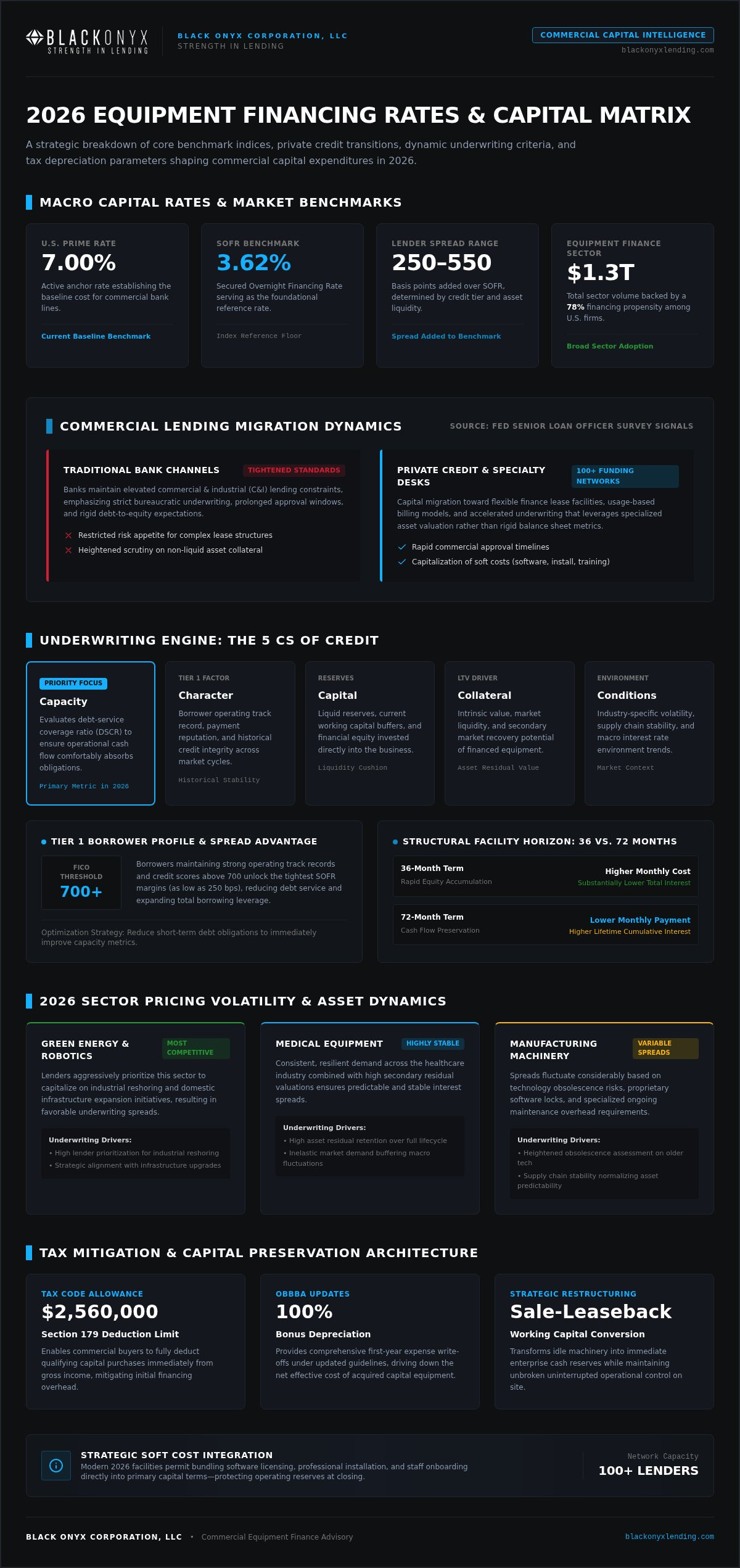
The 2026 fiscal year marks a definitive transition for commercial borrowers. After a period of aggressive interest rate adjustments, the market has entered a stabilization phase where predictability is finally returning to capital expenditure planning. While the U.S. Prime Rate remains at 7.00%, the broader equipment finance and leasing sector continues to expand, now representing a $1.3 trillion industry. This growth is supported by a 78% financing propensity among U.S. businesses, indicating that most firms prefer to preserve cash rather than buy equipment outright.
This shift is fueled by a change in where capital originates. Traditional banks have tightened their commercial and industrial lending standards, forcing a migration toward private credit and specialty finance desks. These alternative lenders often provide more flexible finance lease agreements that traditional institutions cannot match. If your business is planning a major acquisition, then understanding how inflation expectations influence equipment financing rates 2026 is critical for protecting your margins. Lenders are no longer pricing for extreme spikes; instead, they are structuring deals based on moderate, consistent price growth, making 2026 a strategic window for long-term capital allocation.
Monetary Policy and the Cost of Capital
The cost of capital is heavily influenced by the Secured Overnight Financing Rate (SOFR), which currently stands at 3.62%. Lenders typically add a spread of 250 to 550 basis points to this benchmark depending on your credit tier and the liquidity of the asset. If a borrower has a strong cash flow, they can often negotiate these spreads down significantly. Cost of capital in 2026 is the total weighted expense an enterprise incurs to secure an asset, accounting for both the nominal interest rate and the offsetting tax benefits of 100% bonus depreciation under the OBBBA updates.
Industry-Specific Rate Volatility
Not all sectors experience the same pricing pressure. Medical equipment often enjoys more stable rates due to high residual values and consistent demand across the healthcare sector. Conversely, manufacturing machinery may see higher spreads if the specific technology is prone to rapid obsolescence or requires specialized maintenance. Supply chain stability has finally returned, which allows lenders to predict asset values with higher precision. You will likely find the most competitive offers in the green energy and advanced robotics sectors. Lenders are currently prioritizing these industries to capitalize on the reshoring of industrial manufacturing and infrastructure expansion.
Core Factors That Determine Your Equipment Financing Rate
Securing the most competitive equipment financing rates 2026 requires a deep understanding of how lenders quantify risk. While benchmark rates provide a baseline, your specific APR is a reflection of the ‘Five Cs of Credit’: Character, Capacity, Capital, Collateral, and Conditions. In the current market, lenders prioritize Capacity, specifically your debt-service coverage ratio. If your business demonstrates consistent cash flow that comfortably covers new obligations, then you’ll likely bypass the more restrictive underwriting seen at traditional institutions.
The structure of your financing also dictates the final cost. Choosing a 72-month term instead of 36 months may lower your monthly obligation, but it significantly increases the total interest expense over the life of the asset. Additionally, modern financing packages now frequently capitalize ‘soft costs’ like installation, software integration, and staff training. If you bundle these into the primary facility, then you preserve your liquid cash for daily operations, though this may slightly adjust your overall loan-to-value (LTV) ratio.
Credit Tiering and Risk-Based Pricing
Lenders categorize borrowers into distinct tiers that dictate pricing. Tier 1 borrowers with FICO scores above 700 and strong operating histories access the lowest spreads. According to the Senior Loan Officer Opinion Survey on Bank Lending Practices, banks have maintained tighter standards for commercial loans, making your credit profile more critical than ever. If you want to improve your standing before applying, then focus on reducing existing short-term debt and ensuring your business credit reports are accurate. If you are struggling with traditional bank requirements, then exploring specialized commercial funding can help you find lenders who prioritize asset value over perfect credit scores.
Equipment Essentiality and Collateral Value
The type of machinery you acquire is just as important as your credit score. ‘Mission-critical’ equipment, such as medical diagnostic tools or industrial CNC machines, often qualifies for better terms because it is essential for revenue generation. Lenders view these assets as lower risk because businesses are less likely to default on equipment that is central to their survival. New equipment typically offers better LTV ratios, but used machinery can provide a lower entry point if the asset retains high residual value. In 2026, residual value projections are increasingly influenced by technological longevity; assets that resist obsolescence are favored by underwriters and secure more favorable lease payments.
Equipment Lease vs. Loan: Comparing Total Costs in 2026
Choosing between an equipment lease and a traditional loan in 2026 requires more than a simple interest rate comparison. While equipment financing rates 2026 for loans might appear lower on paper, the total cost of ownership often tells a different story. A traditional loan typically requires a larger down payment, often between 10% and 25%, which immediately ties up your working capital. Conversely, The Strategic Guide to Commercial Equipment Leasing in 2026 highlights that leasing structures can provide 100% financing, including soft costs like installation and freight.
Ownership brings hidden expenses that many businesses overlook during the planning phase. Maintenance contracts, specialized insurance, and property taxes can add a significant percentage to your annual carry cost. If you opt for a loan, then these expenses fall squarely on your balance sheet. For those seeking long-term, fixed-rate debt for major machinery, the SBA 504 loan program remains a powerful tool to secure below-market costs. To find the true “effective rate” of an operating lease, you must calculate the net present value of all payments minus the tax savings, then compare that to the total interest and depreciation benefits of a loan.
Tax Advantages and Section 179 in 2026
Tax strategy is a primary driver of ROI in 2026. Under current regulations, the Section 179 expense deduction limit has reached $2,560,000. This allows you to deduct the full purchase price of qualifying equipment from your gross income in the year it is placed in service. Additionally, the federal government now allows 100% immediate bonus depreciation for capital equipment under updated legislative guidelines. If you align your financing structure with these incentives, then you can significantly lower the net cost of your acquisition. Consult with a financial advisor to ensure your lease or loan agreement is structured to qualify for these specific 2026 benefits.
Managing Economic Obsolescence
In technology-heavy sectors like medical diagnostics or advanced robotics, the risk of equipment becoming obsolete is a genuine threat to your competitive edge. Leasing acts as a strategic hedge against rapid technological shifts by allowing you to rotate your inventory every three to five years. At the end of a lease term, you have the flexibility to return the equipment, upgrade to a newer model, or purchase the asset at its fair market value. This prevents your business from being tethered to outdated machinery while your competitors utilize the latest innovations. If your industry evolves quickly, then an operating lease provides the agility necessary to maintain market dominance without the burden of disposing of depreciated hardware.
Rate Mitigation Strategies: Securing Capital Below Market Averages
Many executives mistakenly view market averages as non-negotiable. In reality, equipment financing rates 2026 can be strategically lowered through creative capital structures. If your enterprise owns high-value machinery outright, then utilizing Sale-Leaseback Financing: Unlocking Hidden Liquidity is your most effective move. This arrangement allows you to sell existing assets to a lender and lease them back immediately. You gain a massive injection of cash without losing access to the equipment. It effectively converts trapped equity into liquid capital for expansion or debt restructuring.
Asset-based financing provides a similar advantage for companies with strong balance sheets but seasonal cash flow fluctuations. By focusing on the intrinsic value of the collateral, lenders can often offer terms that traditional cash-flow-based models would reject. To ensure success, professional underwriting consulting acts as a strategic bridge. We pre-sell your credit profile to specific lenders, removing bureaucratic obstacles before the formal application even begins. This proactive approach ensures that your deal is positioned for the most favorable pricing available.
The Power of Multiple Funding Sources
Relying on a single bank for your capital needs is a high-risk strategy in 2026. If your primary institution shifts its risk appetite or hits its industry exposure limit, then your funding disappears instantly. A multi-lender network creates a competitive environment where funding sources must bid for your deal. This competition naturally drives down rates and improves terms. Personalized underwriting ensures that complex deals are presented with clarity, highlighting your operational strengths to the specific credit desks most likely to approve them.
SBA Loans as a Rate-Cap Strategy
For long-term machinery needs, the federal government offers robust support that can outperform private credit. If you compare conventional notes to the 2026 SBA Loans: A Strategic Guide for Business Growth, then the benefits of the SBA 504 program become clear. This program provides long-term, fixed-rate financing that acts as a hedge against future market volatility. While conventional financing might offer more speed, an SBA loan provides the rate-cap security necessary for multi-year industrial projects. You should choose this path when the objective is long-term stability rather than immediate turnaround.
Ready to secure capital that aligns with your growth goals? Consult with our expert underwriting team to explore a customized financing structure today.
Partnering with Black Onyx: Your Strategic Bridge to 2026 Capital
Businesses often find themselves trapped between the urgent need for modern machinery and the rigid, slow-moving requirements of traditional banks. Black Onyx acts as your strategic bridge, connecting your operational goals to a global network of specialized capital. By leveraging our deep market expertise, you can secure equipment financing rates 2026 that reflect your enterprise’s true potential rather than just a static credit score. We transform the acquisition process from a bureaucratic hurdle into a streamlined engine for growth and momentum.
Our network includes over 100 third-party funding sources across the US, Canada, UK, and Australia. This vast reach ensures that your options aren’t limited by the risk appetite of a single institution. If a traditional lender retreats from your specific industry, then we pivot to a specialty finance desk that understands your asset’s intrinsic value. This level of precision is what allows our clients to move from a state of limitation to one of significant opportunity. We focus on the removal of obstacles to foster progress for every professional we serve.
Our Personalized Underwriting Process
We don’t just submit applications; we construct compelling narratives. Lenders in 2026 require more than just balance sheets to approve complex deals. Our team translates your business plan into a narrative that highlights your capacity, character, and the strategic ROI of the equipment. Professional consulting is the difference between accepting a generic offer and securing a tailored facility. We negotiate directly with credit officers to refine terms, adjust covenants, and ensure the structure aligns with your long-term success. This individualized attention removes the friction typical of institutional lending. If your business requires specialized machinery or non-traditional structures, then our underwriting expertise becomes your greatest competitive asset.
Getting Started: Your 2026 Growth Strategy
The path to optimized capital begins with a comprehensive review of your current asset pool and future expansion goals. Our first step is a discovery session where we identify the most efficient structures for your specific tax situation and cash flow needs. This is more than a simple loan search; it’s Strategic Business Financial Consulting: Navigating Commercial Capital in 2026. We analyze your equipment financing rates 2026 against your projected revenue to ensure every dollar of debt is working toward your competitive edge. If you are ready to remove the obstacles standing between your business and its 2026 objectives, then we invite you to consult with one of our seasoned advisors today. Let’s build a financing strategy that protects your liquidity while fueling your next phase of transformation.
Strategic Capital Planning for 2026 and Beyond
Navigating the current commercial credit landscape requires a shift from reactive borrowing to proactive capital management. By understanding how equipment financing rates 2026 are influenced by private credit shifts and asset essentiality, you can position your business for sustainable growth. Success in the coming year depends on more than just securing a low APR; it requires a structure that maximizes tax benefits like Section 179 and hedges against economic obsolescence. Whether you are considering a traditional lease or a specialized sale-leaseback, the right strategy will preserve your working capital for critical operational needs.
Black Onyx serves as your strategic bridge to these resources. We provide access to over 100 global funding sources and utilize professional underwriting to remove bureaucratic obstacles that stall traditional bank applications. Our expertise in asset-based lending ensures that your machinery works for you, unlocking liquidity when you need it most. If you’re ready to transform your state of limitation into one of opportunity, then it’s time to act. Secure your 2026 growth capital; consult with a Black Onyx financing expert today. We look forward to fueling your momentum and ensuring your long-term competitive edge.
Frequently Asked Questions
What is a typical equipment financing rate in 2026?
Typical equipment financing rates 2026 for Tier 1 borrowers currently range from 6.00% to 8.50% APR. If your business falls into the mid-market or fair credit category, then you should expect rates between 8.00% and 14.00%. These benchmarks are driven by the U.S. Prime Rate and SOFR. Subprime or specialized alternative lenders often price their facilities between 15.00% and 22.00% to account for higher collateral risks or distressed credit profiles.
How do I qualify for the lowest equipment leasing rates?
Securing the lowest rates requires a FICO score above 700 and a debt-service coverage ratio that demonstrates strong cash flow. Lenders prioritize “A-tier” applicants who have at least two years of clean operating history. If you provide audited financial statements and show a high level of equipment essentiality, then you’ll likely access the most competitive spreads. Professional underwriting also helps by positioning your business plan as a low-risk narrative to potential funding sources.
Can I get equipment financing with a low credit score in 2026?
Yes, you can obtain equipment financing with a credit score between 620 and 699 through alternative and non-bank lenders. While equipment financing rates 2026 will be higher for these tiers, asset-based structures focus more on the value of the machinery than your personal guarantee. You may need to provide a larger down payment of 10% to 25% to mitigate the lender’s risk. This approach allows growing firms to acquire necessary tools while rebuilding their credit standing.
Is it better to lease or finance equipment when interest rates are rising?
Leasing is often the superior choice during periods of rate volatility because it frequently offers fixed-rate terms and 100% financing. If you choose an operating lease, then you avoid the large upfront capital expenditure required by traditional loans. This preserves your liquid cash for other growth opportunities. Financing with a loan is better if you intend to own the asset for its entire lifecycle and want to claim immediate 100% bonus depreciation benefits.
What equipment qualifies for Section 179 tax deductions in 2026?
Most tangible commercial property used more than 50% for business qualifies, including manufacturing machinery, medical devices, and office furniture. The 2026 deduction limit is set at $2,560,000 with a phase-out threshold starting at $4,090,000. Off-the-shelf software and heavy vehicles also qualify under specific guidelines. You must place the equipment in service by December 31, 2026, to claim the deduction for that tax year. Always consult a tax professional to verify specific asset eligibility.
How long does the commercial equipment loan approval process take?
Approval times vary based on the complexity of the deal and the level of automation used by the lender. Small-ticket applications under $250,000 often receive a decision within 24 to 48 hours thanks to AI-driven underwriting. Larger, mid-market transactions or specialized medical financing typically require 2 to 3 weeks for a full credit review. If you utilize a strategic bridge like Black Onyx, then the process is streamlined by removing bureaucratic obstacles before the application reaches the funding source.
What is the difference between a fair market value lease and a $1 buyout lease?
A Fair Market Value (FMV) lease offers the lowest monthly payments and the flexibility to return the equipment at the end of the term. This is ideal for technology that faces rapid economic obsolescence. A $1 buyout lease is a finance lease where you own the equipment for one dollar once all payments are made. If you plan to keep the machinery for a decade or more, then the $1 buyout structure is the more cost-effective long-term solution.
Do equipment financing rates vary by state or region?
While federal benchmarks like the Prime Rate are national, regional variations occur due to local lender competition and state-specific tax incentives. Some regions with high industrial density may have more specialized lenders offering aggressive rates for “yellow iron” or manufacturing assets. Black Onyx normalizes these discrepancies by providing a global reach to over 100 funding sources. This ensures you receive the best possible terms regardless of your physical location in the US, Canada, or the UK.