


What if your next major equipment purchase actually increased your liquid cash by the end of the fiscal year? Most business owners view tax season as a period of unavoidable loss, but the section 179 deduction 2026 framework transforms tax compliance into a high level strategy for aggressive growth. You likely recognize that scaling operations requires the latest technology, yet the high upfront costs often create a frustrating bottleneck for your monthly cash flow. It’s a common challenge to balance the need for modern tools with the necessity of maintaining a healthy capital reserve.
If you leverage the current tax code correctly, then you can acquire essential assets without draining your bank account. This guide from Black Onyx Corporation, LLC provides the clarity you need to navigate the $2,560,000 deduction limit and the restored 100% bonus depreciation rules effectively. We will explore how strategic equipment financing allows you to claim massive upfront write-offs while keeping your capital available for other operational needs. By the end of this article, you’ll understand how to turn your 2026 tax liabilities into a powerful engine for business transformation and long term competitive advantage.
Key Takeaways
- Secure a maximum deduction of $2,560,000 to drastically reduce your federal tax liability for the 2026 fiscal year.
- Leverage the restored 100% bonus depreciation for qualifying equipment purchases that exceed the standard Section 179 spending caps.
- Utilize equipment leasing as a strategic “cashless write-off” to claim the full section 179 deduction 2026 while preserving your working capital.
- Identify qualifying tangible assets, including machinery and off-the-shelf software, that must be placed in service before the December 31 deadline.
- Partner with an expert funding bridge to navigate complex underwriting and secure the resources necessary for rapid operational scaling.
What is the Section 179 Deduction in 2026?
The Section 179 depreciation deduction is a strategic tax provision designed to incentivize business investment by allowing companies to deduct the full purchase price of qualifying assets in a single tax year. Instead of writing off small portions of equipment costs over several years, the section 179 deduction 2026 allows you to subtract the entire amount from your gross income immediately. It’s not just a tax break; it is an aggressive tool for liquidity management. The IRS created this code to encourage growth by making the acquisition of machinery, software, and vehicles significantly more affordable for small to mid-sized enterprises.
Timing remains the most critical factor for eligibility. To claim the benefit, you must adhere to the “placed in service” rule. This means your equipment must be physically installed and operational at your place of business before midnight on December 31, 2026. Simply paying an invoice or signing a lease agreement is insufficient if the asset is not ready for its intended business use. If you delay installation until January, then you lose the ability to lower your 2026 tax liability, pushing the benefit into the next fiscal cycle.
How Section 179 Differs from Standard Depreciation
Traditional accounting often relies on the Modified Accelerated Cost Recovery System (MACRS), which spreads the cost of an asset over its useful life, such as five or seven years. While this approach eventually accounts for the total cost, it does nothing to help your immediate cash flow. Section 179 provides a “front-loaded” benefit that lowers your tax bill today. If you choose Section 179 expensing over traditional methods, then you effectively reduce the net cost of the equipment by your marginal tax rate. Section 179 acts as a precision tool for immediate capital reinvestment.
The 2026 Bonus Depreciation Factor
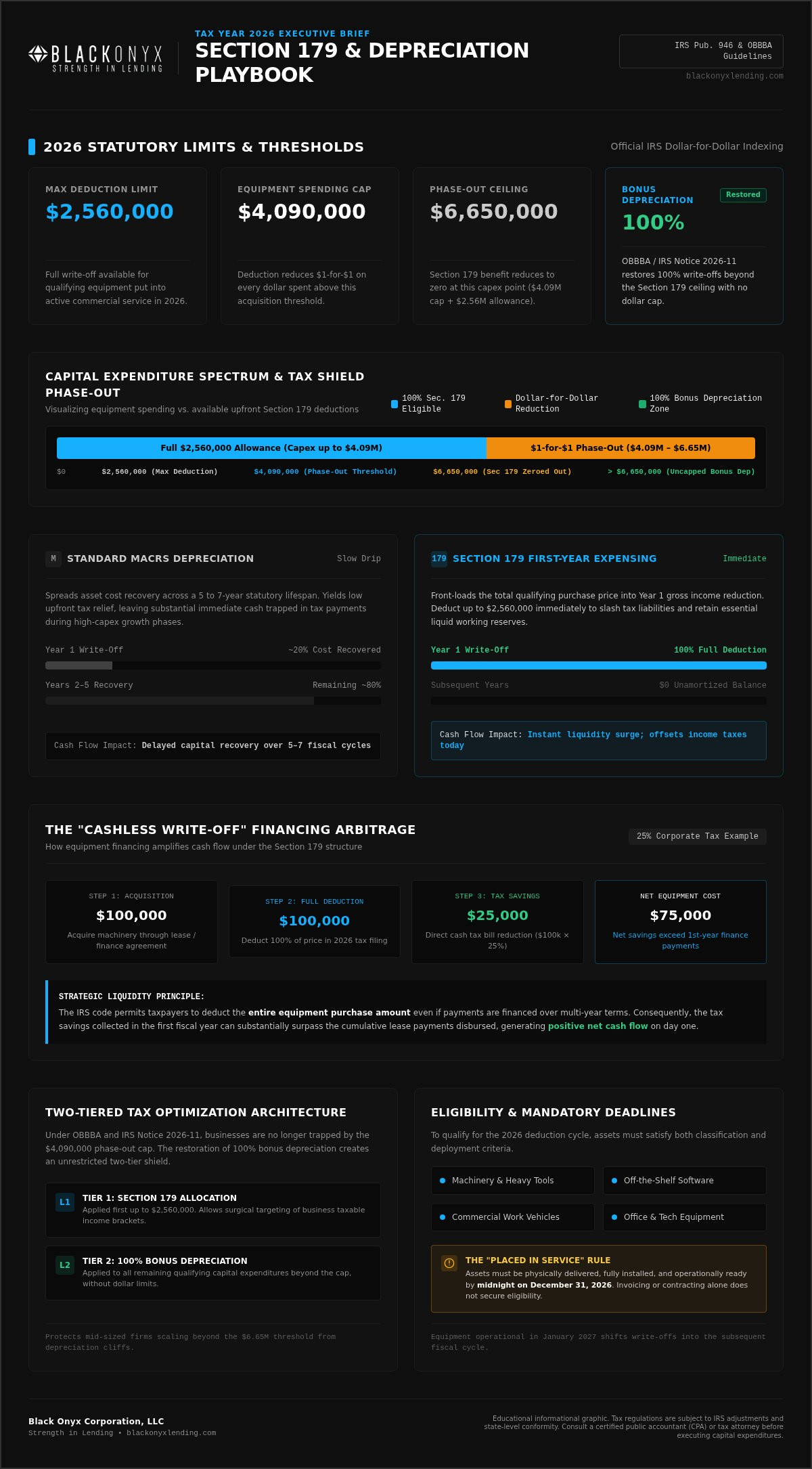
For years, businesses prepared for a “cliff” where bonus depreciation would drop to 20% by 2026. However, the landscape shifted following the enactment of the One Big Beautiful Bill Act (OBBBA). Under IRS Notice 2026-11, 100% bonus depreciation is now permanently restored for qualifying property. This creates a powerful synergy with the section 179 deduction 2026. While Section 179 has a specific deduction cap of $2,560,000, bonus depreciation has no such limit. Strategic planners now prioritize Section 179 to manage taxable income precisely and then apply 100% bonus depreciation to any remaining equipment costs. This layered approach ensures that even businesses exceeding the $4,090,000 spending threshold can still achieve massive tax savings without being restricted by standard phase-out rules.
2026 Deduction Limits and Spending Caps
Understanding the specific parameters of the section 179 deduction 2026 is vital for any CFO planning capital expenditures. For the 2026 tax year, the IRS has established a maximum deduction limit of $2,560,000. This represents the total amount you can write off immediately. However, this benefit is designed primarily for small and mid-sized enterprises. The total equipment purchase threshold, or spending cap, is set at $4,090,000. If your total investment exceeds this amount, then your available deduction begins to diminish.
These figures are adjusted annually for inflation to ensure the incentive keeps pace with market realities. According to IRS Publication 946, the goal is to provide a significant tax shield for businesses that are actively scaling their operations. Once your equipment spending hits the phase-out threshold, every dollar spent over that limit reduces your deduction by exactly one dollar. This creates a complete phase-out ceiling at $6,650,000, where the Section 179 benefit disappears entirely.
Calculating Your Potential Tax Savings
Imagine your business acquires $100,000 in qualifying machinery this year. If you’re in a 25% corporate tax bracket, then claiming the full deduction results in a $25,000 direct reduction in your tax bill. Your effective net cost for the equipment drops to $75,000 immediately. This “cashless write-off” provides a massive liquidity boost. If you want to maximize these savings without depleting your reserves, then exploring customized equipment leasing with Black Onyx Corporation, LLC can help you acquire the assets while keeping your credit lines open.
The “Spending Cap” Trap
Large corporations often find themselves excluded from Section 179 because their capital budgets far exceed the $4,090,000 threshold. If you’re a mid-sized firm approaching this mark, then strategic timing is essential. While the 2026 bonus depreciation rate was originally scheduled to drop to 20%, the permanent restoration of 100% bonus depreciation provides a vital safety net. Bonus depreciation isn’t subject to a spending cap, making it a reliable fallback for high-growth businesses that exceed the Section 179 limits. By monitoring your total spend throughout the year, you can avoid the trap of an unexpected tax bill resulting from a reduced deduction.
Qualifying Equipment and Property for 2026
The section 179 deduction 2026 applies to a vast range of business assets, provided they are “new to you.” This includes both brand-new and used equipment. It’s a scope that’s broader than many realize, encompassing tangible personal property like office furniture, printing presses, and manufacturing tools. Off-the-shelf software also qualifies, which means the program must be available to the general public, subject to a non-exclusive license, and not substantially modified. Additionally, Qualified Improvement Property (QIP) remains a major advantage. This category covers interior enhancements to non-residential buildings, including HVAC systems, fire protection, and security upgrades, allowing you to expense these significant capital projects in a single year.
Common qualifying assets include:
- Manufacturing machinery and assembly lines
- Office workstations and IT hardware
- Diagnostic tools and laboratory equipment
- Standardized business software
Medical and Manufacturing Equipment
Precision is paramount in high-stakes industries. If you are operating in the clinical space, then staying current with diagnostic technology is a necessity rather than a luxury. Leveraging medical equipment financing allows you to acquire state-of-the-art scanners or laboratory tools while utilizing the full Section 179 write-off. Manufacturers face similar pressures to automate. Specialized underwriting bridges the gap for high-value assets like CNC machines or robotic assembly lines. These items are ideal candidates for Section 179 because they often represent a business’s largest annual capital investment.
The 2026 Business Vehicle Rules
Vehicles represent the most complex category for tax planning due to strict weight and usage requirements. To qualify for a full deduction, a vehicle must generally exceed a Gross Vehicle Weight Rating (GVWR) of 6,000 pounds. For 2026, the expensing cap for heavy SUVs in the 6,000 to 14,000-pound range is $32,000. Any remaining basis after this cap can be written off using the 100% bonus depreciation rules. Specialized commercial vehicles, such as cargo vans with no rear seating or flatbed trucks, are typically exempt from the $32,000 cap and allow for a full write-off.
You must use the vehicle for business purposes more than 50% of the time to qualify for any section 179 deduction 2026 treatment. If business use falls between 51% and 99%, then your allowable deduction is multiplied by that specific percentage. Accurate record-keeping is vital for compliance. You will need to document mileage and usage patterns when filing IRS Form 4562. Proving that an asset is a legitimate business tool ensures your claim remains secure during an audit.
Financing Strategy: Leasing vs. Buying for Section 179
The most effective way to utilize the section 179 deduction 2026 is through a “Lease it and Deduct it” strategy. Many business owners mistakenly believe they must pay the full purchase price of an asset in cash to qualify for the tax break. In reality, the IRS allows you to deduct the full cost of the equipment even if you finance the entire amount. This allows you to keep your capital in the bank while the tax savings from the deduction often exceed the total of your first year’s lease payments. Unlike traditional bank loans that frequently require 20% down and tie up your primary credit lines, commercial equipment leasing through Black Onyx Corporation, LLC preserves your liquidity for operational emergencies or payroll.
You must distinguish between lease types to ensure tax compliance. For the purposes of Section 179, you generally need a Capital Lease, also known as a Finance Lease or a $1 Buyout Lease. In these agreements, the IRS treats your business as the owner for tax purposes, granting you the right to claim the full deduction. Conversely, an Operating Lease or Fair Market Value (FMV) lease typically allows the leasing company to keep the depreciation benefit while you deduct the monthly payments as a standard business expense. If you have equity tied up in machinery you already own, then sale-leaseback financing can unlock that cash to fund new acquisitions before the 2026 deadline.
Maximizing Cash Flow with Equipment Leasing
While “zero-down” financing is often a marketing term, many lease structures require only the first and last month’s payments upfront. This is a significant advantage over high-interest loans that demand large capital outlays. Leasing also acts as a vital hedge against equipment obsolescence. If your industry relies on rapidly evolving technology, then a lease allows you to upgrade to newer models at the end of the term without the burden of trying to sell outdated, fully depreciated hardware. It’s a method that prioritizes the use of the asset over the risks of ownership.
Asset-Based Lending and Section 179
For high-value acquisitions like heavy construction gear or manufacturing lines, asset based financing provides a robust alternative to traditional credit. In this scenario, the underlying equipment serves as the primary collateral, which often simplifies the underwriting process for growing firms. This structure is particularly useful for businesses that have strong balance sheets but need to move quickly to meet year-end “placed in service” requirements. Financing creates a “double win” of cash preservation and tax relief by allowing you to write off the asset’s full value while paying for it over several years.
Secure your 2026 tax benefits today by consulting with our equipment financing experts at Black Onyx Corporation, LLC to find the right structure for your next major acquisition.
Implementation: How to Claim Your Deduction with Black Onyx
Executing a successful section 179 deduction 2026 strategy requires more than just a year-end purchase; it demands a methodical approach to procurement and capital management. Your first step should always be a consultation with a qualified tax professional to verify that your business income supports the full deduction. Once eligibility is confirmed, you must identify the specific technology or machinery that will catalyze your growth in the coming year. Waiting until December to source equipment often leads to delivery delays that can jeopardize your tax benefits. If the asset isn’t physically operational by midnight on December 31, then you cannot claim the deduction for the 2026 tax year.
Securing the right capital structure is the next phase. By partnering with Black Onyx Corporation, you gain a strategic ally that manages the complexities of the lending landscape on your behalf. We focus on bridging the gap between your immediate operational needs and the specific documentation requirements of the IRS. Following these steps ensures a seamless implementation:
- Verify Eligibility: Confirm your aggregate active net taxable business income with your CPA.
- Asset Procurement: Finalize the specifications for your machinery, software, or vehicles.
- Funding Integration: Submit your application through Black Onyx to match with the optimal funding source.
- Operational Deployment: Schedule delivery and installation early to meet the strict “placed in service” deadline.
The Black Onyx Advantage
We don’t just provide a single path to capital; we offer a gateway to over 100 diverse funding sources. This vast network allows us to tailor lease structures that align with your specific cash flow patterns and growth targets. Our team provides strategic business financial consulting to ensure your underwriting package is robust and persuasive to lenders. Whether you are scaling operations in the US, Canada, the UK, or Australia, our global reach provides the resources necessary to navigate international commercial capital markets with precision.
Next Steps for Your 2026 Tax Strategy
Timing is your most valuable asset when it’s time to maximize the section 179 deduction 2026. Initiating the financing process in Q3 is a critical move that accounts for potential supply chain disruptions and ensures your equipment is delivered well before the year-end cutoff. To expedite approval, you should prepare updated financial statements, including your most recent P&L and balance sheets. A proactive stance prevents the bureaucratic obstacles that often stall last-minute funding requests. If you are ready to transform your tax liability into a growth engine, then contact Black Onyx for a personalized equipment financing consultation and secure your competitive edge for the new year.
Accelerate Your Business Growth in 2026
Maximizing the section 179 deduction 2026 is more than a year-end tax exercise; it’s a decisive move toward operational excellence. By utilizing the $2,560,000 deduction limit alongside 100% bonus depreciation, you can transform your tax liability into immediate working capital. If you choose to lease your equipment instead of purchasing it outright, then you achieve the “double win” of full tax relief and cash preservation. Success depends on precision and timing. Your assets must be operational by December 31 to qualify for this fiscal year’s benefits.
Navigating these complex financial structures requires a partner with deep market expertise and a global reach. Black Onyx provides specialized commercial underwriting and access to a network of over 100 funding sources to ensure your financing structure is optimized for success. Whether you are upgrading medical technology or expanding a manufacturing line, we bridge the gap between your goals and the capital required to reach them. Secure your 2026 equipment financing with Black Onyx today and position your business for a transformative year of progress.
Frequently Asked Questions
Can I claim Section 179 if I lease the equipment?
Yes, you can claim the deduction if you utilize a Capital Lease or a $1 Buyout structure. These specific agreements treat your business as the owner for tax purposes, which allows for a full write-off in the first year. If you choose an Operating Lease or Fair Market Value agreement, then the financing company retains the tax benefits while you deduct the monthly payments as a standard operational expense.
What is the difference between Section 179 and Bonus Depreciation in 2026?
Section 179 allows for a targeted deduction up to $2,560,000 and is subject to a phase-out threshold once your spending exceeds $4,090,000. In contrast, the 100% bonus depreciation for 2026 has no spending cap or income limitation. Most strategic planners apply Section 179 to specific assets first and then use bonus depreciation to cover any remaining equipment costs that exceed the annual federal deduction limit.
Does used equipment qualify for the Section 179 deduction?
Used equipment qualifies for the deduction provided the asset is new to your specific business entity. This includes machinery, office furniture, and technology that was previously owned by another party but has never been used by your company. This provision is a significant advantage for growing firms that prefer the lower entry cost of pre-owned assets while still requiring the full tax benefits of the current code.
What happens if I sell the equipment before its useful life ends?
If you sell the equipment before the end of its recovery period, then you may trigger Section 179 recapture rules. The IRS requires you to report the difference between the accelerated deduction you claimed and the standard depreciation as ordinary income. This also applies if your business usage of the asset drops to 50% or below, which necessitates a careful monitoring of asset deployment throughout its lifespan.
Is there a limit to how much I can deduct in 2026?
The maximum section 179 deduction 2026 is $2,560,000 for the current tax year. Total equipment purchases are also capped at $4,090,000 before the deduction begins to phase out dollar-for-dollar. Additionally, you cannot deduct more than your total net business income for the year. Any amount that exceeds your income can be carried forward to future years to offset later liabilities and protect your cash flow.
Can software be deducted under Section 179?
Off-the-shelf software is eligible for the deduction if it is available for purchase by the general public and has a non-exclusive license. The software must not be substantially customized for your specific business needs to qualify. It must be placed in service by the December 31 deadline and used for income-producing activities more than 50% of the time to qualify for the full tax benefit this year.
What does “placed in service” actually mean for tax purposes?
The term “placed in service” means the equipment is physically on-site and ready for its intended business use. Simply paying for the asset or signing a lease agreement is not enough to secure the deduction. You must have the machinery installed and operational by midnight on December 31, 2026. This makes early procurement essential to avoid delivery delays that could push the tax benefit into 2027.
Can I use Section 179 for a vehicle I also use personally?
You can use the section 179 deduction 2026 for a mixed-use vehicle if the business usage exceeds 50%. Your deduction is limited to the percentage of the cost that corresponds to business use. If you use a heavy SUV for business 70% of the time, then you can only apply the deduction to 70% of the purchase price, provided you maintain accurate mileage logs for IRS compliance.