


Your startup’s cash reserve is a survival tool, not a down payment. Many founders believe they must choose between draining their liquidity or facing rejection from traditional banks due to a limited time in business. This assumption is a strategic error that stalls growth before it begins. Securing equipment financing for startups in 2026 doesn’t require a two-year trading history or a perfect personal credit score. If you understand how to leverage asset-based structures, then you can acquire high-tech machinery or essential software while keeping your capital intact for operations.
You’re about to master the mechanics of funding to secure essential assets without exhausting your bank account. This guide provides a clear roadmap to navigate the 2026 lending environment, where 100% bonus depreciation and the $2,560,000 Section 179 deduction limit offer massive tax advantages. We’ll clarify the confusion between unsecured loans and asset-based leases so you can make informed decisions. You’ll learn how to find a lender that values your future scaling potential over your past credit history, ensuring your business moves from a state of limitation to one of significant opportunity.
Key Takeaways
- Learn why deploying cash for depreciating assets is a tactical error and how to use the equipment itself as collateral to lower entry barriers.
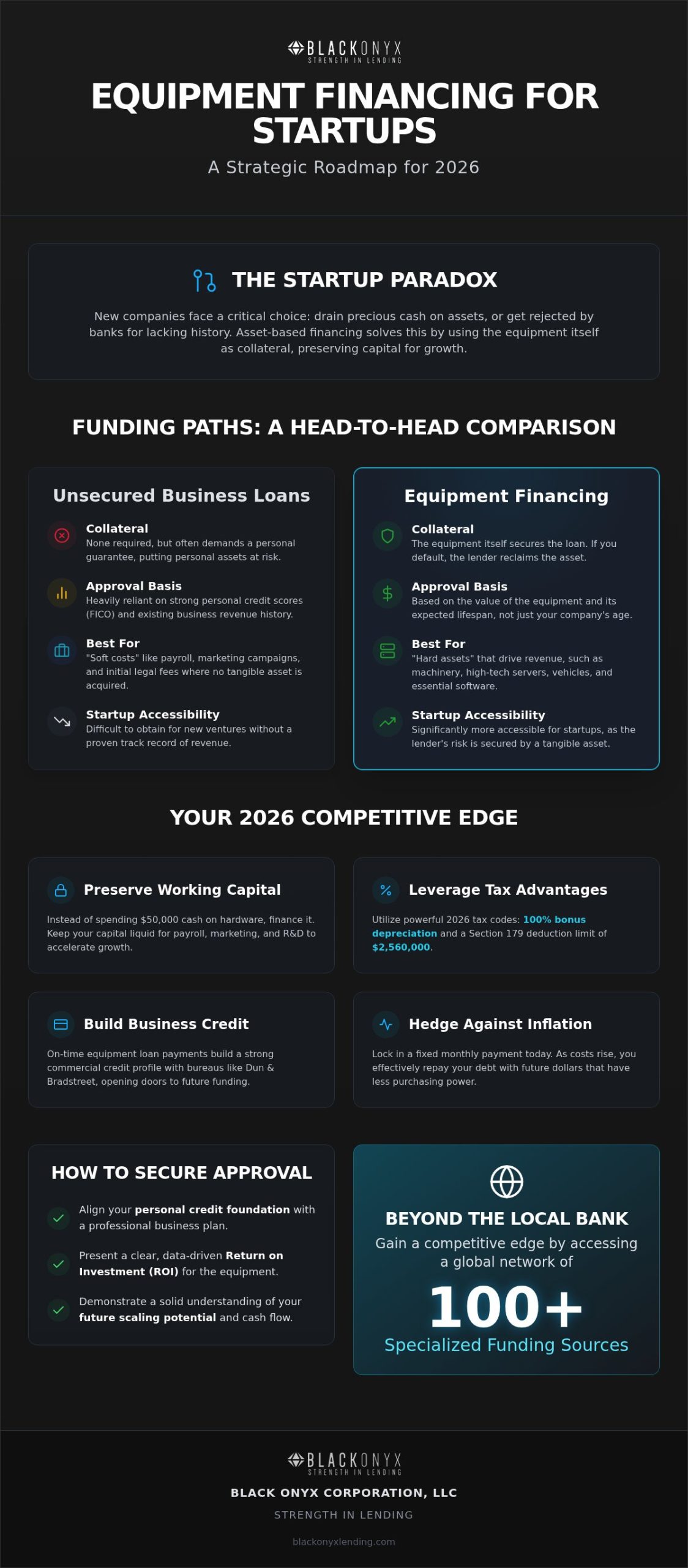
- Discover the “Startup Paradox” and why asset-based equipment financing for startups often provides a more accessible path to growth than traditional unsecured loans.
- Compare leasing versus buying through a 2026 strategic lens, specifically leveraging 100% bonus depreciation to optimize your capital preservation.
- Master the underwriting gauntlet by aligning your personal credit foundation with a professional business plan that demonstrates clear equipment ROI.
- Gain a competitive edge by bypassing local bank limitations through a global network of over 100 specialized funding sources.
Why Equipment Financing is the Strategic Lifeblood of 2026 Startups
Cash is the oxygen of any new venture. Spending your liquidity on a depreciating asset like heavy machinery or specialized servers is often a tactical error that leaves your business vulnerable to market shifts. In the 2026 market, where equipment and software spending exceeds $2 trillion annually, savvy founders treat capital as a tool for growth rather than a way to buy hardware. Equipment financing for startups transforms the asset itself into collateral, which significantly lowers the barrier to entry for new firms. This structure means the lender’s risk is mitigated by the equipment’s value, making it easier for you to secure funding without a decades-long track record.
The 2026 economic environment makes fixed-rate financing a strategic hedge against inflation. If costs rise, you’re locked into a payment based on the asset’s original price, effectively paying back the debt with future dollars that may have less purchasing power. However, you must be disciplined in your selection. Focus your funding on must-have assets that drive revenue immediately. You should leave nice-to-have luxury upgrades for when your cash flow is more robust; financing non-essential items creates a debt burden that doesn’t provide the utility required to service the monthly payment.
Preserving Working Capital for Operations
If you spend $50,000 on a new piece of technology today, that capital is permanently trapped in a piece of hardware. By choosing equipment financing for startups, you keep that $50,000 liquid for payroll, R&D, or aggressive marketing campaigns. This creates a predictable monthly expense structure that simplifies your financial forecasting and protects your runway. Understanding how a Finance Lease Explained works helps you see that you can control an asset without the immediate cash drain. The opportunity cost of buying with cash is simply too high when you’re trying to scale a young company.
Building Business Credit from Day One
Establishing a commercial credit profile separate from your personal score is vital for long-term survival. Early successful repayments on equipment loans demonstrate your firm’s reliability to major commercial credit bureaus like Dun & Bradstreet or Experian Business. Commercial lenders often weigh these repayments more heavily than your personal credit card history because they show you can manage business-specific debt. This proactive approach opens doors to larger lines of credit and more favorable terms as your company matures. If you build this foundation now, then you won’t be scrambling for capital when a major expansion opportunity arises. It’s about moving from a state of limitation to one where your business’s own history carries the weight of its future expansion.
Unsecured Business Loans vs. Equipment Financing: Which Path Fits Your Launch?
Choosing between an unsecured loan and equipment-backed funding is a decision that dictates your startup’s risk profile. If you choose an unsecured loan, the lender bets entirely on your promise to pay; if you choose equipment financing, the lender bets on the tangible value of the asset itself. Unsecured startup loans are capital provided without physical collateral, typically requiring high personal credit scores. This distinction creates what we call the “Startup Paradox.” While unsecured funds provide total spending flexibility, they’re often the hardest to secure because a new company lacks the historical revenue to prove its reliability.
In contrast, equipment financing for startups uses the machinery or technology you’re acquiring as security. This collateral requirement significantly reduces the lender’s exposure, which often translates to a smoother approval process and less reliance on aggressive personal guarantees. By isolating the debt to the asset, you protect your other business and personal holdings from the immediate impact of a potential default. It’s a strategic move that aligns the cost of the equipment with the revenue it generates.
The Mechanics of Unsecured Startup Funding
Lenders view unsecured debt as high-risk for pre-revenue companies because there’s no residual value to recover if the business fails. To overcome this, founders often resort to “credit stacking,” a process of layering multiple small lines of credit based on personal FICO scores. This path is appropriate if you must fund “soft costs” like initial payroll, marketing, or legal fees. However, you should be aware that these funds often carry higher interest rates to compensate for the lack of collateral. If your business plan requires significant capital for non-physical expenses, then the unsecured route might be your only option despite the higher costs; in such cases, founders with high-interest personal debt may find it helpful to Consolidate My Payday Loans to improve their financial standing for future underwriting.
Equipment-backed financing offers a more stable foundation for growth. Because the lender can reclaim and resell the asset, interest rates are typically lower than those found in the unsecured market. This is particularly beneficial for startups with “thin” credit files. Even if your business hasn’t established a robust profile yet, the inherent value of the machinery provides the necessary security for approval. For those seeking long-term machinery, investigating SBA 504 loans can provide a high-leverage, government-backed alternative to traditional bank debt.
If you prioritize capital preservation, then leveraging the asset’s value is the most efficient way to scale without overextending your personal liability. You can explore deeper insights into these structures in The Strategic Guide to Commercial Equipment Leasing in 2026. Navigating these options requires a proactive approach to underwriting. If you want to see which specific funding structure fits your 2026 projections, then connecting with a strategic financial ally is your next logical step.
Leasing vs. Buying: A Comparative Framework for Capital Preservation
Deciding between ownership and utility is a pivotal moment for any founder. Total Cost of Ownership (TCO) is a traditional metric that accounts for acquisition, interest, maintenance, and the eventual disposal of hardware. However, a more strategic approach for 2026 is focusing on the “Cost of Use.” If the monthly revenue generated by a machine exceeds the lease payment, the utility of the asset is more valuable than the title of ownership. Effective equipment financing for startups often hinges on this distinction. Ownership traps capital in a depreciating asset, while leasing allows you to pay for the asset’s productivity in real time.
Your choice also dictates your maintenance obligations. In a Fair Market Value (FMV) lease, you typically have lower monthly payments and the option to return the equipment, which often shifts some long-term maintenance risk away from your firm. Conversely, a $1 Buyout lease functions more like a loan; you’re responsible for all repairs, but you own the asset for a nominal fee at the end of the term. If you anticipate the equipment will have a long, productive life beyond the financing term, buying or a $1 Buyout is logical. If the technology will be obsolete in three years, leasing is the only rational path.
Combating Economic Obsolescence
Economic obsolescence occurs when a piece of equipment is still functional but no longer competitive in the market. In 2026, rapid advancements in AI-integrated machinery mean that hardware lifecycles are shorter than ever. If you own your equipment outright, you risk being stuck with “zombie tech”—outdated tools that drain your efficiency while you still carry the debt. FMV leases act as an obsolescence hedge, allowing you to refresh your technology every 24 to 36 months. This ensures your startup always operates with a competitive edge without the burden of disposing of old assets.
Tax Efficiency and the 2026 Landscape
The 2026 tax environment offers powerful incentives for those utilizing equipment financing for startups. Under current guidelines, the Section 179 deduction limit has reached $2,560,000, allowing you to deduct the full purchase price of qualifying equipment in the first year. Furthermore, the “One Big Beautiful Bill Act” restored 100% bonus depreciation for assets placed in service this year. If your startup is already profitable, these deductions can drastically reduce your tax liability. You should consult with a tax professional to determine if an off-balance-sheet operating lease or a capital lease better aligns with your specific tax bracket and long-term growth projections.
The Underwriting Gauntlet: How Startups Can Secure Approval
Approving a startup for capital is a precise exercise in risk mitigation. While established firms rely on years of tax returns, your approval depends on the strength of your financial foundation and the tangible utility of the asset. Your 2026 personal credit score remains the primary indicator of character for most lenders. If your score is robust, you’ll find the path to equipment financing for startups significantly smoother. However, credit is only the first filter; the lender must also believe in the revenue-generating potential of the machinery you’re acquiring.
The equipment invoice is the most critical document in your application package. Because the asset serves as the primary collateral, the lender needs a precise valuation to determine the loan-to-value ratio. If the equipment is specialized or has a high resale value, the underwriting process often becomes more flexible. Professional underwriting acts as the strategic bridge here; it’s the process of “packaging” your deal to highlight strengths and mitigate perceived weaknesses before it reaches a funding source’s desk.
Beyond the Credit Score: The “Story” Loan
Non-bank lenders often look beyond raw data to understand the “why” behind your request. A “story” loan allows you to explain how specific equipment will solve a production bottleneck or capture a new market segment. If you present a professional business plan that proves the equipment will generate a clear ROI, then you transform your application from a risky bet into a logical investment. Professional consulting can help you navigate this by addressing potential red flags, such as a recent career pivot or thin business credit, with a narrative that emphasizes future growth and competitive edge.
Required Documentation Checklist
Organization is the key to speed. You should prepare 3 to 6 months of bank statements to demonstrate cash flow management, even if your revenue is still scaling. The role of the equipment quote or pro-forma invoice is to provide the lender with a clear picture of what they are actually securing. If you are pursuing a “Sale-Leaseback” to unlock capital from assets you already own, your documentation must also include proof of ownership and current condition reports. This level of detail removes bureaucratic obstacles and moves your application toward a decisive approval.
Navigating these requirements alone can be overwhelming for a founder focused on scaling. If you want to ensure your application is positioned for success, then engaging with an expert to streamline your professional underwriting is the most efficient path forward.
Beyond the Local Bank: Navigating 100+ Global Funding Sources
Local banks are historically conservative. They rely on rigid credit boxes that often exclude new ventures based on a “limited time in business.” If your firm is less than two years old, a traditional institution often sees risk where an innovator sees opportunity. By accessing a multi-lender network, you bypass these bureaucratic hurdles. You gain entry to specialized funds tailored for medical, manufacturing, and tech sectors that understand the specific ROI of your machinery. Black Onyx acts as this strategic bridge, connecting you to over 100 third-party funding sources across the USA, Canada, the UK, and Australia. This broker advantage means one application puts your deal in front of hundreds of potential matches, allowing for expert negotiation that a single bank cannot offer.
Traditional bank lending standards remain tight, yet businesses spend over $2 trillion annually on equipment. To stay competitive, you need a partner that navigates these market dynamics with precision. When you move beyond local branches, you find lenders who use AI-driven underwriting to make faster decisions. This speed is essential for startups that must upgrade frequently to avoid obsolescence. If you want to secure equipment financing for startups in 2026, then looking toward a global network is the most effective way to find a lender that values your future growth over your past history.
Asset-Based Financing and Sale-Leasebacks
Once you have secured the necessary equipment for your medical practice or contracting business, the next step in your growth strategy is facilitating customer access. By partnering with Zip-Loan, you can offer flexible consumer financing, allowing your clients to manage their costs while you maintain the cash flow needed to service your equipment leases.
If you’ve already invested heavily in initial assets, then a Sale-Lease Back is your secret weapon for liquidity. This structure allows you to sell your equipment to a lender and lease it back immediately, unlocking cash for new growth or operational expenses. Unlike traditional loans that can take months to process, non-bank lenders in our network prioritize speed and precision. They focus on the asset’s value rather than just your trading history. It’s a proactive way to maintain momentum without waiting for a bank’s committee to deliberate. This form of asset-based financing ensures your capital isn’t trapped in hardware when it could be funding your next big hire.
Consulting for Long-Term Scalability
Your first lease isn’t just a transaction; it’s a foundation for your next five years of growth. Equipment financing for startups should be designed with future scalability in mind, ensuring your debt structure doesn’t hinder your ability to secure more capital later. Black Onyx provides specialized business planning and consulting to align your funding with your long-term competitive edge. We act as a powerful ally, navigating market dynamics to ensure you aren’t just getting a loan, but a strategic advantage. Ready to scale? Contact Black Onyx for a personalized consulting session.
Empower Your Startup’s 2026 Growth Strategy
Success in the current market requires a decisive shift from traditional ownership to strategic utility. If you focus on the revenue-generating potential of your assets rather than the title, then you protect the liquidity necessary for scaling. We’ve explored how equipment financing for startups serves as a hedge against both inflation and technological obsolescence. By utilizing professional underwriting and asset-based structures, you can navigate the hurdles that typically stall new ventures at the bank’s door.
You don’t have to face the underwriting gauntlet alone. Black Onyx acts as your strategic bridge, providing access to 100+ specialized commercial lenders across the US, UK, Canada, and Australia. Our expert underwriting is specifically tailored for complex startup scenarios, ensuring you find the right funding match to maintain your competitive edge. Secure your startup equipment with our global lender network and move from a state of limitation to one of significant opportunity. Your vision deserves the best tools available; it’s time to build your legacy.
Frequently Asked Questions
Can I get equipment financing for a startup with no revenue?
Yes, you can secure equipment financing for startups even without current revenue by leveraging the tangible value of the asset itself. Lenders in 2026 often prioritize the equipment’s resale value and the founder’s personal credit history over the company’s immediate cash flow. If you provide a professional business plan that demonstrates a clear path to profitability, then specialized non-bank lenders are more likely to approve your application based on future potential.
What is the minimum credit score for startup equipment financing?
Most lenders look for a minimum personal credit score between 600 and 650 for startup approvals. However, a score above 700 significantly increases your chances of securing competitive rates and lower down payment requirements. If your score is lower, then you might need to provide additional collateral or a larger initial investment. Lenders use this score as a primary indicator of financial responsibility when the business itself lacks a long-term credit history.
How does equipment leasing differ from an equipment loan?
Equipment leasing focuses on the cost of use, while a loan focuses on the total cost of ownership. In a lease, you pay for the right to use the asset over a specific term, often with an option to upgrade or buy it later. Loans involve borrowing the full purchase price and making payments until you own the asset outright. Leasing often provides more flexibility for startups that need to hedge against rapid technological shifts.
Can I finance used equipment as a startup?
Yes, financing used equipment is a common strategy for startups looking to preserve capital. Lenders will evaluate the asset’s age, condition, and remaining useful life to determine its collateral value. If the equipment is well-maintained and has a verifiable service history, then it can be financed similarly to new hardware. This approach often results in lower monthly payments; this helps you maintain a healthier cash runway during your initial launch phase.
Do I need to provide a personal guarantee for startup equipment loans?
Most lenders require a personal guarantee for equipment financing for startups because the business hasn’t established its own commercial credit profile yet. This guarantee means you’re personally responsible for the debt if the business cannot make payments. While this increases your personal risk, it’s often the trade-off for securing high-value assets without a two-year trading history. As your company grows and builds business credit, the need for personal guarantees may diminish.
What are the tax benefits of equipment financing in 2026?
In 2026, the primary tax benefits include the Section 179 deduction and 100% bonus depreciation. You can deduct up to $2,560,000 of the purchase price for qualifying equipment in the first year it’s placed in service. The restored 100% bonus depreciation rate allows for an immediate write-off of the full asset value, which drastically reduces your taxable income. You should consult a tax professional to align these deductions with your specific profitability timeline.
How long does the approval process take for startup funding?
The approval process typically ranges from one to four weeks depending on the lender’s requirements and the deal’s complexity. Non-bank and specialty lenders often move faster than traditional institutions by using AI-assisted underwriting to evaluate data points quickly. If you have all your documentation prepared, including bank statements and equipment invoices, then you can streamline the process. A professional broker helps by packaging your application correctly to avoid bureaucratic delays.
Is a down payment required for startup equipment leases?
A down payment of 10% to 20% is standard for most startup equipment leases in 2026. However, if you have an exceptional personal credit score and the equipment has a high resale value, then some lenders may offer 0% down options. These structures allow you to acquire essential machinery without an immediate cash drain. Your specific requirement will depend on the lender’s risk assessment and the strength of your professional business plan and projections.