


Did you know that large banks approved as few as 13% of small business loan applications in early 2026? This data point reflects a frustrating reality for entrepreneurs who feel trapped by opaque underwriting and confusing credit benchmarks. If you’ve struggled to decipher the evolving business loan requirements for LLC entities, you aren’t alone. Most owners find it difficult to prove consistent income for new ventures while trying to manage the friction between personal credit and business liability.
You deserve a clear path to capital that doesn’t rely on the rigid constraints of a local branch. This guide promises to help you master the specific documentation and strategic requirements needed to secure LLC financing in the current market. We’ll provide a definitive checklist of required documents and explain why asset-based requirements often offer a faster route to capital than traditional SBA paths. If your goal is rapid expansion, then understanding the shift toward cash-flow-based lending is essential. By the end of this article, you’ll know how to position your LLC for approval by focusing on performance and strategic assets rather than just a FICO score.
Key Takeaways
- Determine how your LLC’s legal structure and Operating Agreement impact your borrowing authority and risk assessment from a lender’s perspective.
- Master the financial benchmarks lenders use in 2026, including the specific Debt-Service Coverage Ratio calculations that determine your funding limit.
- Navigate the specific business loan requirements for LLC entities by contrasting traditional SBA paths with modern, asset-based alternatives.
- Utilize our comprehensive readiness checklist to organize your legal hygiene and financial transparency before engaging with a lender.
- Learn how professional underwriting consulting can identify potential obstacles early and bridge the gap between your business and a network of 100+ funding sources.
Why LLC Status Impacts Your Business Loan Requirements
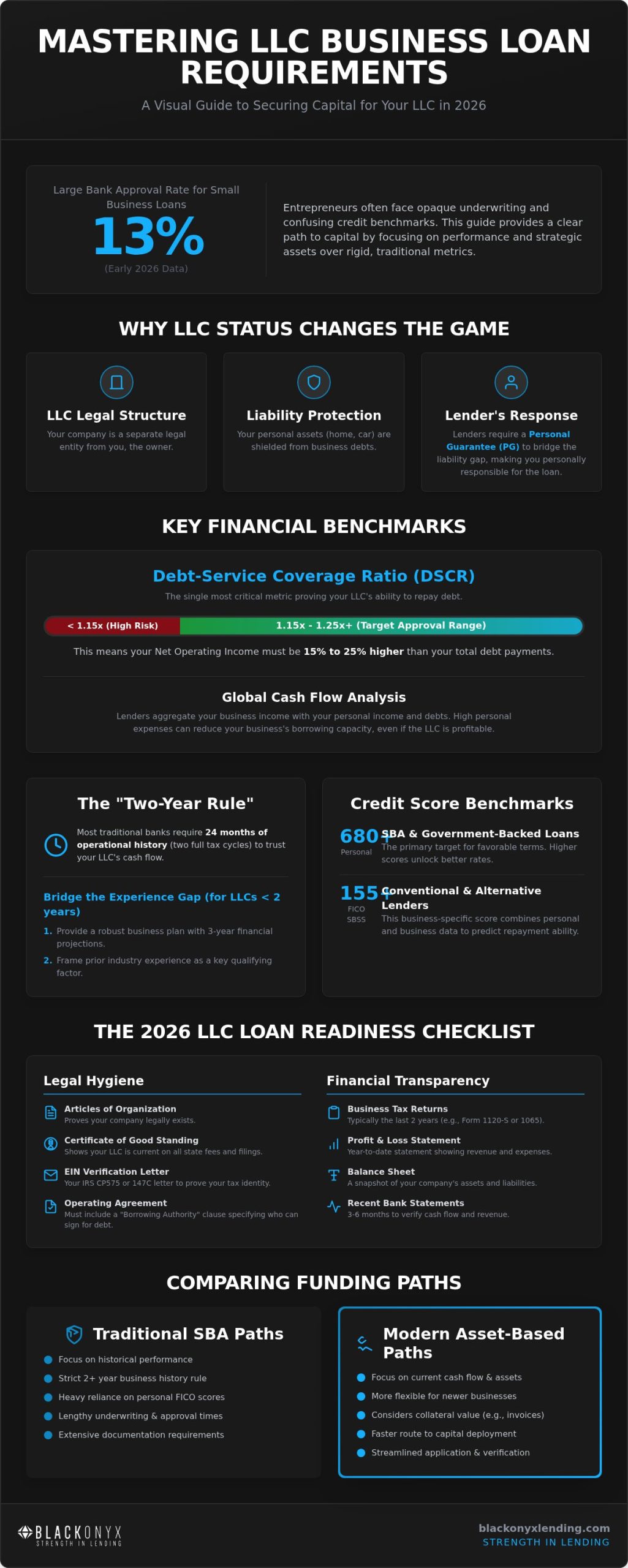
An LLC isn’t just a tax preference; it’s a legal firewall. While the Limited Liability Company (LLC) structure shields your personal assets, it simultaneously creates a hurdle for traditional lenders. If the business fails, the lender can’t automatically seize your home. This protection triggers a specific set of business loan requirements for LLC applicants that sole proprietors don’t always face. Because the entity is separate from the owner, the lender must evaluate the business’s independent viability while still seeking a way to ensure repayment.
Lenders mitigate this “limited” liability by requiring a Personal Guarantee (PG). It’s a strategic paradox: the LLC exists to separate you from the debt, but the loan requirement brings you back in. Additionally, your tax election dictates how you prove income. If you’re taxed as an S-Corp, lenders will scrutinize Form 1120-S. If you’re a partnership, they’ll demand Schedule K-1s. These documents are the primary tools for income verification, and any inconsistency here can stall an approval for weeks. Precision in your tax filings is non-negotiable.
Your Operating Agreement also plays a critical role in the underwriting process. It must clearly state who has the authority to bind the company to a debt. If this document is missing a “Borrowing Authority” clause, a lender might reject the application to avoid potential legal disputes among members later. It’s about certainty. Lenders want to know exactly who is legally responsible if cash flow tightens.
The “Two-Year Rule” for Newly Formed LLCs
Most traditional banks demand 24 months of operational history. They want to see two full tax cycles before they trust your cash flow. If your LLC is younger than two years, you’re often viewed as a high-risk startup, regardless of your personal success. You can bridge this “experience gap” by presenting a robust business plan with three-year financial projections. Professional consulting helps here. It allows you to frame your prior industry experience as a qualifying factor, moving the lender’s focus from the age of the LLC to the expertise of its leadership. This shift can turn a “no” into a conditional approval.
Legal Documentation Every LLC Must Have Ready
Organizing your “legal hygiene” is the first step toward a successful application. You’ll need to provide these documents to meet the standard business loan requirements for LLC financing:
- Articles of Organization: The foundational document filed with the Secretary of State that proves your company exists.
- Certificate of Good Standing: Proof that your LLC is current on all state fees and annual filings. To verify your entity status or find official state links, the Secretary of State Directory is a useful resource.
- EIN Verification: Your IRS CP575 or 147C letter to prove your tax identity and avoid identity verification delays.
- Operating Agreement: A fully executed version that includes specific language authorizing members to sign for commercial debt.
Core Financial and Credit Requirements for LLC Approval
Lenders in 2026 don’t just look at what your LLC makes; they look at how much it keeps. While your legal structure provides a shield, your financial health provides the fuel for approval. Most business loan requirements for LLC applications hinge on a combination of your personal creditworthiness and the company’s independent cash flow. If your business hasn’t yet established a robust commercial credit profile, your personal FICO score will act as the primary proxy for risk.
The Debt-Service Coverage Ratio (DSCR) is the most critical metric in this assessment. It’s the mathematical proof of your LLC’s ability to pay. Lenders typically look for a ratio of 1.15 to 1.25, meaning your net operating income must be at least 15% to 25% higher than your total debt obligations. They also perform a “Global Cash Flow” analysis. This process aggregates your business income with your personal income and debts. If your personal expenses are high, they can drag down the business’s overall debt-capacity score, even if the LLC itself is profitable.
Credit Score Benchmarks: SBA vs. Conventional
For those targeting government-backed financing, the target is often a personal score of 680 or higher. You can review the Official SBA Loan Program Requirements to understand how these guarantees impact lender risk. While some lenders accept scores in the 640 range, higher scores unlock lower interest rates and better terms.
Lenders also utilize the FICO SBSS score to pre-screen applications. The FICO SBSS score is a credit ranking that aggregates personal and business data into a single value ranging from 0 to 300. Although the SBA no longer mandates a specific SBSS minimum for all 7(a) loans as of March 2026, many private lenders still use a score of 155 as their internal floor for automated approvals.
Bank Statements and Tax Return Verification
Transparency is the currency of underwriting. While traditional banks still follow the “Three-Year Rule” for tax returns, alternative lenders have shifted toward real-time data. Twelve months of consecutive bank statements are now the standard for non-bank commercial financing. This provides a more accurate picture of your current liquidity than a tax return from the previous year.
Lenders scan these statements for “red flags” like non-sufficient funds (NSF) fees or consistent low-balance trends. Even one NSF in a ninety-day period can trigger an automatic decline. If your financials show these patterns, engaging in business planning and consulting can help you clean up your ledger before you submit your formal application. Precision here prevents the “deal killers” that often stop funding in its tracks.
Traditional SBA vs. Alternative Asset-Based Requirements
Choosing between an SBA loan and asset-based financing isn’t just about interest rates. It’s a strategic decision based on your LLC’s current liquidity and timeline. While the Business Loan Requirements for an LLC typically emphasize credit scores, asset-based lending shifts the focus to what you own. If your credit is rebuilding but your accounts receivable are strong, you can bypass the traditional “no” from a bank. The primary difference lies in what the lender prioritizes: your past performance or your current assets.
Alternative requirements allow for much faster execution. While a traditional bank might take 90 days to process an application, alternative lenders often provide 48-hour approvals. They do this by evaluating the liquidated value of your equipment or the creditworthiness of your customers rather than performing an exhaustive deep dive into your personal financial history. This speed is a competitive advantage when you need to capitalize on a sudden market opportunity.
When to Choose SBA 7(a) or 504 Loans
SBA programs remain the gold standard for long-term stability, particularly for real estate or major equipment purchases. However, the business loan requirements for LLC applicants in the SBA world are rigorous. You’ll need a detailed “use of proceeds” statement that accounts for every dollar spent. Additionally, you must pass the “No Credit Elsewhere” test. This means you have to prove to the SBA that your LLC cannot obtain the desired loan on reasonable terms from non-government sources. If you have significant cash reserves, you might actually be disqualified from these low-interest programs.
Asset-Based Requirements: Using What You Own
If your balance sheet is asset-rich but cash-poor, asset-based lending provides a path to liquidity that doesn’t rely on a perfect FICO score. These requirements focus on tangible collateral:
- Accounts Receivable (AR) Financing: Lenders review your aging reports. The requirement here is the strength of your customers’ credit, not necessarily your own.
- Equipment Leasing: The equipment itself acts as the primary collateral. This is why commercial equipment leasing is such an effective growth tool; it bypasses many of the rigid balance sheet requirements of a standard term loan.
- Sale-Leaseback: This allows you to unlock equity from machinery you already own. You sell the asset to the lender and lease it back, providing an immediate cash infusion for payroll or expansion.
Asset-based lending is about leverage. If you have the right collateral, you can secure funding that would be impossible through traditional channels. It’s a pragmatic solution for LLCs that are growing faster than their credit scores can keep up with.
The 2026 LLC Loan Readiness Checklist
Preparation isn’t just about gathering papers. It’s about building a case that proves your LLC is a low-risk, high-reward investment for the funding source. Mastering the business loan requirements for LLC success involves a five-phase readiness strategy. This process transforms your application from a simple request into a professional investment proposal that commands attention from underwriters.
Your readiness journey moves through five distinct stages. First, you must address legal hygiene by ensuring your Articles of Organization and Operating Agreements are current. Second, you establish financial transparency with tax returns and balance sheets. Third, you optimize credit by repairing personal scores and building a separate business profile. Fourth, you focus on strategic positioning through a narrative business plan. Finally, you undergo a professional review. If you follow this sequence, you eliminate the friction that typically slows down the approval process.
Step 1: The Documentation “Vault”
Interim financial statements are the most overlooked part of the documentation vault. Lenders don’t just want to see how you did last year; they want to see your year-to-date (YTD) performance. You must also prepare a formal Debt Schedule. This document lists every current liability your LLC carries, including original amounts, current balances, and monthly payments. If you’re applying for government-backed funds, you’ll need to update your personal financial statement using SBA Form 413. This level of organization signals to the lender that you’re a sophisticated operator.
Step 2: The Executive Summary and Business Plan
A narrative is no longer optional for loans exceeding $250,000. Underwriters need to understand the “why” behind the numbers. Your business plan must include detailed projections for the next 2 to 3 years, specifically explaining how the new capital will generate enough revenue to cover the debt. You should also highlight your management team’s industry experience. If you can prove your leadership has successfully managed similar growth cycles, you significantly reduce the perceived risk of the loan. This strategic framing is a core part of the business loan requirements for LLC approval in a competitive market.
The final step before submission is a professional audit of your materials. Our team provides specialized Business Planning & Consulting to identify potential “deal killers” in your financials before a lender ever sees them. This proactive approach ensures your LLC meets every benchmark for a swift approval.
Strategic Underwriting: Overcoming LLC Funding Obstacles
Submitting an application and hoping for a favorable result is a strategy for failure. Even if you meet the basic business loan requirements for LLC approval, subtle “deal killers” can trigger a rejection. Professional underwriting consulting acts as a defensive shield by identifying these obstacles, such as undisclosed liabilities or inconsistent tax reporting, before your file reaches a lender’s desk. This proactive approach transforms a vulnerable application into a high-probability request.
Success in the commercial landscape requires a logical “if-then” framework to simplify complex financial decision-making. If your personal credit score is below the 640 threshold, then asset-based financing is your most viable path to liquidity. If your LLC has significant unpaid invoices but lacks cash on hand, then accounts receivable financing provides the necessary bridge. We move beyond the rigid, automated algorithms used by many fintech platforms that often ignore the human element of business. Algorithms see a dip in revenue as a red flag; our consultants see it as a context-dependent event that can be explained through strategic narrative and documented performance.
Navigating Multiple Funding Sources
Your local bank represents only a fraction of the available capital in 2026. Different lenders have varying appetites for risk, and a “no” from one institution often means you’ve simply approached the wrong source. A seasoned commercial consultant manages requirements across a network of over 100 third-party funding sources. This global reach allows you to leverage multiple competitive offers simultaneously. By creating a competitive environment, you can secure more favorable terms and lower interest rates that a single bank would never offer.
Finalizing the Approval Process
An initial offer is a milestone, not the finish line. Once you receive a term sheet, you enter the due diligence phase. This period involves final document verification, proof of insurance, and potentially site visits for equipment-heavy operations. Precision during this stage is vital. Any discrepancy between your initial claims and the final verification can cause a lender to retract their offer. If you stay organized and responsive, you’ll move from due diligence to funding in record time.
Ready to get loan-ready? Contact Black Onyx for professional underwriting consulting today.
Securing Your LLC’s Financial Future in 2026
Mastering the business loan requirements for LLC entities is no longer about checking boxes at a local bank. It’s about strategic positioning and choosing the right lending framework for your specific growth stage. Whether you’re leveraging accounts receivable to bypass credit hurdles or utilizing the SBA 7(a) program for long-term stability, your success depends on preparation and precision. If you’ve organized your legal hygiene and optimized your debt-service coverage ratio, you’ve already removed the primary obstacles to funding. Precision in your documentation ensures you aren’t just another application in an automated queue.
You don’t have to navigate this complex landscape alone. By partnering with a global financing network, you gain access to over 100 third-party funding sources and specialized commercial underwriting that identifies potential issues before they reach a lender. Streamline your LLC loan approval with Black Onyx Consulting to move from a state of limitation to significant opportunity. Your next phase of expansion is within reach, and the right strategic ally makes all the difference. Take the next step toward growth with confidence.
Frequently Asked Questions
What is the minimum credit score for an LLC business loan in 2026?
Traditional banks typically require a personal FICO score of 680 or higher in 2026. However, SBA lenders generally look for scores in the 640 to 680 range to mitigate risk. If your credit is lower, alternative and online lenders often accept scores between 500 and 550 for specific asset-based products. Higher scores remain the primary tool for unlocking the most competitive variable rates, which currently range from 9.75% to 13.25%.
Can I get a business loan for a new LLC with no revenue?
Securing a loan for a new LLC with zero revenue is challenging but possible through strategic asset-based financing. If you have personal collateral or need specific machinery, equipment leasing acts as a viable entry point. Traditional lenders usually demand two years of history, but a robust business plan with three-year projections can bridge the gap for certain startups. Professional consulting helps frame your industry experience to satisfy early-stage business loan requirements for LLC approval.
Do I need a personal guarantee for an LLC business loan?
Yes, most lenders require a personal guarantee for LLC financing. Because your business structure limits your personal liability, lenders use the guarantee to ensure you remain financially committed to the debt. If the LLC defaults, the guarantee allows the lender to pursue personal assets for repayment. This requirement is standard for both SBA programs and private commercial loans, reflecting the lender’s need for a secondary repayment source.
What documents are required for an SBA loan for an LLC?
SBA loan applications require a comprehensive documentation package. You must provide your Articles of Organization, a signed Operating Agreement, and three years of both business and personal tax returns. Additionally, you’ll need current year-to-date financial statements, a debt schedule, and SBA Form 413. If you’re a manufacturer, you might benefit from waived upfront guarantee fees in 2026, provided you have the correct NAICS codes and verification documents ready.
How long does the LLC loan approval process take?
The timeline varies significantly based on the lender type. Traditional SBA loans often take 30 to 90 days to reach full funding due to extensive due diligence and federal guarantee processing. In contrast, alternative lenders utilizing AI and real-time bank data can offer approvals within 48 hours. If you choose asset-based paths like accounts receivable financing, you can often access capital in less than two weeks by focusing on collateral instead of credit.
What is a Debt Service Coverage Ratio (DSCR) and why does it matter?
The Debt Service Coverage Ratio (DSCR) measures your LLC’s ability to cover its debt payments with its net operating income. Lenders calculate this by dividing your annual net income by your total annual debt service. Most institutions require a minimum ratio of 1.15 to 1.25. If your ratio is below 1.0, it indicates that the business doesn’t generate enough cash flow to pay its debts, which is an automatic deal killer.
Can I use equipment leasing if my LLC doesn’t meet traditional loan requirements?
Equipment leasing is a powerful alternative when your LLC falls short of traditional credit benchmarks. Because the equipment serves as the primary collateral, the lender’s risk is lower than with an unsecured term loan. This path allows you to bypass rigid balance sheet requirements and preserve your working capital for daily operations. If your growth is outpacing your credit score, leasing provides the necessary momentum without the friction of a bank rejection.
Is it possible to get a business loan without 2 years of tax returns?
It is entirely possible to secure funding without two years of tax returns by focusing on business loan requirements for LLC products that prioritize cash flow. Many alternative lenders now use 12 months of consecutive bank statements to verify income in real-time. If your business shows consistent deposit activity and strong revenue-based metrics, you can qualify for accounts receivable financing or purchase order funding even if your tax history is limited or newly established.