


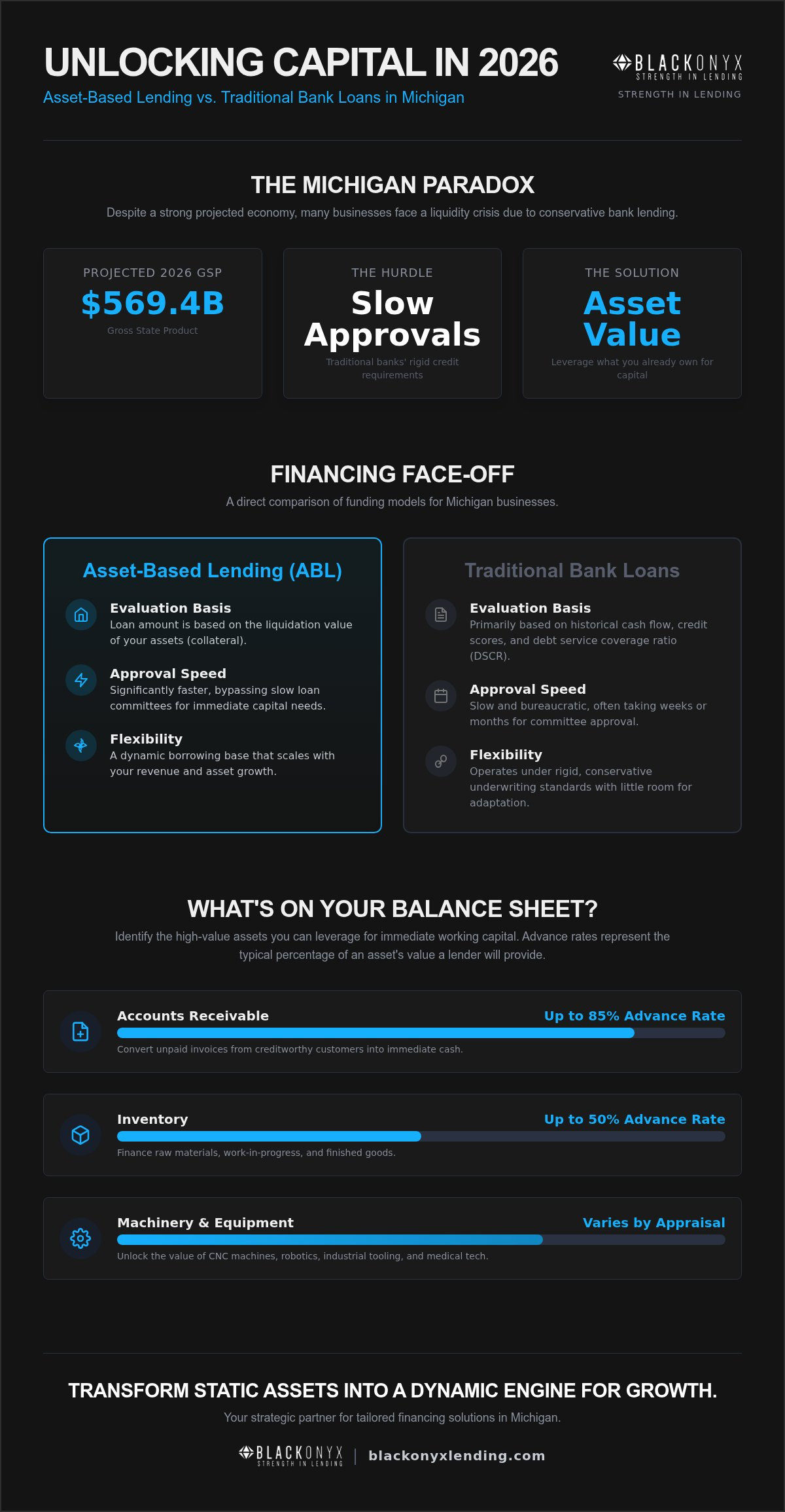
Your balance sheet is likely hiding the very liquidity you’re struggling to secure through traditional channels. While Michigan’s gross state product is projected to hit $569.4 billion in 2026, many local firms find themselves capital-poor despite owning millions in machinery and accounts receivable. If you’ve felt the sting of slow bank approvals or rigid credit requirements, you’re not alone. The shift toward conservative underwriting has made asset based lending Michigan a vital alternative for those who need to move faster than a standard loan committee allows.
You don’t have to let specialized equipment or unpaid invoices sit idle while your competitors capture market share. This strategic guide will show you how to leverage your existing physical value to unlock immediate working capital and bypass the bureaucratic hurdles of 2026. We’ll break down which assets qualify for maximum leverage, from inventory to industrial machinery, and explain how a localized partner in Troy can provide the speed your operations demand. By the end of this article, you’ll understand how to transform static assets into a dynamic engine for growth and long-term stability.
Key Takeaways
- Learn why Michigan businesses are shifting from traditional debt to asset-based structures to navigate the conservative 2026 lending environment.
- Discover how asset based lending Michigan allows you to convert stagnant accounts receivable and inventory into immediate working capital.
- Identify which specific assets on your balance sheet, from raw materials to medical technology, qualify as high-velocity collateral.
- Understand the transition from rigid credit-score requirements to a flexible, collateral-focused underwriting model that scales with your revenue.
- Leverage a Troy-based strategic partner to access over 100 funding sources, ensuring your financing is tailored to real-world operational needs.
Understanding Asset Based Lending in Michigan’s 2026 Economy
While Michigan’s gross state product is projected to reach $569.4 billion in 2026, the local business climate remains a study in contradictions. Many manufacturers and service firms find that while their order books are full, their cash reserves are thin. Local headline inflation sits at 3.2%, and payroll growth has hit a soft patch. In this environment, asset based lending Michigan has emerged as a strategic necessity. It’s a commercial credit facility where the loan amount is determined by the liquidation value of your business assets rather than just your historical cash flow. For a deeper dive into the mechanics, Understanding Asset Based Lending reveals how these structures have evolved from simple factoring into sophisticated liquidity tools.
The Core Components of a Michigan ABL Facility
A typical facility consists of a revolving line of credit or a term loan secured by accounts receivable, inventory, or equipment. The engine of this arrangement is the borrowing base. This is a formula that calculates exactly how much capital you can draw at any given moment. For example, a lender might provide 85% of your eligible accounts receivable and 50% of your finished goods inventory. If your business owns specialized automotive tooling or a high volume of unpaid invoices from Tier-1 suppliers, then your borrowing base represents a significant, untapped reservoir of capital. Michigan’s industrial heritage provides a unique advantage here; our local firms often hold high-value machinery that traditional lenders don’t know how to value properly.
Why Traditional Banks are Falling Short for MI Businesses
Traditional banks are retreating. They want perfect credit. We look at your machinery. In 2026, commercial lenders are operating with disciplined and conservative underwriting standards. This creates a hurdle for businesses that have capital tied up in specialized equipment or are dealing with the 5.7% unemployment rate’s impact on operations. While SBA 7(a) loan rates have climbed to 9.50% for loans over $250,000, bank committees are still taking weeks to issue approvals. Private asset based lending Michigan providers offer a speed advantage that banks simply can’t match. If a traditional institution is focused on your debt service coverage ratio (DSCR) during a temporary downturn, an asset-based lender focuses on the collateral’s inherent value to keep your momentum alive. Evaluating the right asset based lending companies is a critical first step toward finding a partner who values your collateral over your credit score.
Eligible Assets: From Detroit Machinery to Medical Tech
Michigan’s industrial diversity creates a broad spectrum of collateral opportunities that go far beyond simple real estate. Asset based lending Michigan provides a strategic framework where your physical tools and outstanding invoices become your greatest financial leverage. Accounts Receivable (AR) functions as high-velocity collateral because it represents cash that’s already earned but not yet collected. In the Michigan manufacturing sector, where payment terms can stretch to 60 or 90 days, this liquidity gap can be fatal. Inventory financing complements this by valuing your raw materials and finished goods. Lenders typically favor raw materials like steel or aluminum due to their high resale value in the open market, whereas finished goods are valued based on their specific market demand.
Machinery and Equipment (M&E) appraisals are equally critical for unlocking growth capital. In the 2026 market, precise valuation of CNC machines, stamping presses, or specialized robotics can yield a significant cash infusion. While SBA financing guidelines provide a solid framework for standard loans, asset-based structures offer more aggressive leverage for these specialized industrial assets. If you’re unsure which assets on your balance sheet hold the most leverage, consulting with an expert in asset-based financing can clarify your options and identify hidden liquidity.
Specialized Asset Classes for Michigan Industries
Medical equipment financing is a vital resource for healthcare providers in Ann Arbor and Detroit. High-tech diagnostic tools and imaging machines represent significant value that can be leveraged for expansion or upgrades. For those in the automotive or aerospace supply chains, heavy machinery leasing ensures you have access to the latest technology without the massive upfront cost. Additionally, purchase order (PO) financing supports Michigan-based distributors who need to pay suppliers before they can bill their customers. This ensures that a sudden surge in orders doesn’t lead to a cash flow crisis.
The Sale-Leaseback Strategy for Immediate Liquidity
Owned equipment is often a trapped resource that does little for your daily cash position. A sale-leaseback allows you to sell your machinery to a lender and immediately lease it back, resulting in a debt-free cash infusion. This strategy improves your balance sheet for 2026 by converting a fixed asset into liquid cash while retaining full use of the equipment. A sale-leaseback ensures that your production line never stops while you simultaneously extract the dormant capital tied up in your machinery. This approach also offers potential tax advantages, as lease payments are often deductible as a business expense.
Comparing ABL vs. Traditional Commercial Loans
Traditional commercial loans are built on a foundation of historical performance and pristine credit scores. If your Michigan business experienced a dip during the recent economic soft patch, a bank might see an unacceptable risk. In contrast, an asset-based lender sees the value in your equipment and invoices. Asset based lending Michigan focuses on the liquidation value of your collateral rather than your historical debt-to-income ratio. This shift in perspective means that a company dealing with a temporary cash flow crunch can still access significant capital. While traditional loans often come with lower initial interest rates, they also come with rigid financial covenants that can restrict your operational freedom during lean months.
Flexibility is where ABL truly outshines traditional lines of credit. As your revenue grows, your borrowing base grows automatically. You don’t need to renegotiate terms or wait for a new committee approval every time you land a major contract. In contrast, bank loans are often static. If your sales double overnight, a traditional bank line might stay capped, leaving you unable to fulfill new orders. ABL facilities typically have fewer restrictive covenants. You won’t face a technical default just because your net worth fluctuated during an aggressive expansion phase.
When to Choose ABL Over an SBA Loan
Speed is the primary differentiator. While SBA 7(a) loans offer variable rates around 9.50% as of August 2026, the approval process can drag on for months. If you need to capitalize on a sudden market opportunity or bridge a gap in payroll financing, waiting sixty days isn’t an option. Asset-based financing can often be secured in a fraction of that time. Additionally, SBA loans have strict requirements regarding the use of proceeds. If you need capital for non-standard growth initiatives or specialized business planning & consulting, ABL provides the latitude that government-backed programs often lack. A comprehensive review of leading asset based lending companies can help you identify which providers offer the fastest turnaround and most flexible terms for your specific situation.
The Strategic Advantage of Non-Bank Financing
Non-bank lenders offer a level of agility that local credit unions cannot match. Traditional banks often demand a “blanket lien” on all business assets, effectively tying your hands for future financing. Strategic asset-based partners focus specifically on the collateral involved, such as your accounts receivable or machinery. This precision allows you to maintain agility during Michigan’s seasonal economic shifts. For property investors who need fast, collateral-focused solutions, you can check out JGL Capital LLC to bridge the gap in commercial real estate funding. Non-bank entities are also more comfortable with specialized industrial collateral common in the Great Lakes region. They value your specialized tools at their true market worth rather than a generic book value derived from a spreadsheet.
Securing asset based lending Michigan requires a shift from passive borrowing to active strategic planning. The process begins with a rigorous initial assessment where we identify the latent value within your balance sheet. Unlike traditional banks that fixate on credit scores, an asset-based lender investigates the quality of your accounts receivable and the resale value of your machinery. In the conservative lending environment of 2026, professional collateral appraisals have become more detailed. Experts now look at market demand for specific equipment and the creditworthiness of your customers to determine exact advance rates. This level of scrutiny ensures that the capital provided is both sustainable and aligned with your actual operational capacity.
Once the value is established, the focus shifts to closing and ongoing monitoring. This isn’t a “set it and forget it” transaction; it’s an active partnership. Your lender will regularly review your borrowing base to ensure you have maximum access to funds as your business scales. If your inventory levels rise or you land a major new contract, your available credit should reflect that growth immediately. This real-time responsiveness is what allows Michigan firms to remain agile in a fluctuating economy.
The Importance of Professional Underwriting Consulting
Clean data is the primary currency in modern commercial finance. If your financial statements are disorganized, you’ll likely face lower advance rates or outright rejections. Professional underwriting consulting transforms your raw data into a compelling case for funding. This preparation is essential when negotiating with a global network of 100+ funding sources. By presenting a transparent and accurate view of your assets, you can bypass the common pitfalls that stall most Michigan commercial loan approvals. Expert guidance helps you navigate the “why” behind lender requirements, moving you from a state of uncertainty to one of decisive action. To start this process today, you can apply for a professional underwriting assessment to see which funding sources best fit your profile.
UCC Filings and Legal Considerations in Michigan
Understanding the legal framework in Michigan is vital for any business owner. While Michigan does not have a commercial financing disclosure law as of August 2026, the state does enforce a 25% criminal usury ceiling for non-bank lenders. A “first priority lien” is a standard requirement, established through a UCC-1 filing. This legal document publicly declares the lender’s interest in your collateral. For high-value inventory financing, you should also expect periodic field audits. These on-site inspections verify the existence and condition of the assets, providing the security needed for lenders to maintain high advance rates. This structured legal approach protects both parties and ensures the long-term viability of the credit facility.
Why Black Onyx is Michigan’s Strategic Financing Partner
Black Onyx Corporation, LLC operates as a strategic bridge between your current limitations and your future growth. Headquartered in Troy, Michigan, we provide the high-level consulting and specialized underwriting necessary to navigate a conservative 2026 financial market. If your current bank is blinded by a rigid algorithm, then you need a partner who understands the industrial heartbeat of the Great Lakes region. We move beyond surface-level credit scores to identify the true liquidation value of your machinery, inventory, and unpaid invoices. This results-oriented approach ensures that we remove the bureaucratic obstacles that typically stall commercial momentum.
Our firm provides access to a network of over 100 funding sources, offering a level of precision and variety that local credit unions cannot match. Whether you require Sale-Lease Back Financing to unlock capital from your facility or Accounts Receivable Financing to bridge a seasonal gap, our suite of services is comprehensive. We specialize in Asset-Based Financing and Equipment Leasing, tailoring every package to the specific operational needs of your industry. By focusing on individualized attention, we transform your balance sheet from a static document into a dynamic engine for liquidity.
Your Bridge to Global Capital from Troy, MI
Michigan exporters face unique challenges when scaling operations across international borders. We leverage a robust global network that includes funding resources in Canada, Australia, and the UK to support your expansion. For firms pursuing international property or large-scale development, The Federal Group provides specialized finance and private equity expertise to bridge those global gaps. Working with a seasoned consultant allows you to solve complex liquidity gaps that standard lenders often overlook. Our proactive attitude ensures that your business remains competitive, whether you’re navigating supply chain shifts in Detroit or delivering medical technology to global markets. We act as a powerful ally, deeply knowledgeable about market dynamics and intensely focused on your long-term success.
The journey toward immediate liquidity begins with a methodical, no-obligation review of your existing assets. We don’t believe in one-size-fits-all solutions; instead, we provide Business Planning & Consulting to ensure your financing structure is sustainable. If you need Medical Finance for a new clinic in Ann Arbor or Payroll Financing to manage a sudden surge in orders, we have the resources to execute quickly. Our process is designed to respect your time while providing the digestible, logical insights you need to make an informed decision. You can Secure your Michigan business growth with Black Onyx today and experience the speed of professional asset based lending Michigan.
Strategic Capital for Michigan’s Industrial Future
The economic landscape of 2026 demands more than just traditional debt. It requires a precise alignment between your physical assets and your operational goals. By shifting your focus from rigid credit scores to the inherent value of your machinery and accounts receivable, you unlock a level of agility that standard bank loans simply can’t match. Asset based lending Michigan serves as the catalyst that transforms your balance sheet into a powerful tool for rapid expansion and long-term stability. You’ve seen how localized expertise and a diverse borrowing base can bypass the conservative hurdles of traditional institutions.
Black Onyx Corporation, LLC provides the specialized commercial underwriting consulting needed to navigate these complex markets with confidence. Headquartered in Troy, MI, we act as your strategic bridge to over 100 funding sources, ensuring your capital is tailored to your specific industry needs. Don’t let stagnant assets or bureaucratic hurdles slow your momentum. It’s time to move from a state of limitation to one of significant opportunity. Your growth is within reach, and the right partner makes all the difference. Unlock Your Business Liquidity with Black Onyx and secure the capital your business deserves today.
Frequently Asked Questions
What types of assets qualify for asset-based lending in Michigan?
Accounts receivable, inventory, and machinery qualify for these facilities. In the Michigan market, this often includes specialized automotive tooling, medical technology, and industrial real estate. We evaluate the liquidation value of these assets to determine your borrowing base. This approach allows businesses to leverage physical value that traditional banks might ignore during conservative underwriting periods. It’s a strategic way to turn dormant equipment into active working capital.
How much can I typically borrow against my accounts receivable?
Lenders typically advance between 75% and 90% of the value of eligible accounts receivable. The exact percentage depends on the creditworthiness of your customers and the age of the invoices. If your Michigan firm works with Tier-1 automotive suppliers or established healthcare systems, you’ll likely secure a higher advance rate. This provides a high-velocity cash infusion that scales directly with your sales volume.
Is asset-based lending more expensive than a traditional bank loan?
Interest rates for asset based lending Michigan are generally higher than traditional bank loans but offer significantly higher capital availability and speed. While a bank might offer a lower rate, they often impose rigid covenants and smaller credit limits. ABL provides a strategic trade-off. You pay a premium for the flexibility to grow without the restrictive financial hurdles found in conventional commercial lending.
Can I use specialized manufacturing equipment for a sale-leaseback?
Yes, specialized manufacturing equipment such as CNC machines, stamping presses, and robotic assembly lines are ideal for sale-leaseback financing. This structure allows you to sell the equipment to a lender and immediately lease it back for continued use. It converts a fixed asset into immediate liquidity without interrupting your production schedule. This is a common strategy for Michigan manufacturers looking to fund new projects or manage debt.
How long does the commercial underwriting process take with Black Onyx?
Our underwriting process is designed for speed, often reaching a funding decision in a fraction of the time required by traditional banks. While a standard SBA loan might take months, an asset-based facility can often be structured and funded within a few weeks. Our role as a strategic consultant is to streamline the data collection process, ensuring your application is presented effectively to our network of 100+ funding sources.
What is the difference between asset-based lending and invoice factoring?
While invoice factoring is the outright sale of specific invoices, asset-based lending is a revolving line of credit secured by multiple asset classes. ABL offers more comprehensive flexibility, as it can include inventory and equipment in the borrowing base. Factoring is typically a transactional service focused solely on accounts receivable. Michigan businesses often prefer ABL when they need a broader, long-term financing solution that covers their entire balance sheet.
Does Black Onyx provide SBA loan consulting in Michigan?
We provide specialized consulting for SBA loans, including the SBA 7(a) and 504 programs. In August 2026, we help manufacturers navigate current incentives like the SBA fee waivers for manufacturing projects. Our experts analyze whether an SBA loan or an asset-based structure better suits your specific liquidity needs. We act as a bridge to ensure you secure the most competitive rates available in the Michigan market.
What happens if my asset value fluctuates during the loan term?
Your borrowing base is adjusted periodically to reflect the current value of your collateral. If your inventory levels increase or you generate more accounts receivable, your available credit limit rises automatically. Conversely, if asset values drop, the limit may be reduced to maintain the agreed-upon collateral coverage. This dynamic monitoring ensures that your financing stays aligned with the real-time health and scale of your Michigan business operations.