


If your traditional bank sees your inventory as a liability rather than an engine for growth, you aren’t just facing a credit hurdle; you’re operating with a restricted view of your own potential. Many high-growth firms hit a wall when rigid underwriting ignores the true value of their accounts receivable or equipment. Finding the right asset based lending companies is no longer a move of desperation; it’s a strategic pivot for leaders who refuse to let bureaucratic red tape stall their momentum.
You know that traditional bank rejections often have more to do with their internal risk models than your company’s actual performance. It’s frustrating to watch a growth phase stall because a credit line remains frozen. If you can shift the focus from your credit score to the strength of your balance sheet, then you can access the capital required to scale without the typical delays. This guide provides the roadmap to identify a financing partner that offers a flexible borrowing base tailored to your specific industry.
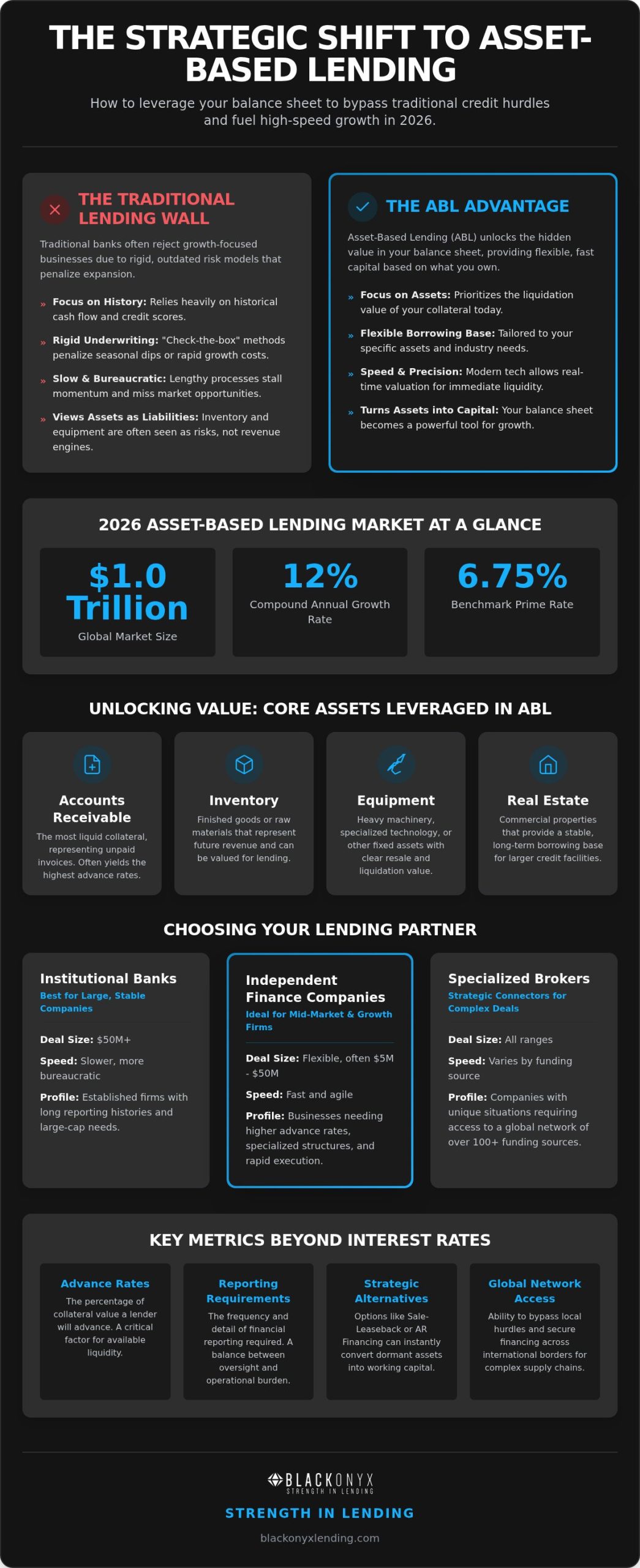
We’ll explore how the lending market has evolved in 2026, as the global asset-based lending market reaches the $1.0 trillion milestone. You’ll learn how to navigate this expansion to find a partner that prioritizes speed and precision over outdated hurdles. This guide provides the framework to secure immediate liquidity and turn your assets into a powerful tool for competitive advantage.
Key Takeaways
- Understand why traditional cash-flow lending is tightening and how modern asset-based structures offer a more resilient path for business growth.
- Learn to distinguish between institutional banks and boutique asset based lending companies to ensure your partner’s speed matches your operational needs.
- Master critical metrics beyond interest rates, such as advance rates and reporting requirements, to accurately calculate your available liquidity.
- Discover how strategic alternatives like sale-leaseback and accounts receivable financing can instantly convert dormant assets into working capital.
- Leverage a global network of over 100 funding sources to bypass bureaucratic hurdles and secure financing across international borders.
The Evolution of Asset Based Lending Companies in 2026
Asset-based lending (ABL) is a specialized financing structure where a business secures revolving credit or term loans through the pledge of tangible collateral. If you’re managing a company with high growth but thin cash reserves, ABL serves as a liquidity tool that prioritizes asset quality over historical earnings. Unlike traditional loans that rely heavily on debt-service coverage ratios, asset based lending companies look at what you own today to determine what you can borrow tomorrow. It’s a method designed to turn your balance sheet into a strategic advantage.
The core assets typically leveraged in these deals include:
- Accounts Receivable: The most liquid form of collateral, often seeing the highest advance rates.
- Inventory: Finished goods or raw materials that represent future revenue.
- Equipment: Heavy machinery or specialized tech with clear resale value.
- Real Estate: Commercial properties that provide a stable, long-term borrowing base.
For a foundational look at these mechanics, you might ask, What is Asset-Based Lending? Essentially, it’s a way to unlock capital tied up in your balance sheet to fuel immediate operations. This approach removes the bureaucratic obstacles often found in cash-flow lending models.
Why Traditional Banks are Moving Away from SMBs
The 2026 regulatory environment has fundamentally shifted bank risk appetites. Tightened capital requirements have forced many institutional lenders to retreat from small and medium-sized businesses, creating a significant “credit gap.” Banks often employ a “check-the-box” underwriting method that penalizes companies for seasonal fluctuations or rapid expansion costs. If your profit history doesn’t meet their rigid criteria, you’re rejected, regardless of the millions you have in unpaid invoices or high-value machinery. Asset based lending companies fill this void by focusing on the liquidation value of the collateral rather than just the income statement. This shift allows businesses to move from a state of limitation to one of significant opportunity.
The Rise of Non-Bank Asset Based Lenders
We’ve entered the year of “Alternative Commercial Finance.” With the global asset-based lending market reaching $1.0 trillion in 2026 and growing at a 12% CAGR, the shift toward private credit and independent financing firms is undeniable. These non-bank lenders aren’t bound by the same bureaucratic constraints as traditional institutions. Technology has also played a massive role; digital collateral management platforms now allow for real-time asset valuation and monitoring. This precision means lenders can move faster and offer higher advance rates even as the Prime Rate sits at 6.75%. If you need a partner that understands the pace of modern commerce, non-bank asset based lending companies provide the flexibility and speed that traditional banking simply cannot match. For a deeper look at how these strategies apply specifically to growing companies, our asset based lending small business growth guide for 2026 outlines how to unlock capital hidden on your balance sheet.
Types of Asset Based Lenders: From Giants to Boutique Specialists
The landscape of asset based lending companies is diverse, ranging from massive institutional banks to agile boutique firms. If you approach a global bank for a fast-moving, mid-market deal, you’ll likely face months of bureaucratic delays. Conversely, a small boutique might lack the capital depth for a nine-figure syndication. Understanding where your business fits in this hierarchy is the first step to unlocking liquidity. According to Thomson Reuters’ Definition of ABL, the focus remains on the collateral, yet the specific lender determines the speed and flexibility of the process.
Lenders generally fall into three categories:
- Institutional Banks: Best for large, stable companies with $50M+ needs.
- Independent Finance Companies: Ideal for mid-market firms needing speed and higher advance rates.
- Specialized Brokers: Strategic consultants who match complex deals with the right funding sources.
Institutional Bank ABL Divisions
Large institutional banks are best suited for large-cap deals and established companies with long-term reporting histories. These lenders often offer the most competitive interest rates because they have access to low-cost capital. However, the trade-off is a significant lack of flexibility. These agreements are typically covenant-heavy and require rigid compliance. If your business is in a rapid expansion phase or has a “storied” credit history, a bank’s check-the-box underwriting will likely result in a rejection or a frozen credit line when you need it most.
Independent and Boutique ABL Firms
Independent asset based lending companies offer a middle ground characterized by speed and adaptability. While their capital may be slightly more expensive than a bank’s, they can close deals in weeks rather than months. These firms excel at defining a “Borrowing Base” that includes assets a bank might ignore, such as work-in-progress inventory or specialized medical equipment. They are the ideal choice for companies facing seasonal fluctuations or those that don’t fit the narrow profile of traditional bank underwriting.
Financing Brokers and Strategic Consultants
Navigating this complex market alone is often a recipe for frustration. A single-source approach limits your options and puts you at the mercy of one lender’s internal policy shifts. This is where a strategic bridge becomes essential. Firms like Black Onyx act as high-level consultants, leveraging a global network of over 100 funding sources. By providing professional underwriting before you ever speak to a lender, these consultants ensure your package is presented in the best possible light. If you want to ensure your business is matched with the most efficient capital source, exploring specialized asset-based financing can provide the momentum you need to outpace the competition.
Key Criteria for Evaluating Asset Based Lending Companies
Selecting a financing partner requires looking past the headline interest rate. While the Prime Rate currently sits at 6.75% and asset-based bridge loan floors start around 8.99%, these numbers don’t tell the whole story of your potential liquidity. If a lender offers a low rate but restricts your borrowing base through conservative valuations, you’ll remain cash-strapped despite the “cheaper” debt. High-performing asset based lending companies prioritize the volume of capital they can safely deploy into your business, focusing on the strength of your collateral rather than just the cost of funds.
Asset Valuation and Advance Rates
The “Advance Rate” is the percentage of an asset’s value that a lender is willing to provide as credit. For Accounts Receivable, top-tier firms typically offer between 80% and 90% on eligible invoices. Inventory valuation is more complex, as lenders must choose between Cost or Net Orderly Liquidation Value (NOLV). Usually, inventory advance rates hover around 50% because of the inherent risks in liquidating physical goods. It’s a fundamental truth in this industry: the highest advance rate is often more valuable than the lowest interest rate because it provides the immediate capital necessary to fulfill new orders and scale operations.
Lender Flexibility and Covenants
Traditional bank loans are notoriously covenant-heavy, often triggering defaults if your debt-to-equity ratio fluctuates even slightly. In contrast, strategic asset based lending companies focus on “Operational Covenants” rather than rigid financial ratios. These might include requirements for weekly aging reports or periodic inventory audits. If you encounter a lender that demands the same restrictive financial covenants as a traditional bank, you’re likely dealing with a misaligned partner. A true strategic ally uses professional underwriting to understand your industry’s specific cycles, allowing for loan-to-value fluctuations without threatening your stability.
Scalability and reporting frequency are the final pillars of a successful partnership. You must determine if a lender can grow alongside your receivables. If your sales double over a quarter, your credit line should expand seamlessly without a secondary application process. Additionally, evaluate the “Reporting Requirements” to ensure they don’t become a bureaucratic hurdle. Some firms require daily data uploads, while others are satisfied with weekly summaries. Finding a balance that respects your team’s time while providing the lender with necessary transparency is essential for maintaining momentum and progress.
Strategic Alternatives: Sale-Leaseback and AR Financing
Asset-based lending is not a one-size-fits-all solution. While revolving credit lines are common, high-growth firms often require more specialized structures to unlock the full value of their balance sheets. If you own high-value equipment or manage a complex order book, then simply looking for traditional asset based lending companies might not be enough. You need to consider strategic alternatives that target specific capital needs, such as converting dormant equipment equity into cash or leveraging purchase orders before an invoice even exists.
Sale-Leaseback: Unlocking Capital from Existing Assets
If you own heavy machinery, medical technology, or specialized vehicles outright, you’re sitting on significant dormant capital. A sale-leaseback allows you to sell those assets to a lender for a lump sum of cash while immediately leasing them back for continued use. This mechanism provides an instant liquidity injection without disrupting your daily operations. In the 2026 fiscal environment, this is a preferred strategy for asset-heavy industries like construction or healthcare. It replaces a fixed asset with cash on your balance sheet, which often improves your overall financial ratios and credit profile. If you’re ready to explore these structures, you can access specialized sale-leaseback financing to unlock the equity in your existing equipment.
AR and Purchase Order Financing
For manufacturers and distributors, the “death valley” of cash flow exists between receiving a massive order and getting paid for it. Purchase Order (PO) financing bridges this gap by providing the capital to pay suppliers and fulfill contracts that would otherwise be out of reach. Once the goods are delivered, Accounts Receivable (AR) financing takes over, advancing cash on the final invoice so you don’t wait 60 or 90 days for payment. This synergy is particularly powerful in 2026, as the SBA has formalized rule changes to programs like the Export Working Capital Program. These changes now allow for loan maturities up to five years and permit proceeds to be used for asset-based lines of credit against inventory and receivables.
Combining these products creates a “Total Capital Solution” that supports every stage of the business cycle. By leveraging PO financing for production, AR financing for the waiting period, and payroll financing for operational stability, you remove the bureaucratic obstacles that stall progress. Leading asset based lending companies now offer these as integrated packages, ensuring that your financing partner understands the specific rhythm of your industry’s supply chain and sales cycles. This integrated approach allows you to move from a state of limitation to one of significant opportunity, scaling your business with precision and speed.
Partnering with Black Onyx: Your Global Strategic Bridge
Securing capital in a competitive market requires more than just a strong balance sheet; it demands a partner that acts as a strategic bridge between your goals and the global financial market. Applying blindly to asset based lending companies often leads to high rejection rates or predatory terms because direct applications lack professional preparation. Black Onyx Corporation, LLC changes this dynamic by functioning as both a direct lender and a high-level consultant. Based in Troy, Michigan, we provide our clients with a sophisticated entry point into a network of over 100 funding sources. This “Consultant First” approach ensures that your specific assets are matched with the lender best equipped to value them, whether you’re dealing with complex inventory or international receivables.
Professional Underwriting and Consulting
“Loan Readiness” is the most critical factor in securing favorable terms. If you present a disorganized financial package, lenders will price that perceived risk into your interest rate. We remove these bureaucratic obstacles by providing professional underwriting before your file ever reaches a funding source. To further ensure your business is positioned for success, you can explore The VULPIN Check as part of your comprehensive strategic assessment. Our team negotiates on your behalf, ensuring that the final agreement reflects the true strength of your operations. Professional business planning and consulting are not just add-ons; they’re essential tools that clarify your growth trajectory for potential partners. When a lender sees a clear, data-backed plan, they’re more likely to offer higher advance rates and more flexible covenants.
Commercial operations don’t stop at national borders, and neither should your financing options. Black Onyx Corporation, LLC provides specialized support across the US, Canada, the UK, and Australia. Navigating international asset based lending companies requires a deep understanding of local market dynamics and regulatory frameworks. We provide this expertise for specialized industries including manufacturing, logistics, and medical finance. If you’re a manufacturer in the UK or a medical provider in Australia, we understand the specific asset valuations required to unlock liquidity. Our global reach means you aren’t limited by local credit conditions or the risk appetite of a single regional bank. You gain access to a world of capital designed to fuel your momentum. For marketing firms in Canada looking to expand their fulfillment capabilities, Omega Odyss provides the white label SEO and PPC infrastructure needed to match that financial scaling.
The path to immediate liquidity starts with an objective evaluation of your current assets. Don’t let a frozen credit line or a bank rejection define your company’s future. You can move from a state of limitation to one of significant opportunity by leveraging our global resources and professional underwriting. Start your asset evaluation today to see how a flexible borrowing base can transform your growth phase into a sustained competitive edge.
Transforming Your Assets into Strategic Momentum
The financial landscape of 2026 demands a shift from traditional cash-flow models to a more agile, asset-focused strategy. You’ve seen how modern asset based lending companies prioritize the tangible value of your balance sheet over rigid earnings history. By focusing on advance rates and operational flexibility, you can bypass the credit gaps that often stall high-growth firms. Whether you’re leveraging accounts receivable or exploring the liquidity benefits of a sale-leaseback, the right structure provides the momentum needed to outpace the competition.
Partnering with a seasoned consultant ensures your business is presented to the market with precision. Black Onyx acts as your strategic bridge, offering access to 100+ funding sources and specialized underwriting experts who understand the nuances of your industry. Our global reach across the US, Canada, UK, and Australia means you’re never limited by local credit constraints. It’s time to move from a state of limitation to one of significant opportunity.
Secure your strategic commercial financing with Black Onyx today and unlock the capital required to fuel your long-term success. Your growth shouldn’t have to wait for a bank’s permission.
Frequently Asked Questions
What are the typical advance rates for asset-based lending?
Advance rates typically range from 80% to 90% for accounts receivable and approximately 50% for inventory. These percentages depend on the liquidity and quality of the specific assets. For instance, finished goods often receive higher advances than raw materials because they are easier to liquidate in a secondary market. If you have high-value machinery, you might see advance rates between 70% and 80% of its appraised liquidation value.
How do asset-based lending companies differ from traditional banks?
Asset based lending companies focus on the liquidation value of collateral rather than historical cash flow or rigid debt-service coverage ratios. Banks often reject growing firms because of strict earnings requirements or bureaucratic underwriting processes. ABL providers prioritize the strength of your balance sheet instead. This approach allows for more flexible borrowing structures that scale as your assets grow, providing a strategic alternative to traditional institutional banking.
Can I use asset-based lending if I have a low credit score?
You can absolutely secure financing with a low credit score because the loan is primarily secured by tangible business assets. While banks view poor credit history as a disqualifier, ABL lenders care more about the value of your invoices and equipment. If your accounts receivable are from creditworthy customers, then your personal score becomes a secondary factor. This makes ABL an ideal solution for turnaround situations or rapid expansion.
What types of assets can be used as collateral for an ABL?
Core collateral types include accounts receivable, inventory, machinery, equipment, and commercial real estate. Modern lenders also evaluate specialized assets like medical technology or logistics fleets. In 2026, updated SBA regulations even allow for asset-based lines of credit secured by international receivables. By pledging these diverse assets, you unlock liquidity that would otherwise remain dormant on your balance sheet, fueling your immediate operational momentum and progress.
How long does it take to get funded by an asset-based lender?
Funding typically occurs within two to four weeks, which is significantly faster than the several months required by traditional banks. Speed is a primary advantage of independent asset based lending companies. The process moves quickly because the underwriting focuses on asset valuation rather than exhaustive historical audits. If you have organized financial records and clear collateral documentation, then you can move from application to closing with high precision.
What is the difference between ABL and factoring?
The main difference is that ABL is a revolving line of credit secured by assets, while factoring is the outright sale of invoices. In an ABL structure, you maintain control of your accounts receivable and pay interest on the funds you use. Factoring involves a third party collecting payments directly from your customers. ABL often provides lower costs for established firms that need a comprehensive capital solution.
Are there tax benefits to sale-leaseback financing in 2026?
Sale-leaseback structures can offer significant tax advantages by converting a depreciating asset into a fully deductible lease expense. Instead of taking small depreciation deductions over many years, you can often deduct the entire lease payment as an operational cost. This shift improves your immediate cash flow and simplifies your balance sheet. You should consult with a tax professional to see how specific 2026 regulations apply to your equipment.
How does Black Onyx help businesses secure ABL without a bank?
Black Onyx streamlines the process by acting as a strategic bridge to a network of over 100 funding sources. We provide professional underwriting to ensure your application is “loan ready” before it reaches a lender. This approach removes systemic hurdles and increases your chances of approval. By matching your specific industry needs with the right capital source, we help you secure competitive terms that traditional banks don’t offer. Small business owners looking to explore these options further can review our comprehensive asset based lending small business strategies for 2026 to understand how to leverage balance sheet equity for immediate growth capital.