


In 2026, the most successful companies aren’t waiting for a traditional bank’s permission to grow. They’re leveraging the capital already hidden on their balance sheets. You likely feel the frustration of restrictive covenants and the agonizingly slow pace of commercial loan approvals that seem designed for a different era. If your growth is currently tethered to a lender’s rigid box, then you’re leaving untapped equity sitting idle in your equipment and unpaid invoices. It’s a common hurdle, but it’s one that modern asset based lending small business strategies are designed to clear.
This guide will show you how to unlock immediate liquidity and bypass traditional bureaucracy to fund your next phase of expansion. We’ll provide a roadmap to securing flexible loan terms that actually grow alongside your revenue. You’ll discover a simplified underwriting process that prioritizes your operational value over a perfect credit score. By the end of this article, you’ll understand how to transform static assets into a dynamic engine for momentum, ensuring your business stays ahead of the competition in a volatile market.
Key Takeaways
- Learn how asset based lending small business strategies prioritize the value of your collateral over rigid credit scores to provide immediate, flexible capital.
- Identify how to leverage accounts receivable and inventory to create a self-scaling credit line that automatically expands as your sales volume grows.
- Discover the specific documentation required to streamline underwriting and secure the most favorable terms for your existing assets.
- Understand how a strategic bridge to a network of 100+ global funding sources can help you bypass the limitations of traditional bank bureaucracy.
- Master the transition from restrictive cash-flow lending to a sophisticated, asset-driven model that supports sustainable long-term expansion.
What is Asset Based Lending (ABL) for Small Businesses?
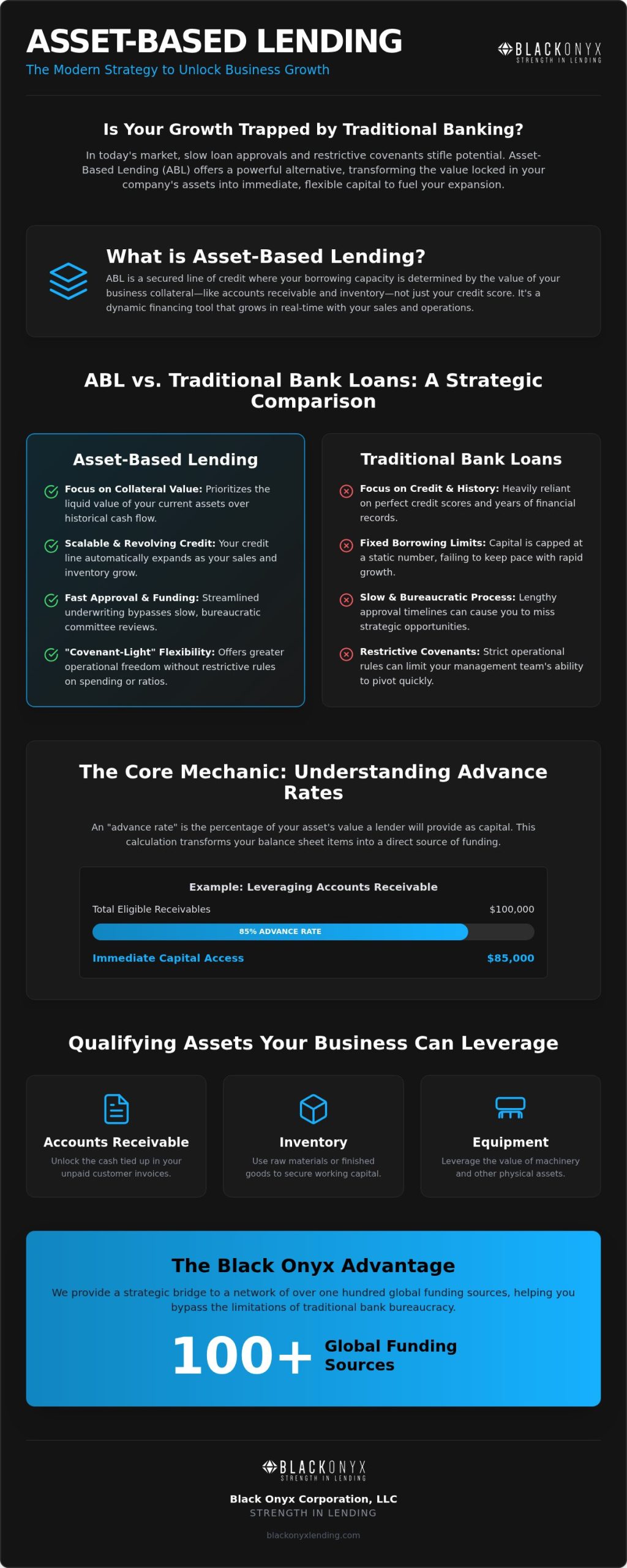
Asset-based lending (ABL) isn’t just a financial product; it’s a strategic pivot. It functions as a secured loan or line of credit where your business collateral, such as inventory or accounts receivable, dictates your borrowing capacity. While traditional lenders fixate on historical cash flow and credit scores, an Asset-based lending (ABL) model prioritizes the liquid value of what you own today. This distinction is vital for the 2026 market where the U.S. Prime Rate remains at 6.75% and traditional credit standards have tightened. If you’re managing a high-growth company with significant orders but limited historical cash flow, ABL provides the momentum you need without the wait.
The structure is essentially revolving. It’s a dynamic financing tool for an asset based lending small business that scales with your operations. As you generate more invoices or stock more inventory, your credit limit expands automatically. This ensures that your capital isn’t a static number but a growing resource that mirrors your market success. It’s a solution designed for those who have moved beyond the limitations of their initial startup phase and now require capital that can keep pace with their ambition.
The Core Mechanics of an Asset-Based Loan
Lenders determine your funding through a specific calculation known as the advance rate. An advance rate is the percentage of an asset’s value a lender will provide. If you have $100,000 in eligible receivables and the lender offers an 85% advance rate, you gain immediate access to $85,000. Lenders typically distinguish between an asset-secured term loan, used for specific equipment purchases, and a revolving line of credit. The revolving option is particularly effective for managing seasonal fluctuations or rapid scaling phases where payroll and material costs precede your actual revenue.
ABL vs. Traditional Bank Loans: A Strategic Comparison
Traditional commercial loans often come with a heavy burden of restrictive operational covenants. These rules can dictate how you manage your debt-to-equity ratios or even limit your capital spending. In contrast, asset based lending small business structures are typically “covenant-light.” This offers your management team the flexibility to pivot quickly without seeking bank permission for every tactical move. Speed is the other major differentiator. Because the focus is on the collateral rather than a complex committee review of your five-year history, approvals move significantly faster than SBA or traditional bank loans. You avoid the bureaucracy and gain a partner focused on your current operational strength.
Strategic Advantages: Why ABL Beats Traditional Financing in 2026
In a 2026 economy defined by fluctuating credit availability, traditional banking often feels like a bottleneck rather than a bridge. Asset-based lending offers a decisive alternative by transforming your balance sheet into a source of immediate liquidity. Unlike conventional loans that trap cash in line items like inventory or slow-paying invoices, an asset based lending small business strategy unlocks that capital for immediate reinvestment. This model provides true scalability. Your borrowing capacity isn’t capped by a fixed limit decided months ago. Instead, it expands in real-time as you acquire more inventory or generate more billable work.
Credit independence is perhaps the most significant shift for modern entrepreneurs. Traditional lenders often lean heavily on personal credit scores or rigid debt-to-equity ratios. In the current market, the quality of your accounts receivable and the liquidation value of your equipment carry more weight than your historical cash flow. This is particularly relevant given that SBA lending programs have introduced stricter eligibility requirements as of March 2026, including 100% U.S. citizenship mandates. ABL offers a path forward for businesses that may no longer fit the narrow SBA criteria but possess strong, tangible assets. Partnering with the right asset based lending companies is increasingly recognized as a strategic pivot rather than a last resort for high-growth firms navigating these tighter restrictions.
Fueling Rapid Growth and Acquisitions
Strategic growth in 2026 frequently requires moving faster than a bank’s loan committee. If you’re eyeing a competitor for acquisition, ABL allows you to fund the deal without diluting your equity. It also serves as a critical buffer for seasonal industries. Manufacturers and retailers can use their “work-in-progress” inventory to secure the capital needed for peak production cycles. Whether you’re in a high-growth bridge phase or navigating a complex turnaround, this financing provides the flexibility to act on opportunities that traditional lenders would deem too risky.
Improving Cash Flow and Working Capital Ratios
The logic of ABL is simple and effective. If you have $1M in outstanding invoices, then you have immediate access to approximately $850,000 in cash. This drastically reduces your cash conversion cycle. You’re no longer waiting 60 or 90 days for clients to pay before you can take on new projects. By converting receivables into working capital instantly, you improve your balance sheet’s health. This proactive approach to debt management can even position you for more favorable terms in the future. To see how these structures can be tailored to your specific asset class, you can consult with a strategic financing expert today to begin your transformation.
Qualifying Assets: What Can Your Small Business Leverage?
Identifying the right collateral is the first step toward securing a strategic advantage. For an asset based lending small business, the primary focus is on liquidity and the ease of valuation. Accounts Receivable (A/R) remains the “gold standard” because it represents cash already earned but not yet collected. Lenders prioritize these invoices because they are only one step away from currency. If your customers have strong payment histories, then your A/R aging report becomes your most powerful tool for unlocking immediate growth capital.
Inventory is another significant driver of value. This includes raw materials, work-in-progress, and finished goods ready for market. While inventory is less liquid than receivables, it provides a crucial buffer for manufacturers and retailers. Beyond these current assets, your small business can leverage fixed assets like equipment, machinery, and commercial real estate. Using the equity in your warehouses or offices allows you to fund operations without selling the property. Understanding the nuances of qualifying for asset-based lending ensures you don’t overlook value hidden within your own facilities. This approach turns dormant equity into a proactive growth engine.
The Power of Sale-Leaseback Financing
Sale-leaseback financing is the ultimate hidden liquidity tool for asset-heavy industries. It’s a straightforward strategy. You sell your existing equipment or machinery to a lender and lease it back immediately. This allows you to maintain full use of the assets while gaining a significant cash infusion for your balance sheet. It’s particularly effective for construction, manufacturing, and medical services companies that own expensive, specialized equipment. If you need to move from a state of limitation to one of opportunity, this hybrid model removes the burden of ownership while preserving your operational capacity.
Emerging Assets: Brand Names and Intellectual Property
The 2026 lending landscape is witnessing a shift toward valuing intangible assets. Sophisticated lenders are increasingly looking at intellectual property, patents, and established brand trademarks as viable collateral. This trend favors tech-driven or consumer-facing brands that have built immense market equity without massive physical footprints. As you develop these brand assets, you can discover The CEO Creative to source custom branded products that help establish both your market presence and trade credit history. Criteria for using these assets often involve a clear history of revenue generation or legal protection. Black Onyx acts as a strategic bridge in this space. We identify these unconventional value drivers to ensure no potential capital is ignored. If your business has a dominant brand presence or unique IP, then you have more options than a traditional bank would ever acknowledge.
Preparing for Underwriting: How to Secure the Best Terms
Securing the most favorable terms isn’t just about the assets you own; it’s about how precisely you can prove their value. For an asset based lending small business, the accounts receivable (A/R) aging report is the primary document that dictates your borrowing power. Lenders scrutinize this report to assess the creditworthiness of your customers and identify potential dilution factors like returns or discounts. If your invoices are consistently past the 90-day mark, they’ll likely be excluded from your borrowing base, which directly reduces your available liquidity. Maintaining “clean” financials is the difference between a high-cost bridge loan and a sustainable growth line.
Physical assets require a separate layer of preparation through formal valuation and appraisal. Lenders will conduct an audit to determine the forced-liquidation value of your inventory and equipment. This assessment focuses on what the assets would fetch in a rapid sale scenario rather than their retail price. To maximize this value, you must provide clear documentation of your asset’s condition and marketability. Once the loan is active, you’ll need to transition into a rhythm of ongoing reporting, typically involving weekly or monthly borrowing base certificates that track your collateral levels in real-time.
Organizing Your Asset Documentation
- A/R Credit Checks: Verify the financial health of your largest debtors to minimize the risk of excluded invoices.
- Real-time Inventory Tracking: Use digital management systems to provide lenders with up-to-the-minute stock levels, which increases your borrowing capacity.
- Maintenance Logs: Keep detailed records of machinery service history to support a higher appraised value for equipment financing.
The Consulting Advantage: Getting ‘Loan Ready’
Traditional bank underwriting is often a binary process where an automated system issues a rejection based on a single missing metric. A professional consultant acts as a strategic bridge, identifying and resolving “deal killers” like unresolved tax liens or commingled funds before the lender ever sees your file. This proactive approach transforms a standard application into a structured pitch that highlights your operational momentum. Industry experts note that thorough preparation can significantly reduce your cost of capital by ensuring you match with the most efficient funding source. You can start your underwriting assessment with our team today to ensure your business is positioned for the best possible terms.
The Black Onyx Advantage: Accessing a Global Lending Network
Most small businesses fall into the “single bank” trap. They assume that if their primary institution declines a request, the capital simply doesn’t exist. This is a costly misconception. In the 2026 market, one lender’s “no” is often another’s “yes.” Black Onyx Corporation, LLC functions as a strategic bridge, connecting you to a network of over 100 third-party funding sources globally. This vast reach ensures that your asset based lending small business strategy isn’t limited by one bank’s rigid internal policy or geographic footprint.
Our reach extends across the US, Canada, Australia, and the UK. This global perspective allows us to match your specific asset class to the right niche lender, whether you’re leveraging heavy equipment in Michigan or accounts receivable in London. We prioritize personalized underwriting, treating your company as a strategic partner rather than a mere transaction. This ensures that the financing structure we secure is tailored to your long-term competitive edge and doesn’t just provide a temporary fix.
Beyond the Local Bank: The Power of Alternative Capital
Non-bank lenders often provide higher advance rates and more flexible terms than traditional institutions. They aren’t bound by the same bureaucratic constraints that often stifle progress in commercial banking. If you have a complex balance sheet, then a specialized alternative lender is better equipped to price your operational value accurately. The Black Onyx Corporation, LLC process begins with a deep dive into your assets, followed by a structured pitch to our global network. We’ve seen this approach unlock capital for clients that traditional banks ignored by focusing on the liquidation value of specialized tooling rather than just historical cash flow. Understanding how leading asset based lending companies evaluate and structure these deals can give you a significant negotiating advantage before you ever submit an application.
Your Strategic Bridge to Growth
Black Onyx Corporation, LLC operates as a long-term financial advisor rather than a simple broker. We don’t just find a loan; we build a capital structure that supports sustainable expansion. Our role is to remove the systemic hurdles that prevent you from reaching your full potential. The journey starts with a thorough initial assessment and asset valuation to determine your true borrowing base. This clarity allows you to move from a state of limitation to one of significant opportunity. If you’re ready to bypass the bureaucracy and fund your next phase of growth, you should schedule your confidential asset-based lending consultation with Black Onyx Corporation, LLC today.
Maximizing Your Operational Value for 2026
Transitioning from restrictive cash-flow lending to a collateral-driven model is the key to maintaining momentum in a shifting economic landscape. By prioritizing the liquid value of your inventory and receivables, you gain the flexibility that traditional bank committees simply can’t offer. An effective asset based lending small business strategy ensures that your capital scales alongside your sales volume. This allows you to act on acquisition opportunities or seasonal peaks without hesitation, turning your balance sheet into a proactive engine for expansion.
Black Onyx acts as your strategic bridge, providing access to over 100 global funding sources and over 20 years of commercial underwriting expertise. We specialize in complex structures like Sale-Leaseback and Purchase Order financing that turn static equipment and contracts into immediate working capital. Don’t let bureaucratic obstacles dictate your growth trajectory. You can secure your business growth capital with Black Onyx and move from a state of limitation to one of significant opportunity today. Your assets are ready to work; it’s time to unlock their full potential.
Frequently Asked Questions
Is asset based lending more expensive than a traditional bank loan?
Interest rates for this type of financing typically sit a few points above the prime rate, making them slightly more expensive than traditional bank loans but significantly cheaper than equity financing. The value lies in the increased liquidity and fewer restrictive covenants. If you can’t qualify for a bank loan due to rapid growth, the slightly higher rate is a small price for the momentum you gain.
What happens if my business credit score is low?
Your credit score is secondary to the liquidation value of your collateral in an asset based lending small business structure. Traditional banks prioritize historical cash flow and personal credit, but ABL lenders look at the quality of your accounts receivable and equipment. For individuals who may be seeking personal financing rather than business capital, personalloans.net offers a platform to find suitable loan options quickly. If your business assets are strong, then a low credit score won’t prevent you from securing a strategic bridge to the capital you need.
Funding through an asset-based loan typically moves with greater urgency than traditional commercial bank committees, often closing in a fraction of the time. Speed is a core advantage of this model. Because the underwriting process focuses on tangible collateral appraisals rather than exhaustive historical audits, decisions are made with the precision that high-growth businesses require to stay competitive in a fast-moving market.
Can I use asset based lending to fund payroll during a cash gap?
Yes, you can use the liquidity from an asset-based loan to cover payroll, tax obligations, or material costs during a cash flow gap. Since the funds are structured as a revolving line of credit or a lump sum, you have the flexibility to deploy them wherever the need is greatest. It’s a reliable tool for managing the timing mismatch between operational expenses and customer payments.
What is the difference between factoring and asset-based lending?
Factoring is the outright sale of your invoices to a third party, whereas asset-based lending is a loan or line of credit secured by those invoices and other assets. In an ABL structure, you typically maintain the relationship with your customers and manage your own collections. This provides a more sophisticated financial solution for companies that want to keep their billing processes internal while still unlocking value.
Do I lose control of my assets when I use them as collateral?
You retain full operational control and physical possession of your assets while using them as collateral for a loan. The lender places a lien on the assets, but your day-to-day use of machinery, inventory, or office space remains unchanged. In a sale-leaseback scenario, you technically sell the asset and lease it back immediately, ensuring you never lose the use of equipment necessary for your business.
Can I use international assets for a loan through Black Onyx?
Black Onyx specializes in securing financing for businesses with assets located in the United States, Canada, the United Kingdom, and Australia. Our global network of over 100 funding sources allows us to navigate cross-border complexities that local banks often avoid. If your business operates internationally, then we can act as the strategic bridge to match your global collateral with the right niche lender for your market.
What industries are best suited for asset-based financing?
Asset based lending small business solutions are ideal for industries with significant tangible assets, such as manufacturing, wholesale distribution, construction, and medical services. Companies in these sectors often have high levels of inventory or large accounts receivable balances that traditional banks don’t know how to price. If your business model involves heavy equipment or long payment cycles, then ABL is the most efficient way to grow.